

12
T. K. Barik et al.
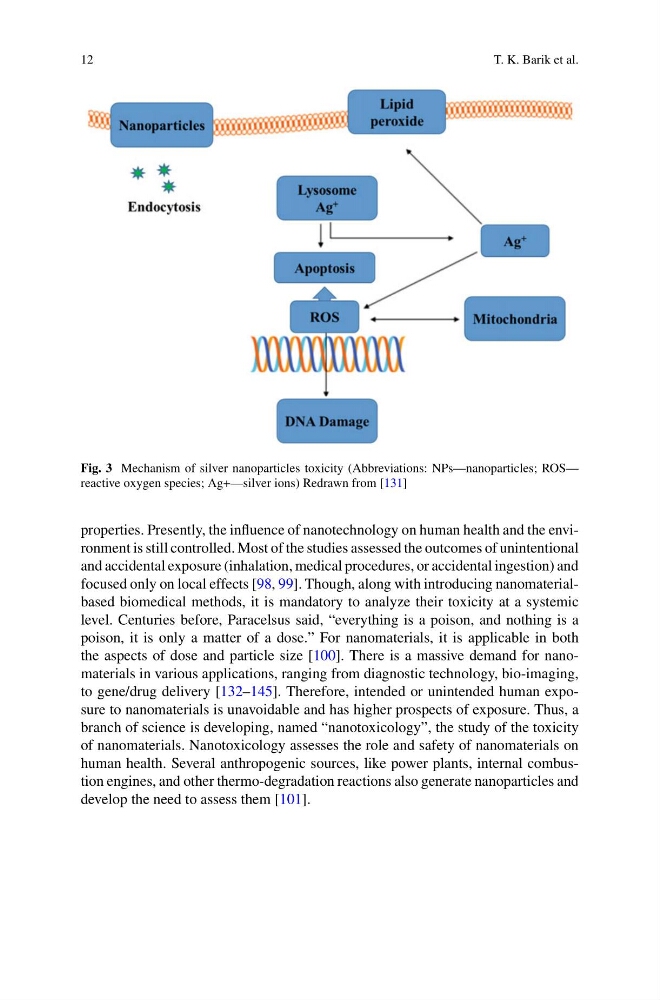
Fig. 3 Mechanism of silver nanoparticles toxicity (Abbreviations: NPs—nanoparticles; ROS—
reactive oxygen species; Ag+—silver ions) Redrawn from [131]
properties. Presently, the influence of nanotechnology on human health and the environment is still controlled. Most of the studies assessed the outcomes of unintentional
and accidental exposure (inhalation, medical procedures, or accidental ingestion) and
focused only on local effects [98, 99]. Though, along with introducing nanomaterialbased biomedical methods, it is mandatory to analyze their toxicity at a systemic
level. Centuries before, Paracelsus said, “everything is a poison, and nothing is a
poison, it is only a matter of a dose.” For nanomaterials, it is applicable in both
the aspects of dose and particle size [100]. There is a massive demand for nanomaterials in various applications, ranging from diagnostic technology, bio-imaging,
to gene/drug delivery [132–145]. Therefore, intended or unintended human exposure to nanomaterials is unavoidable and has higher prospects of exposure. Thus, a
branch of science is developing, named “nanotoxicology”, the study of the toxicity
of nanomaterials. Nanotoxicology assesses the role and safety of nanomaterials on
human health. Several anthropogenic sources, like power plants, internal combustion engines, and other thermo-degradation reactions also generate nanoparticles and
develop the need to assess them [101].
T. K. Barik et al.
Fig. 3 Mechanism of silver nanoparticles toxicity (Abbreviations: NPs—nanoparticles; ROS—
reactive oxygen species; Ag+—silver ions) Redrawn from [131]
properties. Presently, the influence of nanotechnology on human health and the environment is still controlled. Most of the studies assessed the outcomes of unintentional
and accidental exposure (inhalation, medical procedures, or accidental ingestion) and
focused only on local effects [98, 99]. Though, along with introducing nanomaterialbased biomedical methods, it is mandatory to analyze their toxicity at a systemic
level. Centuries before, Paracelsus said, “everything is a poison, and nothing is a
poison, it is only a matter of a dose.” For nanomaterials, it is applicable in both
the aspects of dose and particle size [100]. There is a massive demand for nanomaterials in various applications, ranging from diagnostic technology, bio-imaging,
to gene/drug delivery [132–145]. Therefore, intended or unintended human exposure to nanomaterials is unavoidable and has higher prospects of exposure. Thus, a
branch of science is developing, named “nanotoxicology”, the study of the toxicity
of nanomaterials. Nanotoxicology assesses the role and safety of nanomaterials on
human health. Several anthropogenic sources, like power plants, internal combustion engines, and other thermo-degradation reactions also generate nanoparticles and
develop the need to assess them [101].