

212
G. Keerthiga et al.
1 Introduction
Hydrogels are three-dimensional cross-linked polymeric network capable of
imbibing large volumes of water (90–99wt%) [145, 7]. These hydrophilic polymeric
networks are formed by cross-linking monomers in addition to a physical or chemical cross-linking agent. Different polymeric sources (natural or synthetic) and varied
crosslinking methodologies have led hydrogel into the limelight of research. Back
in the early 1960s [215], a study on poly (2-hydroxyethyl methacrylate) comprehensively predicted a net repulsion between polymer network and a poor solvent
causes phase transition, change in the degree of swelling and volume. Progress has
been made to find a biocompatible and non-toxic formulation for in vivo delivery
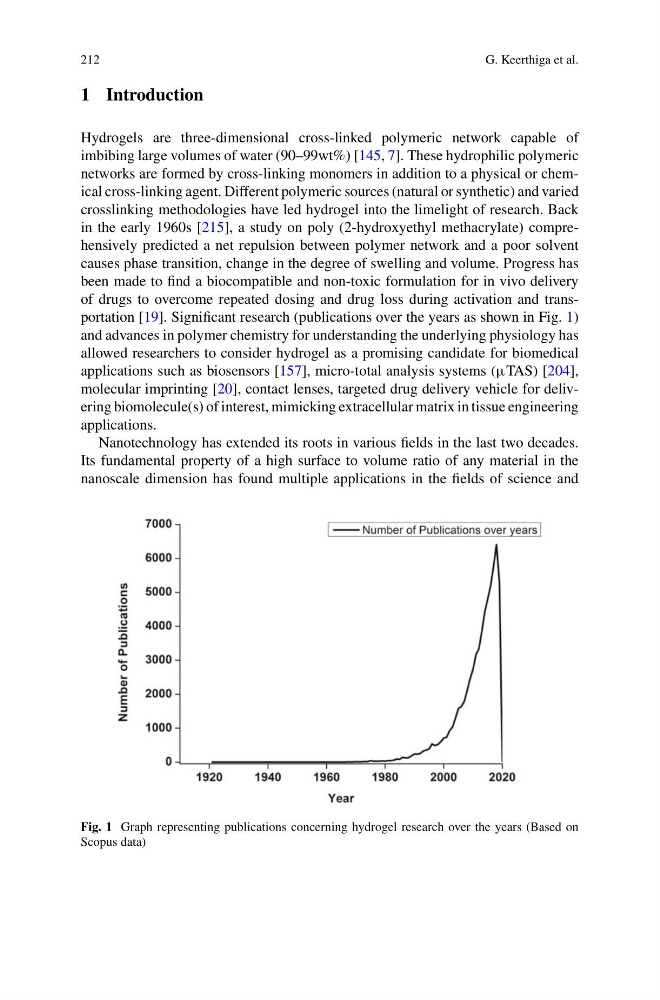
of drugs to overcome repeated dosing and drug loss during activation and transportation [19]. Significant research (publications over the years as shown in Fig. 1)
and advances in polymer chemistry for understanding the underlying physiology has
allowed researchers to consider hydrogel as a promising candidate for biomedical
applications such as biosensors [157], micro-total analysis systems (μTAS) [204],
molecular imprinting [20], contact lenses, targeted drug delivery vehicle for delivering biomolecule(s) of interest, mimicking extracellular matrix in tissue engineering
applications.
Nanotechnology has extended its roots in various fields in the last two decades.
Its fundamental property of a high surface to volume ratio of any material in the
nanoscale dimension has found multiple applications in the fields of science and
Fig. 1 Graph representing publications concerning hydrogel research over the years (Based on
Scopus data)
G. Keerthiga et al.
1 Introduction
Hydrogels are three-dimensional cross-linked polymeric network capable of
imbibing large volumes of water (90–99wt%) [145, 7]. These hydrophilic polymeric
networks are formed by cross-linking monomers in addition to a physical or chemical cross-linking agent. Different polymeric sources (natural or synthetic) and varied
crosslinking methodologies have led hydrogel into the limelight of research. Back
in the early 1960s [215], a study on poly (2-hydroxyethyl methacrylate) comprehensively predicted a net repulsion between polymer network and a poor solvent
causes phase transition, change in the degree of swelling and volume. Progress has
been made to find a biocompatible and non-toxic formulation for in vivo delivery
of drugs to overcome repeated dosing and drug loss during activation and transportation [19]. Significant research (publications over the years as shown in Fig. 1)
and advances in polymer chemistry for understanding the underlying physiology has
allowed researchers to consider hydrogel as a promising candidate for biomedical
applications such as biosensors [157], micro-total analysis systems (μTAS) [204],
molecular imprinting [20], contact lenses, targeted drug delivery vehicle for delivering biomolecule(s) of interest, mimicking extracellular matrix in tissue engineering
applications.
Nanotechnology has extended its roots in various fields in the last two decades.
Its fundamental property of a high surface to volume ratio of any material in the
nanoscale dimension has found multiple applications in the fields of science and
Fig. 1 Graph representing publications concerning hydrogel research over the years (Based on
Scopus data)