

204
S. James
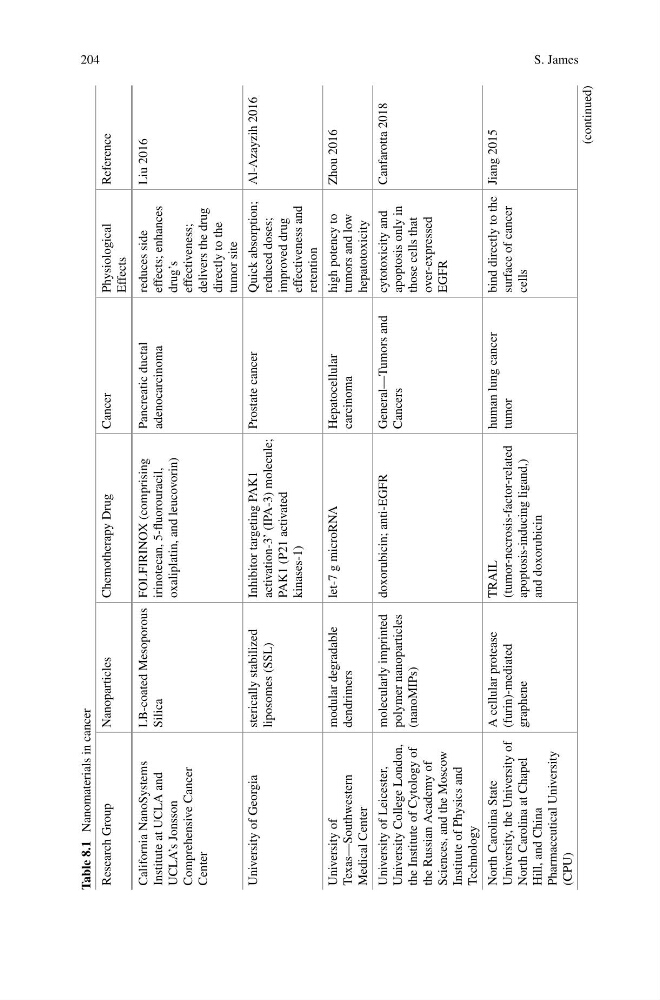
Table 8.1
Nanomaterials in cancer
Research Group
Nanoparticles
Chemotherapy Drug
Cancer
Physiological
Effects
Reference
California NanoSystems
Institute at UCLA and
UCLA’s Jonsson
Comprehensive Cancer
Center
LB-coated Mesoporous
Silica
FOLFIRINOX (comprising
irinotecan, 5-fluorouracil,
oxaliplatin, and leucovorin)
Pancreatic ductal
adenocarcinoma
reduces side
effects; enhances
drug’s
effectiveness;
delivers the drug
directly to the
tumor site
Liu 2016
University of Georgia
sterically stabilized
liposomes (SSL)
Inhibitor targeting PAK1
activation-3’ (IPA-3) molecule;
PAK1 (P21 activated
kinases-1)
Prostate cancer
Quick absorption;
reduced doses;
improved drug
effectiveness and
retention
Al-Azayzih 2016
University of
Texas—Southwestern
Medical Center
modular degradable
dendrimers
let-7 g microRNA
Hepatocellular
carcinoma
high potency to
tumors and low
hepatotoxicity
Zhou 2016
University of Leicester,
University College London,
the Institute of Cytology of
the Russian Academy of
Sciences, and the Moscow
Institute of Physics and
Technology
molecularly imprinted
polymer nanoparticles
(nanoMIPs)
doxorubicin; anti-EGFR
General—Tumors and
Cancers
cytotoxicity and
apoptosis only in
those cells that
over-expressed
EGFR
Canfarotta 2018
North Carolina State
University, the University of
North Carolina at Chapel
Hill, and China
Pharmaceutical University
(CPU)
A cellular protease
(furin)-mediated
graphene
TRAIL
(tumor-necrosis-factor-related
apoptosis-inducing ligand,)
and doxorubicin
human lung cancer
tumor
bind directly to the
surface of cancer
cells
Jiang 2015
(continued)
S. James
Table 8.1
Nanomaterials in cancer
Research Group
Nanoparticles
Chemotherapy Drug
Cancer
Physiological
Effects
Reference
California NanoSystems
Institute at UCLA and
UCLA’s Jonsson
Comprehensive Cancer
Center
LB-coated Mesoporous
Silica
FOLFIRINOX (comprising
irinotecan, 5-fluorouracil,
oxaliplatin, and leucovorin)
Pancreatic ductal
adenocarcinoma
reduces side
effects; enhances
drug’s
effectiveness;
delivers the drug
directly to the
tumor site
Liu 2016
University of Georgia
sterically stabilized
liposomes (SSL)
Inhibitor targeting PAK1
activation-3’ (IPA-3) molecule;
PAK1 (P21 activated
kinases-1)
Prostate cancer
Quick absorption;
reduced doses;
improved drug
effectiveness and
retention
Al-Azayzih 2016
University of
Texas—Southwestern
Medical Center
modular degradable
dendrimers
let-7 g microRNA
Hepatocellular
carcinoma
high potency to
tumors and low
hepatotoxicity
Zhou 2016
University of Leicester,
University College London,
the Institute of Cytology of
the Russian Academy of
Sciences, and the Moscow
Institute of Physics and
Technology
molecularly imprinted
polymer nanoparticles
(nanoMIPs)
doxorubicin; anti-EGFR
General—Tumors and
Cancers
cytotoxicity and
apoptosis only in
those cells that
over-expressed
EGFR
Canfarotta 2018
North Carolina State
University, the University of
North Carolina at Chapel
Hill, and China
Pharmaceutical University
(CPU)
A cellular protease
(furin)-mediated
graphene
TRAIL
(tumor-necrosis-factor-related
apoptosis-inducing ligand,)
and doxorubicin
human lung cancer
tumor
bind directly to the
surface of cancer
cells
Jiang 2015
(continued)