

STARSHIPS 165
Specific impulse is measured in seconds. A typical chemical rocket
might have a specific impulse of 400-500 seconds. The specific impulse of the Space Shuttle engine is 453 seconds. (The highest specific
impulse ever achieved for a chemical rocket was 542 seconds, using a
propellant mixture of hydrogen, lithium, and fluorine.) The thruster
for the Smart 1 ion engine had a specific impulse of 1,640 seconds. And
the nuclear rocket attained specific impulses of 850 seconds.
The maximum possible specific impulse would be a rocket that
could attain the speed of light. It would have a specific impulse of about
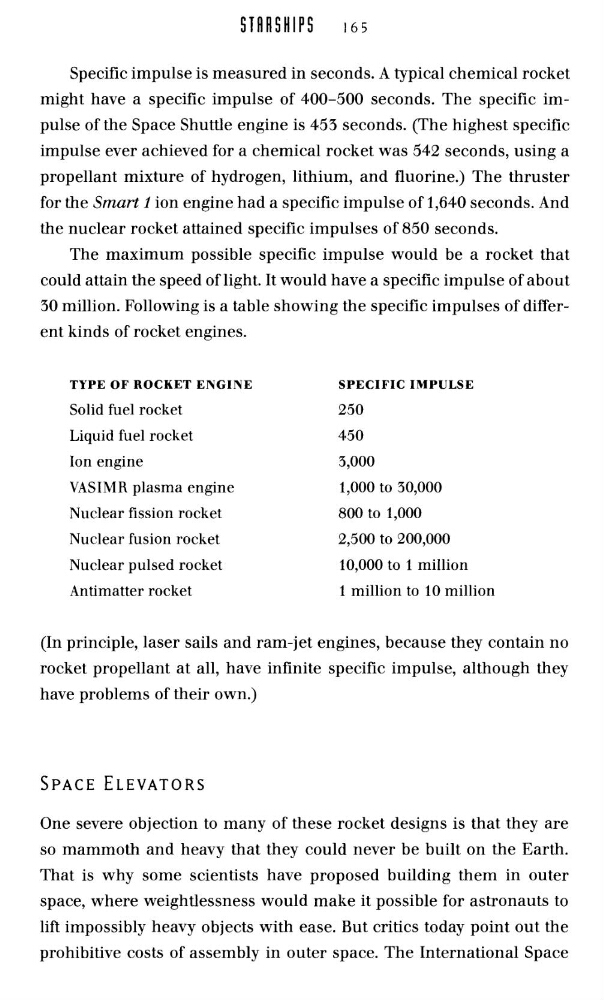
30 million. Following is a table showing the specific impulses of different kinds of rocket engines.
TYPE OF ROCKET ENGINE
Solid fuel rocket
Liquid fuel rocket
Ion engine
VASIMR plasma engine
Nuclear fission rocket
Nuclear fusion rocket
Nuclear pulsed rocket
Antimatter rocket
SPECIFIC IMPULSE
250
450
3,000
1,000 to 30,000
800 to 1,000
2,500 to 200,000
10,000 to 1 million
1 million to 10 million
(In principle, laser sails and ram-jet engines, because they contain no
rocket propellant at all, have infinite specific impulse, although they
have problems of their own.)
SPACE
ELEVATORS
One severe objection to many of these rocket designs is that they are
so mammoth and heavy that they could never be built on the Earth.
That is why some scientists have proposed building them in outer
space, where weightlessness would make it possible for astronauts to
lift impossibly heavy objects with ease. But critics today point out the
prohibitive costs of assembly in outer space. The International Space
Specific impulse is measured in seconds. A typical chemical rocket
might have a specific impulse of 400-500 seconds. The specific impulse of the Space Shuttle engine is 453 seconds. (The highest specific
impulse ever achieved for a chemical rocket was 542 seconds, using a
propellant mixture of hydrogen, lithium, and fluorine.) The thruster
for the Smart 1 ion engine had a specific impulse of 1,640 seconds. And
the nuclear rocket attained specific impulses of 850 seconds.
The maximum possible specific impulse would be a rocket that
could attain the speed of light. It would have a specific impulse of about
30 million. Following is a table showing the specific impulses of different kinds of rocket engines.
TYPE OF ROCKET ENGINE
Solid fuel rocket
Liquid fuel rocket
Ion engine
VASIMR plasma engine
Nuclear fission rocket
Nuclear fusion rocket
Nuclear pulsed rocket
Antimatter rocket
SPECIFIC IMPULSE
250
450
3,000
1,000 to 30,000
800 to 1,000
2,500 to 200,000
10,000 to 1 million
1 million to 10 million
(In principle, laser sails and ram-jet engines, because they contain no
rocket propellant at all, have infinite specific impulse, although they
have problems of their own.)
SPACE
ELEVATORS
One severe objection to many of these rocket designs is that they are
so mammoth and heavy that they could never be built on the Earth.
That is why some scientists have proposed building them in outer
space, where weightlessness would make it possible for astronauts to
lift impossibly heavy objects with ease. But critics today point out the
prohibitive costs of assembly in outer space. The International Space