

70
3 Area-Preserving Maps
3.5.3 The Universal Map
The renormalization procedure for the twist map shown in Eqs. (3.41) and (3.42)
appears to hold when K > 0, and the fixed point Eqs. (3.43) and (3.44), for K > 0,
appear to have another solution. As a result, the mapping given by Eq. (3.38) is
dependent on K and approaches a limiting value, F ∗
μ , where
F
∗
μ = lim
i→∞
B 0 . . . B i−1 F
M i
μ i δ −i R
N i B
−1
i−1 . . . B
−1
0 .
(3.54)
The map F ∗
μ is called the universal map. In Eq. (3.54), δ is given by Eq. (3.50) and
μ i measures the value of K i at which the ith dominant elliptic fixed point becomes
unstable (μ = 1 is critical). The universal map exists in a small neighborhood of all
twist maps that have an inverse golden mean KAM torus and a dominant symmetry
line, and, more generally, in small neighborhoods of all noble KAM tori; that is,
tori whose winding number is represented by continued fractions of the form ω =
[b 1 , . . . , b n , 1, 1, . . . , 1].
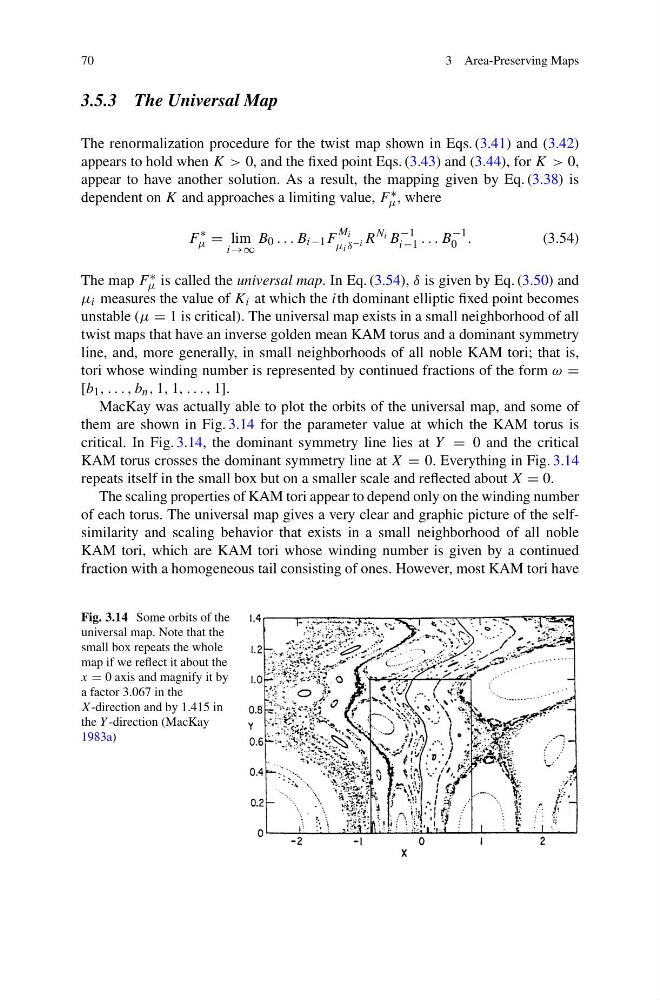
MacKay was actually able to plot the orbits of the universal map, and some of
them are shown in Fig. 3.14 for the parameter value at which the KAM torus is
critical. In Fig. 3.14, the dominant symmetry line lies at Y = 0 and the critical
KAM torus crosses the dominant symmetry line at X = 0. Everything in Fig. 3.14
repeats itself in the small box but on a smaller scale and reflected about X = 0.
The scaling properties of KAM tori appear to depend only on the winding number
of each torus. The universal map gives a very clear and graphic picture of the selfsimilarity and scaling behavior that exists in a small neighborhood of all noble
KAM tori, which are KAM tori whose winding number is given by a continued
fraction with a homogeneous tail consisting of ones. However, most KAM tori have
Fig. 3.14 Some orbits of the
universal map. Note that the
small box repeats the whole
map if we reflect it about the
x = 0 axis and magnify it by
a factor 3.067 in the
X-direction and by 1.415 in
the Y -direction (MacKay
1983a)
3 Area-Preserving Maps
3.5.3 The Universal Map
The renormalization procedure for the twist map shown in Eqs. (3.41) and (3.42)
appears to hold when K > 0, and the fixed point Eqs. (3.43) and (3.44), for K > 0,
appear to have another solution. As a result, the mapping given by Eq. (3.38) is
dependent on K and approaches a limiting value, F ∗
μ , where
F
∗
μ = lim
i→∞
B 0 . . . B i−1 F
M i
μ i δ −i R
N i B
−1
i−1 . . . B
−1
0 .
(3.54)
The map F ∗
μ is called the universal map. In Eq. (3.54), δ is given by Eq. (3.50) and
μ i measures the value of K i at which the ith dominant elliptic fixed point becomes
unstable (μ = 1 is critical). The universal map exists in a small neighborhood of all
twist maps that have an inverse golden mean KAM torus and a dominant symmetry
line, and, more generally, in small neighborhoods of all noble KAM tori; that is,
tori whose winding number is represented by continued fractions of the form ω =
[b 1 , . . . , b n , 1, 1, . . . , 1].
MacKay was actually able to plot the orbits of the universal map, and some of
them are shown in Fig. 3.14 for the parameter value at which the KAM torus is
critical. In Fig. 3.14, the dominant symmetry line lies at Y = 0 and the critical
KAM torus crosses the dominant symmetry line at X = 0. Everything in Fig. 3.14
repeats itself in the small box but on a smaller scale and reflected about X = 0.
The scaling properties of KAM tori appear to depend only on the winding number
of each torus. The universal map gives a very clear and graphic picture of the selfsimilarity and scaling behavior that exists in a small neighborhood of all noble
KAM tori, which are KAM tori whose winding number is given by a continued
fraction with a homogeneous tail consisting of ones. However, most KAM tori have
Fig. 3.14 Some orbits of the
universal map. Note that the
small box repeats the whole
map if we reflect it about the
x = 0 axis and magnify it by
a factor 3.067 in the
X-direction and by 1.415 in
the Y -direction (MacKay
1983a)