

3.5 Renormalization in Twist Maps
65
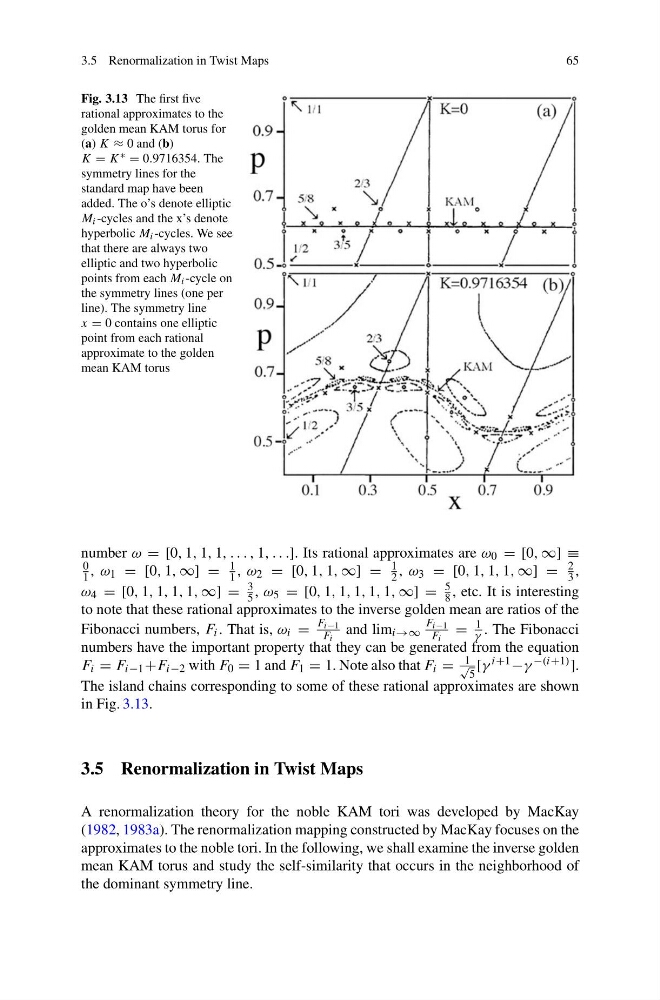
Fig. 3.13 The first five
rational approximates to the
golden mean KAM torus for
(a) K ≈ 0 and (b)
K = K ∗ = 0.9716354. The
symmetry lines for the
standard map have been
added. The o’s denote elliptic
M i -cycles and the x’s denote
hyperbolic M i -cycles. We see
that there are always two
elliptic and two hyperbolic
points from each M i -cycle on
the symmetry lines (one per
line). The symmetry line
x = 0 contains one elliptic
point from each rational
approximate to the golden
mean KAM torus
number ω = [0, 1, 1, 1, . . . , 1, . . .]. Its rational approximates are ω 0 = [0, ∞] ≡
0
1 , ω 1 = [0, 1, ∞] =
1
1 , ω 2 = [0, 1, 1, ∞] =
1
2 , ω 3 = [0, 1, 1, 1, ∞] =
2
3 ,
ω 4 = [0, 1, 1, 1, 1, ∞] =
3
5 , ω 5 = [0, 1, 1, 1, 1, 1, ∞] =
5
8 , etc. It is interesting
to note that these rational approximates to the inverse golden mean are ratios of the
Fibonacci numbers, F i . That is, ω i =
F i−1
F i
and lim i→∞
F i−1
F i
=
1
γ . The Fibonacci
numbers have the important property that they can be generated from the equation
F i = F i−1 +F i−2 with F 0 = 1 and F 1 = 1. Note also that F i =
1
√
5
[γ i+1 −γ −(i+1) ].
The island chains corresponding to some of these rational approximates are shown
in Fig. 3.13.
3.5 Renormalization in Twist Maps
A renormalization theory for the noble KAM tori was developed by MacKay
(1982, 1983a). The renormalization mapping constructed by MacKay focuses on the
approximates to the noble tori. In the following, we shall examine the inverse golden
mean KAM torus and study the self-similarity that occurs in the neighborhood of
the dominant symmetry line.
65
Fig. 3.13 The first five
rational approximates to the
golden mean KAM torus for
(a) K ≈ 0 and (b)
K = K ∗ = 0.9716354. The
symmetry lines for the
standard map have been
added. The o’s denote elliptic
M i -cycles and the x’s denote
hyperbolic M i -cycles. We see
that there are always two
elliptic and two hyperbolic
points from each M i -cycle on
the symmetry lines (one per
line). The symmetry line
x = 0 contains one elliptic
point from each rational
approximate to the golden
mean KAM torus
number ω = [0, 1, 1, 1, . . . , 1, . . .]. Its rational approximates are ω 0 = [0, ∞] ≡
0
1 , ω 1 = [0, 1, ∞] =
1
1 , ω 2 = [0, 1, 1, ∞] =
1
2 , ω 3 = [0, 1, 1, 1, ∞] =
2
3 ,
ω 4 = [0, 1, 1, 1, 1, ∞] =
3
5 , ω 5 = [0, 1, 1, 1, 1, 1, ∞] =
5
8 , etc. It is interesting
to note that these rational approximates to the inverse golden mean are ratios of the
Fibonacci numbers, F i . That is, ω i =
F i−1
F i
and lim i→∞
F i−1
F i
=
1
γ . The Fibonacci
numbers have the important property that they can be generated from the equation
F i = F i−1 +F i−2 with F 0 = 1 and F 1 = 1. Note also that F i =
1
√
5
[γ i+1 −γ −(i+1) ].
The island chains corresponding to some of these rational approximates are shown
in Fig. 3.13.
3.5 Renormalization in Twist Maps
A renormalization theory for the noble KAM tori was developed by MacKay
(1982, 1983a). The renormalization mapping constructed by MacKay focuses on the
approximates to the noble tori. In the following, we shall examine the inverse golden
mean KAM torus and study the self-similarity that occurs in the neighborhood of
the dominant symmetry line.