

3.2 Twist Maps
53
is stationary with respect to an arbitrary variation of intermediate points φ n . An infinite
sequence {φ n } defines an orbit if and only if every finite segment has a stationary action.
These results will prove useful in Sect. 3.4, where we discuss a mechanism for
breakup of KAM tori.
3.2.3 Birkhoff Fixed Point Theorem
The behavior of fixed points under a perturbation is the subject of the Birkhoff
fixed point theorem (Birkhoff 1927; Berry 1978). Consider a circle, C, with winding
number ω =
N
M and two neighboring circles, C + and C − , with irrational winding
numbers ω + >
N
M and ω − <
N
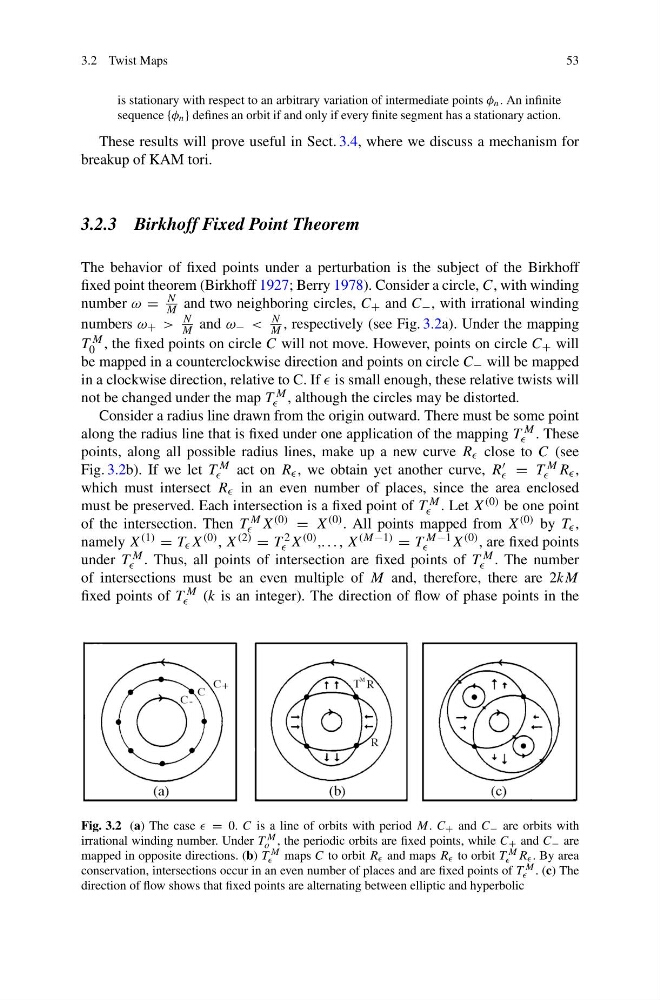
M , respectively (see Fig. 3.2a). Under the mapping
T M
0 , the fixed points on circle C will not move. However, points on circle C + will
be mapped in a counterclockwise direction and points on circle C − will be mapped
in a clockwise direction, relative to C. If is small enough, these relative twists will
not be changed under the map T M
, although the circles may be distorted.
Consider a radius line drawn from the origin outward. There must be some point
along the radius line that is fixed under one application of the mapping T M
. These
points, along all possible radius lines, make up a new curve R close to C (see
Fig. 3.2b). If we let T M
act on R , we obtain yet another curve, R
= T M
R ,
which must intersect R in an even number of places, since the area enclosed
must be preserved. Each intersection is a fixed point of T M
. Let X (0) be one point
of the intersection. Then T M
X (0) = X (0) . All points mapped from X (0) by T ,
namely X (1) = T X (0) , X (2) = T 2
X (0) ,. . . , X (M−1) = T M−1
X (0) , are fixed points
under T M
. Thus, all points of intersection are fixed points of T M
. The number
of intersections must be an even multiple of M and, therefore, there are 2kM
fixed points of T M
(k is an integer). The direction of flow of phase points in the
Fig. 3.2 (a) The case = 0. C is a line of orbits with period M. C + and C − are orbits with
irrational winding number. Under T M
o , the periodic orbits are fixed points, while C + and C − are
mapped in opposite directions. (b) T M
maps C to orbit R and maps R to orbit T M
R . By area
conservation, intersections occur in an even number of places and are fixed points of T M
. (c) The
direction of flow shows that fixed points are alternating between elliptic and hyperbolic
53
is stationary with respect to an arbitrary variation of intermediate points φ n . An infinite
sequence {φ n } defines an orbit if and only if every finite segment has a stationary action.
These results will prove useful in Sect. 3.4, where we discuss a mechanism for
breakup of KAM tori.
3.2.3 Birkhoff Fixed Point Theorem
The behavior of fixed points under a perturbation is the subject of the Birkhoff
fixed point theorem (Birkhoff 1927; Berry 1978). Consider a circle, C, with winding
number ω =
N
M and two neighboring circles, C + and C − , with irrational winding
numbers ω + >
N
M and ω − <
N
M , respectively (see Fig. 3.2a). Under the mapping
T M
0 , the fixed points on circle C will not move. However, points on circle C + will
be mapped in a counterclockwise direction and points on circle C − will be mapped
in a clockwise direction, relative to C. If is small enough, these relative twists will
not be changed under the map T M
, although the circles may be distorted.
Consider a radius line drawn from the origin outward. There must be some point
along the radius line that is fixed under one application of the mapping T M
. These
points, along all possible radius lines, make up a new curve R close to C (see
Fig. 3.2b). If we let T M
act on R , we obtain yet another curve, R
= T M
R ,
which must intersect R in an even number of places, since the area enclosed
must be preserved. Each intersection is a fixed point of T M
. Let X (0) be one point
of the intersection. Then T M
X (0) = X (0) . All points mapped from X (0) by T ,
namely X (1) = T X (0) , X (2) = T 2
X (0) ,. . . , X (M−1) = T M−1
X (0) , are fixed points
under T M
. Thus, all points of intersection are fixed points of T M
. The number
of intersections must be an even multiple of M and, therefore, there are 2kM
fixed points of T M
(k is an integer). The direction of flow of phase points in the
Fig. 3.2 (a) The case = 0. C is a line of orbits with period M. C + and C − are orbits with
irrational winding number. Under T M
o , the periodic orbits are fixed points, while C + and C − are
mapped in opposite directions. (b) T M
maps C to orbit R and maps R to orbit T M
R . By area
conservation, intersections occur in an even number of places and are fixed points of T M
. (c) The
direction of flow shows that fixed points are alternating between elliptic and hyperbolic