

3.2 Twist Maps
51
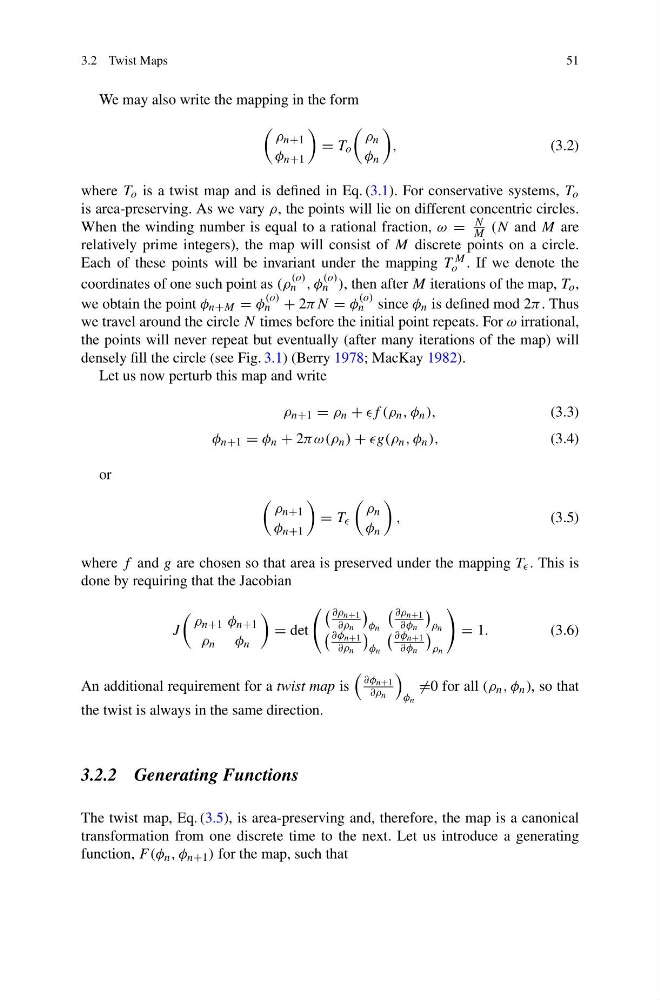
We may also write the mapping in the form
ρ n+1
φ n+1
= T o
ρ n
φ n
,
(3.2)
where T o is a twist map and is defined in Eq. (3.1). For conservative systems, T o
is area-preserving. As we vary ρ, the points will lie on different concentric circles.
When the winding number is equal to a rational fraction, ω =
N
M (N and M are
relatively prime integers), the map will consist of M discrete points on a circle.
Each of these points will be invariant under the mapping T M
o . If we denote the
coordinates of one such point as (ρ
(o)
n , φ
(o)
n ), then after M iterations of the map, T o ,
we obtain the point φ n+M = φ
(o)
n + 2πN = φ
(o)
n since φ n is defined mod 2π . Thus
we travel around the circle N times before the initial point repeats. For ω irrational,
the points will never repeat but eventually (after many iterations of the map) will
densely fill the circle (see Fig. 3.1) (Berry 1978; MacKay 1982).
Let us now perturb this map and write
ρ n+1 = ρ n + (ρ n , φ n ),
(3.3)
φ n+1 = φ n + 2πω(ρ n ) + n , φ n ),
(3.4)
or
ρ n+1
φ n+1
= T
ρ n
φ n
,
(3.5)
where f and g are chosen so that area is preserved under the mapping T . This is
done by requiring that the Jacobian
J
ρ n+1 φ n+1
ρ n φ n
= det
∂ρ n+1
∂ρ n
φ n
∂ρ n+1
∂φ n
ρ n
∂φ n+1
∂ρ n
φ n
∂φ n+1
∂φ n
ρ n
= 1.
(3.6)
An additional requirement for a twist map is
∂φ n+1
∂ρ n
φ n
=0 for all (ρ n , φ n ), so that
the twist is always in the same direction.
3.2.2 Generating Functions
The twist map, Eq. (3.5), is area-preserving and, therefore, the map is a canonical
transformation from one discrete time to the next. Let us introduce a generating
function, F (φ n , φ n+1 ) for the map, such that
51
We may also write the mapping in the form
ρ n+1
φ n+1
= T o
ρ n
φ n
,
(3.2)
where T o is a twist map and is defined in Eq. (3.1). For conservative systems, T o
is area-preserving. As we vary ρ, the points will lie on different concentric circles.
When the winding number is equal to a rational fraction, ω =
N
M (N and M are
relatively prime integers), the map will consist of M discrete points on a circle.
Each of these points will be invariant under the mapping T M
o . If we denote the
coordinates of one such point as (ρ
(o)
n , φ
(o)
n ), then after M iterations of the map, T o ,
we obtain the point φ n+M = φ
(o)
n + 2πN = φ
(o)
n since φ n is defined mod 2π . Thus
we travel around the circle N times before the initial point repeats. For ω irrational,
the points will never repeat but eventually (after many iterations of the map) will
densely fill the circle (see Fig. 3.1) (Berry 1978; MacKay 1982).
Let us now perturb this map and write
ρ n+1 = ρ n + (ρ n , φ n ),
(3.3)
φ n+1 = φ n + 2πω(ρ n ) + n , φ n ),
(3.4)
or
ρ n+1
φ n+1
= T
ρ n
φ n
,
(3.5)
where f and g are chosen so that area is preserved under the mapping T . This is
done by requiring that the Jacobian
J
ρ n+1 φ n+1
ρ n φ n
= det
∂ρ n+1
∂ρ n
φ n
∂ρ n+1
∂φ n
ρ n
∂φ n+1
∂ρ n
φ n
∂φ n+1
∂φ n
ρ n
= 1.
(3.6)
An additional requirement for a twist map is
∂φ n+1
∂ρ n
φ n
=0 for all (ρ n , φ n ), so that
the twist is always in the same direction.
3.2.2 Generating Functions
The twist map, Eq. (3.5), is area-preserving and, therefore, the map is a canonical
transformation from one discrete time to the next. Let us introduce a generating
function, F (φ n , φ n+1 ) for the map, such that