

2.7 The Definition of Chaos
41
that can be formed from the alphabet by selecting s k = 0 or 1, where s k is the
kth entry in the sequence and −∞ ≤ k ≤ ∞. The set {S} includes sequences
with random ordering and periodic ordering of elements. Each sequence, S, can be
mapped to a point, (p, q), in the unit square by defining
p =
0
k=−∞
s k 2
k−1
(2.82)
and
q =
∞
k=1
s k 2
−k .
(2.83)
We can introduce dynamics into this system by means of the Bernoulli shift, T ,
which shifts all entries in a given sequence, S, to the right by one place. Let the
sequence S be defined as in Eq. (2.81). Then
T S = (. . . , s −3 , s −2 , s −1 ; s 0 , s 1 , . . .).
(2.84)
This shift causes the following mapping of the coordinates (p, q) on the unit square
T (p, q) =
(2p,
1
2 q) for 0 ≤ p <
1
2
(2p − 1,
1
2 q +
1
2 ) for
1
2 ≤ p ≤ 1
It is important to note that whenever the element, s 0 , of a sequence, S, has the value
s 0 = 0(1), the point (p, q) will lie to the left (right) of p =
1
2 . Thus, for random
sequences, the point (p, q) will be mapped randomly to the left or right of p =
1
2
by T .
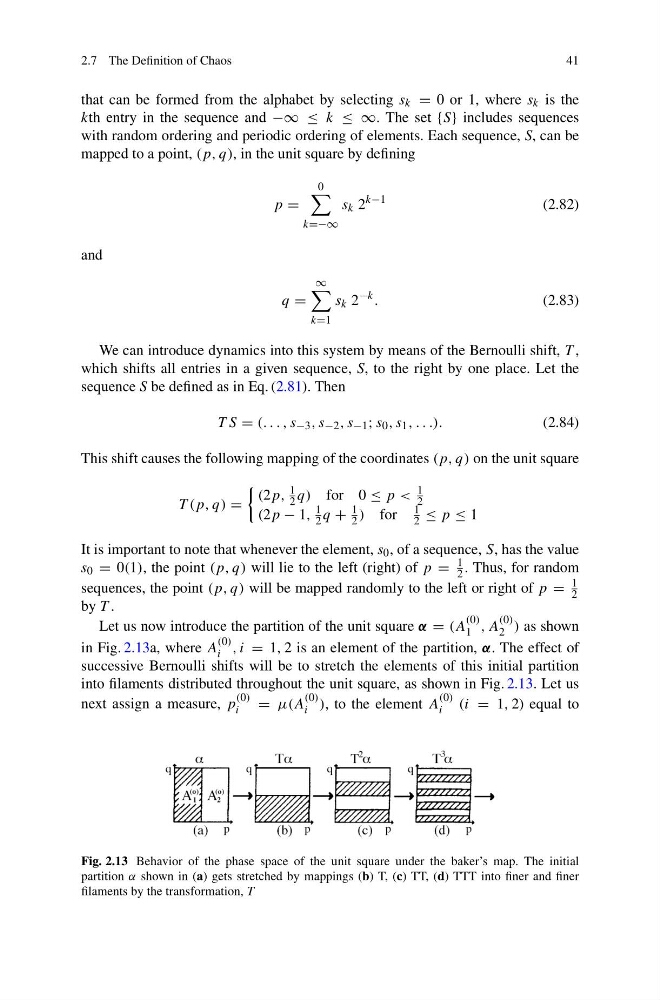
Let us now introduce the partition of the unit square α = (A
(0)
1 , A
(0)
2 ) as shown
in Fig. 2.13a, where A
(0)
i , i = 1, 2 is an element of the partition, α. The effect of
successive Bernoulli shifts will be to stretch the elements of this initial partition
into filaments distributed throughout the unit square, as shown in Fig. 2.13. Let us
next assign a measure, p
(0)
i
= μ(A
(0)
i ), to the element A
(0)
i (i = 1, 2) equal to
Fig. 2.13 Behavior of the phase space of the unit square under the baker’s map. The initial
partition α shown in (a) gets stretched by mappings (b) T, (c) TT, (d) TTT into finer and finer
filaments by the transformation, T
41
that can be formed from the alphabet by selecting s k = 0 or 1, where s k is the
kth entry in the sequence and −∞ ≤ k ≤ ∞. The set {S} includes sequences
with random ordering and periodic ordering of elements. Each sequence, S, can be
mapped to a point, (p, q), in the unit square by defining
p =
0
k=−∞
s k 2
k−1
(2.82)
and
q =
∞
k=1
s k 2
−k .
(2.83)
We can introduce dynamics into this system by means of the Bernoulli shift, T ,
which shifts all entries in a given sequence, S, to the right by one place. Let the
sequence S be defined as in Eq. (2.81). Then
T S = (. . . , s −3 , s −2 , s −1 ; s 0 , s 1 , . . .).
(2.84)
This shift causes the following mapping of the coordinates (p, q) on the unit square
T (p, q) =
(2p,
1
2 q) for 0 ≤ p <
1
2
(2p − 1,
1
2 q +
1
2 ) for
1
2 ≤ p ≤ 1
It is important to note that whenever the element, s 0 , of a sequence, S, has the value
s 0 = 0(1), the point (p, q) will lie to the left (right) of p =
1
2 . Thus, for random
sequences, the point (p, q) will be mapped randomly to the left or right of p =
1
2
by T .
Let us now introduce the partition of the unit square α = (A
(0)
1 , A
(0)
2 ) as shown
in Fig. 2.13a, where A
(0)
i , i = 1, 2 is an element of the partition, α. The effect of
successive Bernoulli shifts will be to stretch the elements of this initial partition
into filaments distributed throughout the unit square, as shown in Fig. 2.13. Let us
next assign a measure, p
(0)
i
= μ(A
(0)
i ), to the element A
(0)
i (i = 1, 2) equal to
Fig. 2.13 Behavior of the phase space of the unit square under the baker’s map. The initial
partition α shown in (a) gets stretched by mappings (b) T, (c) TT, (d) TTT into finer and finer
filaments by the transformation, T