

G.3 Circular Orthogonal Ensemble (COE)
503
N
2 −
1
2
p=−
N
2 +
1
2
p = (−1)
N/2 1
π
N + 1
2
2
,
(G.62)
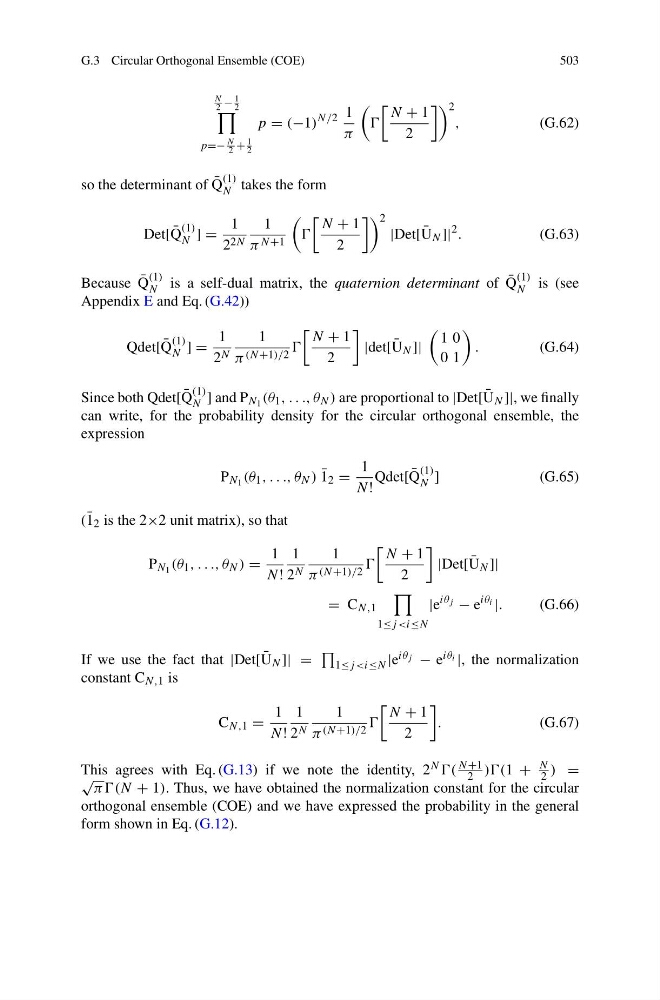
so the determinant of ¯
Q
(1)
N takes the form
Det[ ¯
Q
(1)
N ] =
1
2 2N
1
π N +1
N + 1
2
2
|Det[ ¯
U N ]|
2 .
(G.63)
Because ¯
Q
(1)
N is a self-dual matrix, the quaternion determinant of ¯
Q
(1)
N is (see
Appendix E and Eq. (G.42))
Qdet[ ¯
Q
(1)
N ] =
1
2 N
1
π (N +1)/2
N + 1
2
|det[ ¯
U N ]|
1 0
0 1
.
(G.64)
Since both Qdet[ ¯
Q
(1)
N ] and P N 1 (θ 1 , . . ., θ N ) are proportional to |Det[ ¯
U N ]|, we finally
can write, for the probability density for the circular orthogonal ensemble, the
expression
P N 1 (θ 1 , . . ., θ N ) ¯
1 2 =
1
N!
Qdet[ ¯
Q
(1)
N ]
(G.65)
( ¯
1 2 is the 2×2 unit matrix), so that
P N 1 (θ 1 , . . ., θ N ) =
1
N!
1
2 N
1
π (N +1)/2
N + 1
2
|Det[ ¯
U N ]|
= C N,1
1≤j
iθ j − e
iθ i |.
(G.66)
If we use the fact that |Det[ ¯
U N ]| =
1≤j
C N,1 =
1
N!
1
2 N
1
π (N +1)/2
N + 1
2
.
(G.67)
This agrees with Eq. (G.13) if we note the identity, 2 N (
N +1
2 ))(1 +
N
2 ) =
√
ππ(N + 1). Thus, we have obtained the normalization constant for the circular
orthogonal ensemble (COE) and we have expressed the probability in the general
form shown in Eq. (G.12).
503
N
2 −
1
2
p=−
N
2 +
1
2
p = (−1)
N/2 1
π
N + 1
2
2
,
(G.62)
so the determinant of ¯
Q
(1)
N takes the form
Det[ ¯
Q
(1)
N ] =
1
2 2N
1
π N +1
N + 1
2
2
|Det[ ¯
U N ]|
2 .
(G.63)
Because ¯
Q
(1)
N is a self-dual matrix, the quaternion determinant of ¯
Q
(1)
N is (see
Appendix E and Eq. (G.42))
Qdet[ ¯
Q
(1)
N ] =
1
2 N
1
π (N +1)/2
N + 1
2
|det[ ¯
U N ]|
1 0
0 1
.
(G.64)
Since both Qdet[ ¯
Q
(1)
N ] and P N 1 (θ 1 , . . ., θ N ) are proportional to |Det[ ¯
U N ]|, we finally
can write, for the probability density for the circular orthogonal ensemble, the
expression
P N 1 (θ 1 , . . ., θ N ) ¯
1 2 =
1
N!
Qdet[ ¯
Q
(1)
N ]
(G.65)
( ¯
1 2 is the 2×2 unit matrix), so that
P N 1 (θ 1 , . . ., θ N ) =
1
N!
1
2 N
1
π (N +1)/2
N + 1
2
|Det[ ¯
U N ]|
= C N,1
1≤j
iθ j − e
iθ i |.
(G.66)
If we use the fact that |Det[ ¯
U N ]| =
1≤j
C N,1 =
1
N!
1
2 N
1
π (N +1)/2
N + 1
2
.
(G.67)
This agrees with Eq. (G.13) if we note the identity, 2 N (
N +1
2 ))(1 +
N
2 ) =
√
ππ(N + 1). Thus, we have obtained the normalization constant for the circular
orthogonal ensemble (COE) and we have expressed the probability in the general
form shown in Eq. (G.12).