

500
G Circular Ensembles
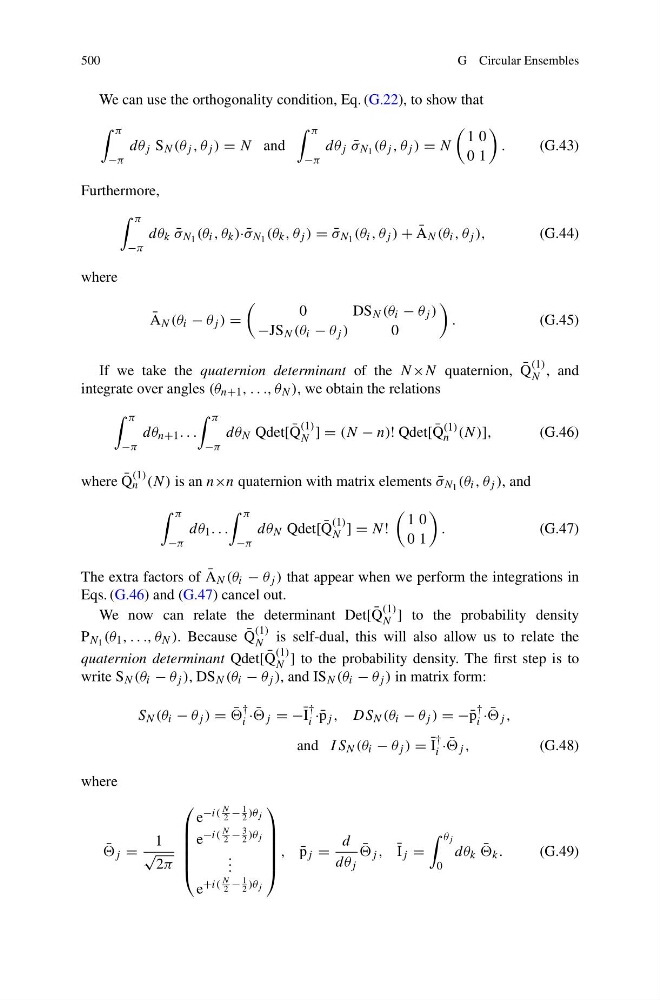
We can use the orthogonality condition, Eq. (G.22), to show that
π
−π
dθ j S N (θ j , θ j ) = N and
π
−π
dθ j ¯
σ N 1 (θ j , θ j ) = N
1 0
0 1
.
(G.43)
Furthermore,
π
−π
dθ k ¯
σ N 1 (θ i , θ k )· ¯
σ N 1 (θ k , θ j ) = ¯
σ N 1 (θ i , θ j ) + ¯
A N (θ i , θ j ),
(G.44)
where
¯
A N (θ i − θ j ) =
0
D S N (θ i − θ j )
−JS N (θ i − θ j )
0
.
(G.45)
If we take the quaternion determinant of the N×N quaternion, ¯
Q
(1)
N , and
integrate over angles (θ n+1 , . . ., θ N ), we obtain the relations
π
−π
dθ n+1 . . .
π
−π
dθ N Qdet[ ¯
Q
(1)
N ] = (N − n)! Qdet[ ¯
Q
(1)
n (N)],
(G.46)
where ¯
Q
(1)
n (N) is an n×n quaternion with matrix elements ¯
σ N 1 (θ i , θ j ), and
π
−π
dθ 1 . . .
π
−π
dθ N Qdet[ ¯
Q
(1)
N ] = N!
1 0
0 1
.
(G.47)
The extra factors of ¯
A N (θ i − θ j ) that appear when we perform the integrations in
Eqs. (G.46) and (G.47) cancel out.
We now can relate the determinant Det[ ¯
Q
(1)
N ] to the probability density
P N 1 (θ 1 , . . ., θ N ). Because ¯
Q
(1)
N is self-dual, this will also allow us to relate the
quaternion determinant Qdet[ ¯
Q
(1)
N ] to the probability density. The first step is to
write S N (θ i − θ j ), DS N (θ i − θ j ), and IS N (θ i − θ j ) in matrix form:
S N (θ i − θ j ) = ¯
†
i · ¯
j = − ¯ I
†
i ·¯ p j , DS N (θ i − θ j ) = −¯ p
†
i · ¯
j ,
and I S N (θ i − θ j ) = ¯ I
†
i · ¯
j ,
(G.48)
where
¯
j =
1
√
2π
⎛
⎜
⎜
⎜
⎜
⎝
e
−i(
N
2 −
1
2 )θ j
e
−i(
N
2 −
3
2 )θ j
. . .
e
+i(
N
2 −
1
2 )θ j
⎞
⎟
⎟
⎟
⎟
⎠
, ¯
p j =
d
dθ j
¯
j , ¯ I j =
θ j
0
dθ k ¯
k .
(G.49)
G Circular Ensembles
We can use the orthogonality condition, Eq. (G.22), to show that
π
−π
dθ j S N (θ j , θ j ) = N and
π
−π
dθ j ¯
σ N 1 (θ j , θ j ) = N
1 0
0 1
.
(G.43)
Furthermore,
π
−π
dθ k ¯
σ N 1 (θ i , θ k )· ¯
σ N 1 (θ k , θ j ) = ¯
σ N 1 (θ i , θ j ) + ¯
A N (θ i , θ j ),
(G.44)
where
¯
A N (θ i − θ j ) =
0
D S N (θ i − θ j )
−JS N (θ i − θ j )
0
.
(G.45)
If we take the quaternion determinant of the N×N quaternion, ¯
Q
(1)
N , and
integrate over angles (θ n+1 , . . ., θ N ), we obtain the relations
π
−π
dθ n+1 . . .
π
−π
dθ N Qdet[ ¯
Q
(1)
N ] = (N − n)! Qdet[ ¯
Q
(1)
n (N)],
(G.46)
where ¯
Q
(1)
n (N) is an n×n quaternion with matrix elements ¯
σ N 1 (θ i , θ j ), and
π
−π
dθ 1 . . .
π
−π
dθ N Qdet[ ¯
Q
(1)
N ] = N!
1 0
0 1
.
(G.47)
The extra factors of ¯
A N (θ i − θ j ) that appear when we perform the integrations in
Eqs. (G.46) and (G.47) cancel out.
We now can relate the determinant Det[ ¯
Q
(1)
N ] to the probability density
P N 1 (θ 1 , . . ., θ N ). Because ¯
Q
(1)
N is self-dual, this will also allow us to relate the
quaternion determinant Qdet[ ¯
Q
(1)
N ] to the probability density. The first step is to
write S N (θ i − θ j ), DS N (θ i − θ j ), and IS N (θ i − θ j ) in matrix form:
S N (θ i − θ j ) = ¯
†
i · ¯
j = − ¯ I
†
i ·¯ p j , DS N (θ i − θ j ) = −¯ p
†
i · ¯
j ,
and I S N (θ i − θ j ) = ¯ I
†
i · ¯
j ,
(G.48)
where
¯
j =
1
√
2π
⎛
⎜
⎜
⎜
⎜
⎝
e
−i(
N
2 −
1
2 )θ j
e
−i(
N
2 −
3
2 )θ j
. . .
e
+i(
N
2 −
1
2 )θ j
⎞
⎟
⎟
⎟
⎟
⎠
, ¯
p j =
d
dθ j
¯
j , ¯ I j =
θ j
0
dθ k ¯
k .
(G.49)