

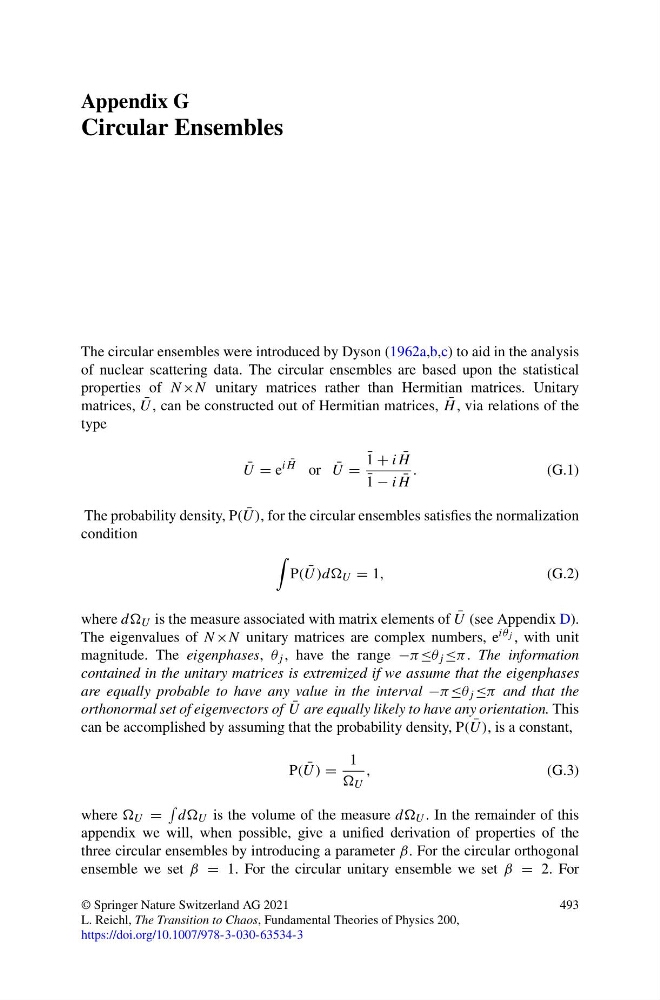
Appendix G
Circular Ensembles
The circular ensembles were introduced by Dyson (1962a,b,c) to aid in the analysis
of nuclear scattering data. The circular ensembles are based upon the statistical
properties of N×N unitary matrices rather than Hermitian matrices. Unitary
matrices, ¯
U , can be constructed out of Hermitian matrices, ¯
H , via relations of the
type
¯
U = e
i ¯
H or ¯
U =
¯
1 + i ¯
H
¯
1 − i ¯
H
.
(G.1)
The probability density, P( ¯
U), for the circular ensembles satisfies the normalization
condition
P( ¯
U)dd U = 1,
(G.2)
where dd U is the measure associated with matrix elements of ¯
U (see Appendix D).
The eigenvalues of N×N unitary matrices are complex numbers, e iθ j , with unit
magnitude. The eigenphases, θ j , have the range −π ≤θ j ≤π . The information
contained in the unitary matrices is extremized if we assume that the eigenphases
are equally probable to have any value in the interval −π ≤θ j ≤π and that the
orthonormal set of eigenvectors of ¯
U are equally likely to have any orientation. This
can be accomplished by assuming that the probability density, P( ¯
U), is a constant,
P( ¯
U) =
1
U
,
(G.3)
where U =
dd U is the volume of the measure dd U . In the remainder of this
appendix we will, when possible, give a unified derivation of properties of the
three circular ensembles by introducing a parameter β. For the circular orthogonal
ensemble we set β = 1. For the circular unitary ensemble we set β = 2. For
© Springer Nature Switzerland AG 2021
L. Reichl, The Transition to Chaos, Fundamental Theories of Physics 200,
https://doi.org/10.1007/978-3-030-63534-3
493
Circular Ensembles
The circular ensembles were introduced by Dyson (1962a,b,c) to aid in the analysis
of nuclear scattering data. The circular ensembles are based upon the statistical
properties of N×N unitary matrices rather than Hermitian matrices. Unitary
matrices, ¯
U , can be constructed out of Hermitian matrices, ¯
H , via relations of the
type
¯
U = e
i ¯
H or ¯
U =
¯
1 + i ¯
H
¯
1 − i ¯
H
.
(G.1)
The probability density, P( ¯
U), for the circular ensembles satisfies the normalization
condition
P( ¯
U)dd U = 1,
(G.2)
where dd U is the measure associated with matrix elements of ¯
U (see Appendix D).
The eigenvalues of N×N unitary matrices are complex numbers, e iθ j , with unit
magnitude. The eigenphases, θ j , have the range −π ≤θ j ≤π . The information
contained in the unitary matrices is extremized if we assume that the eigenphases
are equally probable to have any value in the interval −π ≤θ j ≤π and that the
orthonormal set of eigenvectors of ¯
U are equally likely to have any orientation. This
can be accomplished by assuming that the probability density, P( ¯
U), is a constant,
P( ¯
U) =
1
U
,
(G.3)
where U =
dd U is the volume of the measure dd U . In the remainder of this
appendix we will, when possible, give a unified derivation of properties of the
three circular ensembles by introducing a parameter β. For the circular orthogonal
ensemble we set β = 1. For the circular unitary ensemble we set β = 2. For
© Springer Nature Switzerland AG 2021
L. Reichl, The Transition to Chaos, Fundamental Theories of Physics 200,
https://doi.org/10.1007/978-3-030-63534-3
493