

484
F Gaussian Ensembles
(GU E)
3
=
1
2π 2
ln[2πN] + γ −
5
4
+ O
1
N
. . .,
(F.97)
where O
1
N
indicates that we have neglected terms of order
1
N . Equation (F.97)
gives the 3 -statistic for the Gaussian unitary ensemble.
F.2.7 Eigenvalue Nearest Neighbor Spacing Distribution
for GUE (N=2)
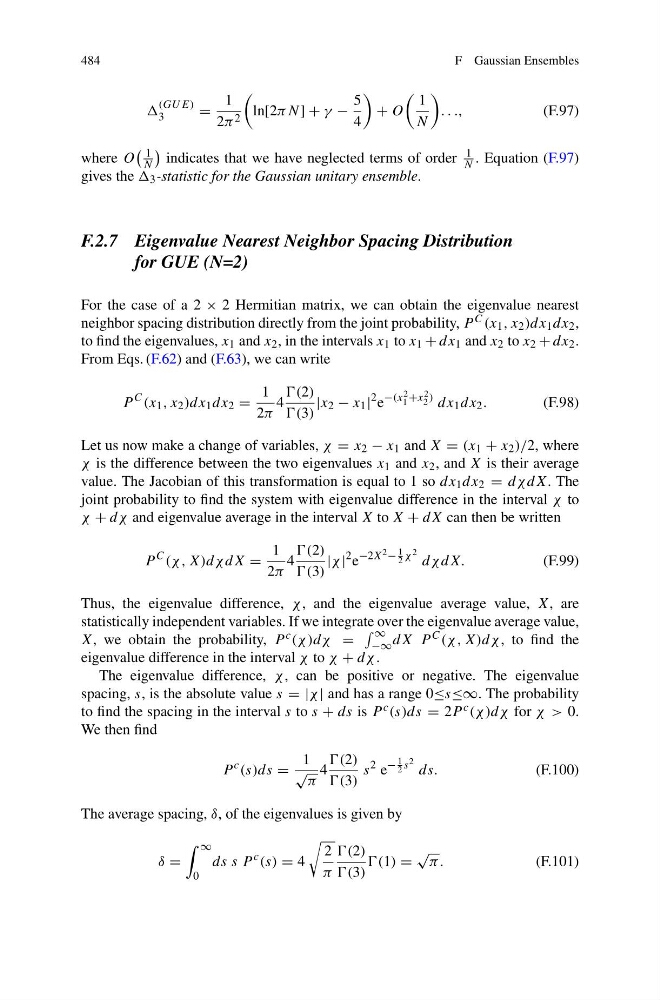
For the case of a 2 × 2 Hermitian matrix, we can obtain the eigenvalue nearest
neighbor spacing distribution directly from the joint probability, P C (x 1 , x 2 )dx 1 dx 2 ,
to find the eigenvalues, x 1 and x 2 , in the intervals x 1 to x 1 + dx 1 and x 2 to x 2 + dx 2 .
From Eqs. (F.62) and (F.63), we can write
P
C (x 1 , x 2 )dx 1 dx 2 =
1
2π
4
(2)
(3)
|x 2 − x 1 |
2 e
−(x 2
1 +x 2
2 ) dx 1 dx 2 .
(F.98)
Let us now make a change of variables, χ = x 2 − x 1 and X = (x 1 + x 2 )/2, where
χ is the difference between the two eigenvalues x 1 and x 2 , and X is their average
value. The Jacobian of this transformation is equal to 1 so dx 1 dx 2 = dχdX. The
joint probability to find the system with eigenvalue difference in the interval χ to
χ + dχ and eigenvalue average in the interval X to X + dX can then be written
P
C (χ , X)dχ dX =
1
2π
4
(2)
(3)
|χ |
2 e
−2X 2 −
1
2 χ 2 dχdX.
(F.99)
Thus, the eigenvalue difference, χ , and the eigenvalue average value, X, are
statistically independent variables. If we integrate over the eigenvalue average value,
X, we obtain the probability, P c (χ )dχ =
∞
−∞ dX P C (χ , X)dχ , to find the
eigenvalue difference in the interval χ to χ + dχ.
The eigenvalue difference, χ , can be positive or negative. The eigenvalue
spacing, s, is the absolute value s = |χ | and has a range 0≤s≤∞. The probability
to find the spacing in the interval s to s + ds is P c (s)ds = 2P c (χ )dχ for χ > 0.
We then find
P
c (s)ds =
1
√
π
4
(2)
(3)
s
2 e
−
1
2 s 2 ds.
(F.100)
The average spacing, δ, of the eigenvalues is given by
δ =
∞
0
ds s P
c (s) = 4
2
π
(2)
(3)
(1) =
√
π.
(F.101)
F Gaussian Ensembles
(GU E)
3
=
1
2π 2
ln[2πN] + γ −
5
4
+ O
1
N
. . .,
(F.97)
where O
1
N
indicates that we have neglected terms of order
1
N . Equation (F.97)
gives the 3 -statistic for the Gaussian unitary ensemble.
F.2.7 Eigenvalue Nearest Neighbor Spacing Distribution
for GUE (N=2)
For the case of a 2 × 2 Hermitian matrix, we can obtain the eigenvalue nearest
neighbor spacing distribution directly from the joint probability, P C (x 1 , x 2 )dx 1 dx 2 ,
to find the eigenvalues, x 1 and x 2 , in the intervals x 1 to x 1 + dx 1 and x 2 to x 2 + dx 2 .
From Eqs. (F.62) and (F.63), we can write
P
C (x 1 , x 2 )dx 1 dx 2 =
1
2π
4
(2)
(3)
|x 2 − x 1 |
2 e
−(x 2
1 +x 2
2 ) dx 1 dx 2 .
(F.98)
Let us now make a change of variables, χ = x 2 − x 1 and X = (x 1 + x 2 )/2, where
χ is the difference between the two eigenvalues x 1 and x 2 , and X is their average
value. The Jacobian of this transformation is equal to 1 so dx 1 dx 2 = dχdX. The
joint probability to find the system with eigenvalue difference in the interval χ to
χ + dχ and eigenvalue average in the interval X to X + dX can then be written
P
C (χ , X)dχ dX =
1
2π
4
(2)
(3)
|χ |
2 e
−2X 2 −
1
2 χ 2 dχdX.
(F.99)
Thus, the eigenvalue difference, χ , and the eigenvalue average value, X, are
statistically independent variables. If we integrate over the eigenvalue average value,
X, we obtain the probability, P c (χ )dχ =
∞
−∞ dX P C (χ , X)dχ , to find the
eigenvalue difference in the interval χ to χ + dχ.
The eigenvalue difference, χ , can be positive or negative. The eigenvalue
spacing, s, is the absolute value s = |χ | and has a range 0≤s≤∞. The probability
to find the spacing in the interval s to s + ds is P c (s)ds = 2P c (χ )dχ for χ > 0.
We then find
P
c (s)ds =
1
√
π
4
(2)
(3)
s
2 e
−
1
2 s 2 ds.
(F.100)
The average spacing, δ, of the eigenvalues is given by
δ =
∞
0
ds s P
c (s) = 4
2
π
(2)
(3)
(1) =
√
π.
(F.101)