

466
E Quaternions
Let us next note that
¯
S N =
⎛
⎜
⎜
⎜
⎝
¯
φ T
1 , ¯
p T
1
¯
φ T
2 , ¯
p T
2
. . .
. . .
¯
φ T
N , ¯
p T
N
⎞
⎟
⎟
⎟
⎠
·
− ¯
p 1 , − ¯
p 2 , . . ., − ¯
p N
¯
φ 1 , ¯
φ 2 , . . ., ¯
φ N
.
(E.63)
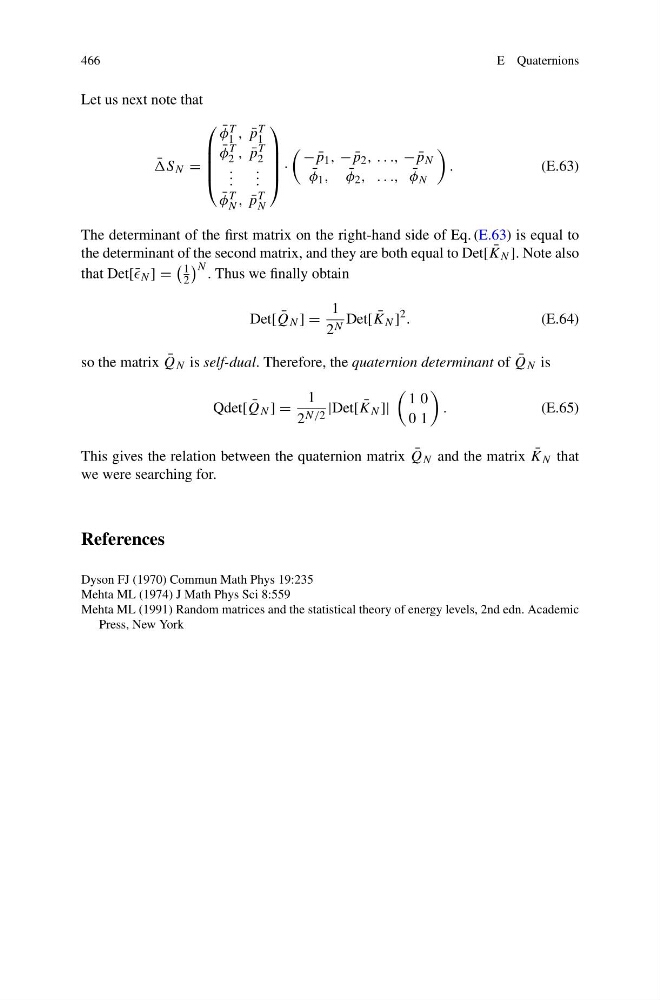
The determinant of the first matrix on the right-hand side of Eq. (E.63) is equal to
the determinant of the second matrix, and they are both equal to Det[ ¯
K N ]. Note also
that Det[¯ N ] =
1
2
N . Thus we finally obtain
Det[ ¯
Q N ] =
1
2 N Det[ ¯
K N ]
2 .
(E.64)
so the matrix ¯
Q N is self-dual. Therefore, the quaternion determinant of ¯
Q N is
Qdet[ ¯
Q N ] =
1
2 N/2 |Det[ ¯
K N ]|
1 0
0 1
.
(E.65)
This gives the relation between the quaternion matrix ¯
Q N and the matrix ¯
K N that
we were searching for.
References
Dyson FJ (1970) Commun Math Phys 19:235
Mehta ML (1974) J Math Phys Sci 8:559
Mehta ML (1991) Random matrices and the statistical theory of energy levels, 2nd edn. Academic
Press, New York
E Quaternions
Let us next note that
¯
S N =
⎛
⎜
⎜
⎜
⎝
¯
φ T
1 , ¯
p T
1
¯
φ T
2 , ¯
p T
2
. . .
. . .
¯
φ T
N , ¯
p T
N
⎞
⎟
⎟
⎟
⎠
·
− ¯
p 1 , − ¯
p 2 , . . ., − ¯
p N
¯
φ 1 , ¯
φ 2 , . . ., ¯
φ N
.
(E.63)
The determinant of the first matrix on the right-hand side of Eq. (E.63) is equal to
the determinant of the second matrix, and they are both equal to Det[ ¯
K N ]. Note also
that Det[¯ N ] =
1
2
N . Thus we finally obtain
Det[ ¯
Q N ] =
1
2 N Det[ ¯
K N ]
2 .
(E.64)
so the matrix ¯
Q N is self-dual. Therefore, the quaternion determinant of ¯
Q N is
Qdet[ ¯
Q N ] =
1
2 N/2 |Det[ ¯
K N ]|
1 0
0 1
.
(E.65)
This gives the relation between the quaternion matrix ¯
Q N and the matrix ¯
K N that
we were searching for.
References
Dyson FJ (1970) Commun Math Phys 19:235
Mehta ML (1974) J Math Phys Sci 8:559
Mehta ML (1991) Random matrices and the statistical theory of energy levels, 2nd edn. Academic
Press, New York