

452
D Invariant Measures
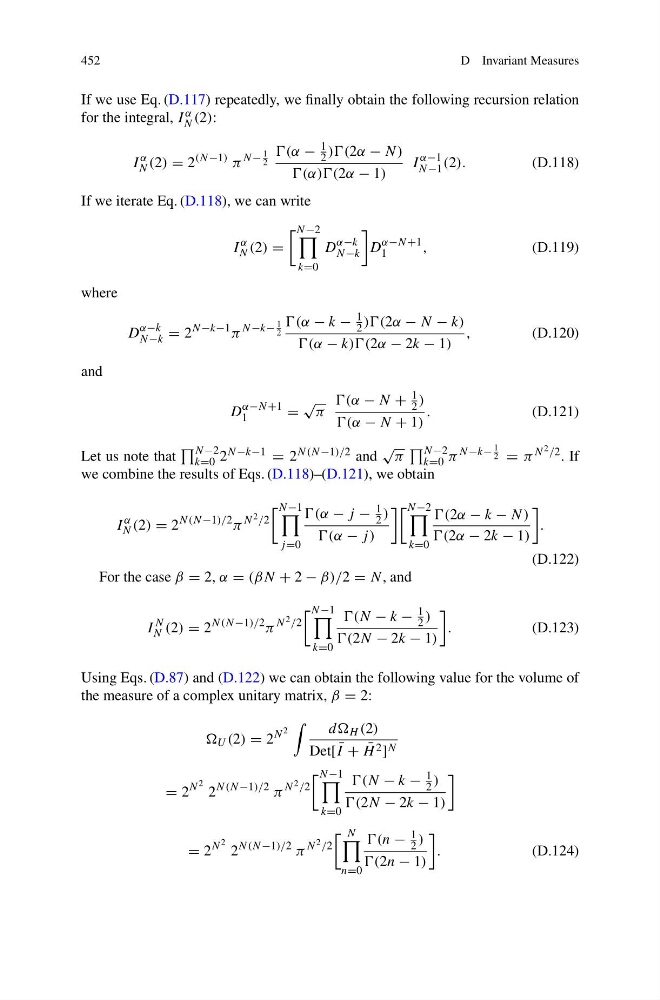
If we use Eq. (D.117) repeatedly, we finally obtain the following recursion relation
for the integral, I α
N (2):
I
α
N (2) = 2
(N −1) π
N −
1
2
−
1
2 ))(2α − N)
(α))(2α − 1)
I
α−1
N −1 (2).
(D.118)
If we iterate Eq. (D.118), we can write
I
α
N (2) =
N −2
k=0
D
α−k
N −k
D
α−N +1
1
,
(D.119)
where
D
α−k
N −k = 2
N −k−1 π
N −k−
1
2
− k −
1
2 ))(2α − N − k)
(α − k))(2α − 2k − 1)
,
(D.120)
and
D
α−N +1
1
=
√
π
− N +
1
2 )
(α − N + 1)
.
(D.121)
Let us note that
N −2
k=0 2 N −k−1 = 2 N(N−1)/2 and
√
π
N −2
k=0 π
N −k−
1
2 = π N 2 /2 . If
we combine the results of Eqs. (D.118)–(D.121), we obtain
I
α
N (2) = 2
N(N−1)/2 π
N 2 /2
N −1
j =0
(α − j −
1
2 )
(α − j)
N −2
k=0
(2α − k − N)
(2α − 2k − 1)
.
(D.122)
For the case β = 2, α = (βN + 2 − β)/2 = N, and
I
N
N (2) = 2
N(N−1)/2 π
N 2 /2
N −1
k=0
(N − k −
1
2 )
(2N − 2k − 1)
.
(D.123)
Using Eqs. (D.87) and (D.122) we can obtain the following value for the volume of
the measure of a complex unitary matrix, β = 2:
U (2) = 2
N 2
dd H (2)
Det[ ¯
I + ¯
H 2 ] N
= 2
N 2 2
N(N−1)/2 π
N 2 /2
N −1
k=0
(N − k −
1
2 )
(2N − 2k − 1)
= 2
N 2 2
N(N−1)/2 π
N 2 /2
N
n=0
(n −
1
2 )
(2n − 1)
.
(D.124)
D Invariant Measures
If we use Eq. (D.117) repeatedly, we finally obtain the following recursion relation
for the integral, I α
N (2):
I
α
N (2) = 2
(N −1) π
N −
1
2
−
1
2 ))(2α − N)
(α))(2α − 1)
I
α−1
N −1 (2).
(D.118)
If we iterate Eq. (D.118), we can write
I
α
N (2) =
N −2
k=0
D
α−k
N −k
D
α−N +1
1
,
(D.119)
where
D
α−k
N −k = 2
N −k−1 π
N −k−
1
2
− k −
1
2 ))(2α − N − k)
(α − k))(2α − 2k − 1)
,
(D.120)
and
D
α−N +1
1
=
√
π
− N +
1
2 )
(α − N + 1)
.
(D.121)
Let us note that
N −2
k=0 2 N −k−1 = 2 N(N−1)/2 and
√
π
N −2
k=0 π
N −k−
1
2 = π N 2 /2 . If
we combine the results of Eqs. (D.118)–(D.121), we obtain
I
α
N (2) = 2
N(N−1)/2 π
N 2 /2
N −1
j =0
(α − j −
1
2 )
(α − j)
N −2
k=0
(2α − k − N)
(2α − 2k − 1)
.
(D.122)
For the case β = 2, α = (βN + 2 − β)/2 = N, and
I
N
N (2) = 2
N(N−1)/2 π
N 2 /2
N −1
k=0
(N − k −
1
2 )
(2N − 2k − 1)
.
(D.123)
Using Eqs. (D.87) and (D.122) we can obtain the following value for the volume of
the measure of a complex unitary matrix, β = 2:
U (2) = 2
N 2
dd H (2)
Det[ ¯
I + ¯
H 2 ] N
= 2
N 2 2
N(N−1)/2 π
N 2 /2
N −1
k=0
(N − k −
1
2 )
(2N − 2k − 1)
= 2
N 2 2
N(N−1)/2 π
N 2 /2
N
n=0
(n −
1
2 )
(2n − 1)
.
(D.124)