

D.4 Volume of Invariant Measure for Unitary Matrices
449
where ¯
A is an N ×N Hermitian matrix, ¯
u is a 1×N column matrix, and ¯
u † is its Hermitian
adjoint. Let us now take the determinant of Eq. (D.95) and remember that the determinant
of a product of matrices is equal to the product of the determinants. We then find
Det
¯
A ¯
u
¯
u † a
= Det
¯
A
0
0 a − ¯
u † · ¯
A −1 · ¯
u
= Det[ ¯
A] (a − ¯
u
† · ¯
A
−1 · ¯
u),
(D.96)
where we have used the fact that Det
¯
1
0
− ¯
u † · ¯
A −1 1
= 1.
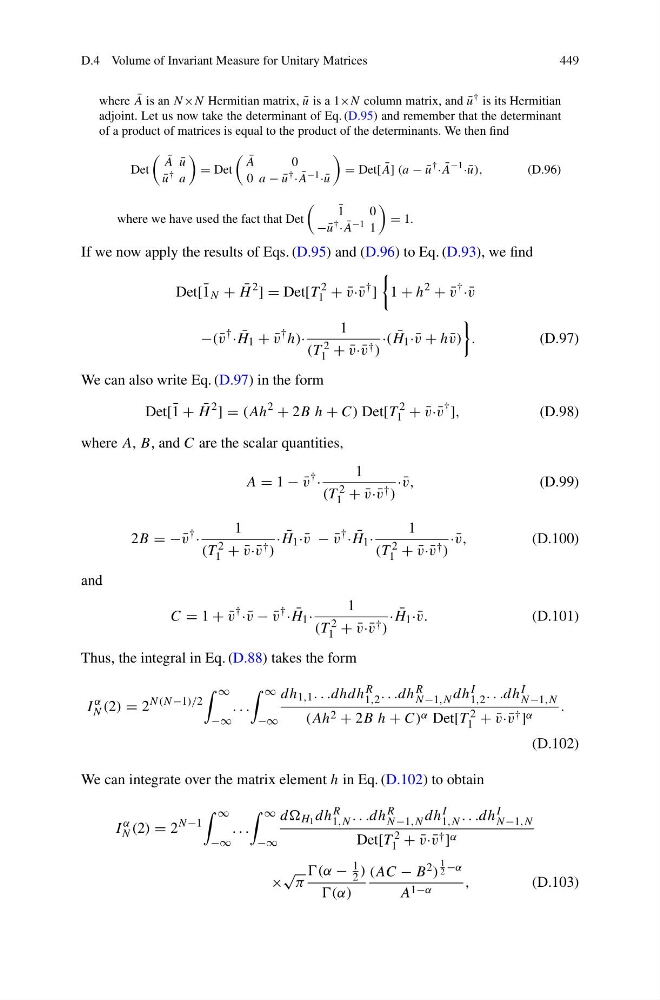
If we now apply the results of Eqs. (D.95) and (D.96) to Eq. (D.93), we find
Det[ ¯
1 N + ¯
H
2
] = Det[T
2
1 + ¯
v· ¯
v
†
]
1 + h
2
+ ¯
v
†
· ¯
v
−( ¯
v
†
· ¯
H 1 + ¯
v
† h)·
1
(T 2
1 + ¯
v· ¯
v † )
·( ¯
H 1 · ¯
v + h ¯
v)
.
(D.97)
We can also write Eq. (D.97) in the form
Det[ ¯
1 + ¯
H
2
] = (Ah
2
+ 2B h + C) Det[T
2
1 + ¯
v· ¯
v
†
],
(D.98)
where A, B, and C are the scalar quantities,
A = 1 − ¯
v
†
·
1
(T 2
1 + ¯
v· ¯
v † )
· ¯
v,
(D.99)
2B = −¯ v
†
·
1
(T 2
1 + ¯
v· ¯
v † )
· ¯
H 1 · ¯
v − ¯
v
†
· ¯
H 1 ·
1
(T 2
1 + ¯
v· ¯
v † )
· ¯
v,
(D.100)
and
C = 1 + ¯
v
†
· ¯
v − ¯
v
†
· ¯
H 1 ·
1
(T 2
1 + ¯
v· ¯
v † )
· ¯
H 1 · ¯
v.
(D.101)
Thus, the integral in Eq. (D.88) takes the form
I
α
N (2) = 2
N(N−1)/2
∞
−∞
. . .
∞
−∞
dh 1,1 . . .dhdh R
1,2 . . .dh R
N −1,N dh I
1,2 . . .dh I
N −1,N
(Ah 2 + 2B h + C) α Det[T 2
1 + ¯
v· ¯
v † ] α
.
(D.102)
We can integrate over the matrix element h in Eq. (D.102) to obtain
I
α
N (2) = 2
N −1
∞
−∞
. . .
∞
−∞
dd H 1 dh R
1,N . . .dh R
N −1,N dh I
1,N . . .dh I
N −1,N
Det[T 2
1 + ¯
v· ¯
v † ] α
×
√
π
−
1
2 )
(α)
(AC − B 2 )
1
2 −α
A 1−α
,
(D.103)
449
where ¯
A is an N ×N Hermitian matrix, ¯
u is a 1×N column matrix, and ¯
u † is its Hermitian
adjoint. Let us now take the determinant of Eq. (D.95) and remember that the determinant
of a product of matrices is equal to the product of the determinants. We then find
Det
¯
A ¯
u
¯
u † a
= Det
¯
A
0
0 a − ¯
u † · ¯
A −1 · ¯
u
= Det[ ¯
A] (a − ¯
u
† · ¯
A
−1 · ¯
u),
(D.96)
where we have used the fact that Det
¯
1
0
− ¯
u † · ¯
A −1 1
= 1.
If we now apply the results of Eqs. (D.95) and (D.96) to Eq. (D.93), we find
Det[ ¯
1 N + ¯
H
2
] = Det[T
2
1 + ¯
v· ¯
v
†
]
1 + h
2
+ ¯
v
†
· ¯
v
−( ¯
v
†
· ¯
H 1 + ¯
v
† h)·
1
(T 2
1 + ¯
v· ¯
v † )
·( ¯
H 1 · ¯
v + h ¯
v)
.
(D.97)
We can also write Eq. (D.97) in the form
Det[ ¯
1 + ¯
H
2
] = (Ah
2
+ 2B h + C) Det[T
2
1 + ¯
v· ¯
v
†
],
(D.98)
where A, B, and C are the scalar quantities,
A = 1 − ¯
v
†
·
1
(T 2
1 + ¯
v· ¯
v † )
· ¯
v,
(D.99)
2B = −¯ v
†
·
1
(T 2
1 + ¯
v· ¯
v † )
· ¯
H 1 · ¯
v − ¯
v
†
· ¯
H 1 ·
1
(T 2
1 + ¯
v· ¯
v † )
· ¯
v,
(D.100)
and
C = 1 + ¯
v
†
· ¯
v − ¯
v
†
· ¯
H 1 ·
1
(T 2
1 + ¯
v· ¯
v † )
· ¯
H 1 · ¯
v.
(D.101)
Thus, the integral in Eq. (D.88) takes the form
I
α
N (2) = 2
N(N−1)/2
∞
−∞
. . .
∞
−∞
dh 1,1 . . .dhdh R
1,2 . . .dh R
N −1,N dh I
1,2 . . .dh I
N −1,N
(Ah 2 + 2B h + C) α Det[T 2
1 + ¯
v· ¯
v † ] α
.
(D.102)
We can integrate over the matrix element h in Eq. (D.102) to obtain
I
α
N (2) = 2
N −1
∞
−∞
. . .
∞
−∞
dd H 1 dh R
1,N . . .dh R
N −1,N dh I
1,N . . .dh I
N −1,N
Det[T 2
1 + ¯
v· ¯
v † ] α
×
√
π
−
1
2 )
(α)
(AC − B 2 )
1
2 −α
A 1−α
,
(D.103)