

444
D Invariant Measures
D.3.2 General Unitary Matrices
Unitary matrices, ¯
U C , obtained via Eq. (D.51) from complex Hermitian matrices,
¯
H C , are the most general form of unitary matrix. They are diagonalized by a general
unitary matrix ¯
V C , whose matrix elements are complex. Thus, dV i,j = dV R
i,j +
idV I
i,j , where dV R
i,j and dV I
i,j are independent of each other. Using Eq. (D.61), we
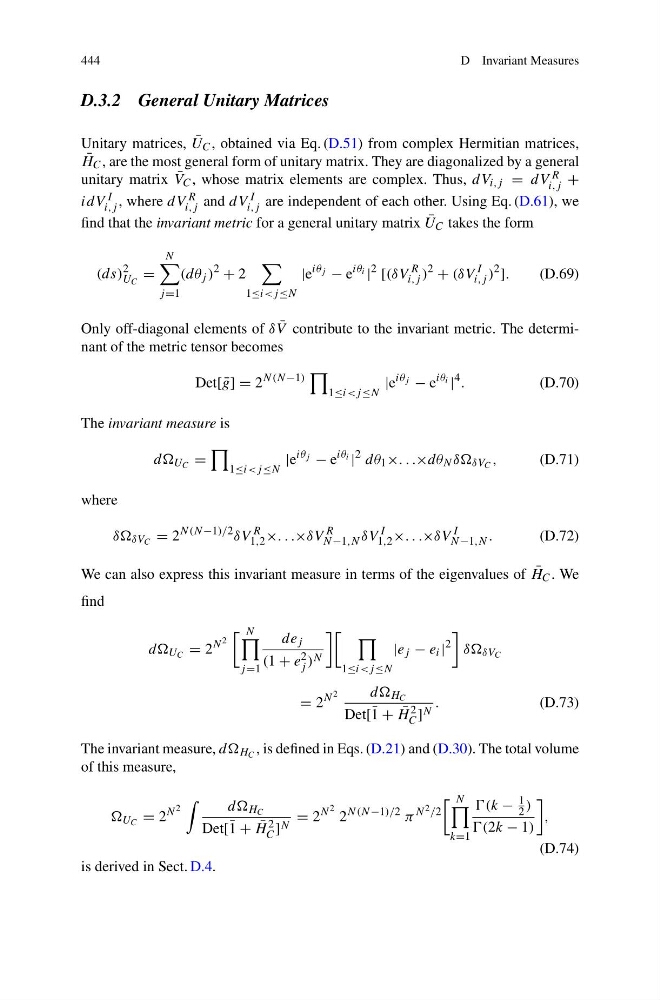
find that the invariant metric for a general unitary matrix ¯
U C takes the form
(ds)
2
U C
=
N
j =1
(dθ j )
2
+ 2
1≤i
iθ j − e
iθ i |
2
[(δV
R
i,j )
2
+ (δV
I
i,j )
2
].
(D.69)
Only off-diagonal elements of δ ¯
V contribute to the invariant metric. The determinant of the metric tensor becomes
Det[ ¯
g] = 2
N(N−1)
1≤i
iθ j − e
iθ i |
4 .
(D.70)
The invariant measure is
dd U C =
1≤i
iθ j − e
iθ i |
2 dθ 1 ×. . .×dθ N δδ δV C ,
(D.71)
where
δδ δV C = 2
N(N−1)/2 δV
R
1,2 ×. . .×δV
R
N −1,N δV
I
1,2 ×. . .×δV
I
N −1,N .
(D.72)
We can also express this invariant measure in terms of the eigenvalues of ¯
H C . We
find
dd U C = 2
N 2
N
j =1
de j
(1 + e 2
j ) N
1≤i
2
δδ δV C
= 2
N 2
dd H C
Det[ ¯
1 + ¯
H 2
C ] N
.
(D.73)
The invariant measure, dd H C , is defined in Eqs. (D.21) and (D.30). The total volume
of this measure,
U C = 2
N 2
dd H C
Det[ ¯
1 + ¯
H 2
C ] N
= 2
N 2 2
N(N−1)/2 π
N 2 /2
N
k=1
(k −
1
2 )
(2k − 1)
,
(D.74)
is derived in Sect. D.4.
D Invariant Measures
D.3.2 General Unitary Matrices
Unitary matrices, ¯
U C , obtained via Eq. (D.51) from complex Hermitian matrices,
¯
H C , are the most general form of unitary matrix. They are diagonalized by a general
unitary matrix ¯
V C , whose matrix elements are complex. Thus, dV i,j = dV R
i,j +
idV I
i,j , where dV R
i,j and dV I
i,j are independent of each other. Using Eq. (D.61), we
find that the invariant metric for a general unitary matrix ¯
U C takes the form
(ds)
2
U C
=
N
j =1
(dθ j )
2
+ 2
1≤i
iθ j − e
iθ i |
2
[(δV
R
i,j )
2
+ (δV
I
i,j )
2
].
(D.69)
Only off-diagonal elements of δ ¯
V contribute to the invariant metric. The determinant of the metric tensor becomes
Det[ ¯
g] = 2
N(N−1)
1≤i
iθ j − e
iθ i |
4 .
(D.70)
The invariant measure is
dd U C =
1≤i
iθ j − e
iθ i |
2 dθ 1 ×. . .×dθ N δδ δV C ,
(D.71)
where
δδ δV C = 2
N(N−1)/2 δV
R
1,2 ×. . .×δV
R
N −1,N δV
I
1,2 ×. . .×δV
I
N −1,N .
(D.72)
We can also express this invariant measure in terms of the eigenvalues of ¯
H C . We
find
dd U C = 2
N 2
N
j =1
de j
(1 + e 2
j ) N
1≤i
2
δδ δV C
= 2
N 2
dd H C
Det[ ¯
1 + ¯
H 2
C ] N
.
(D.73)
The invariant measure, dd H C , is defined in Eqs. (D.21) and (D.30). The total volume
of this measure,
U C = 2
N 2
dd H C
Det[ ¯
1 + ¯
H 2
C ] N
= 2
N 2 2
N(N−1)/2 π
N 2 /2
N
k=1
(k −
1
2 )
(2k − 1)
,
(D.74)
is derived in Sect. D.4.