

428
C Symmetries and the Hamiltonian Matrix
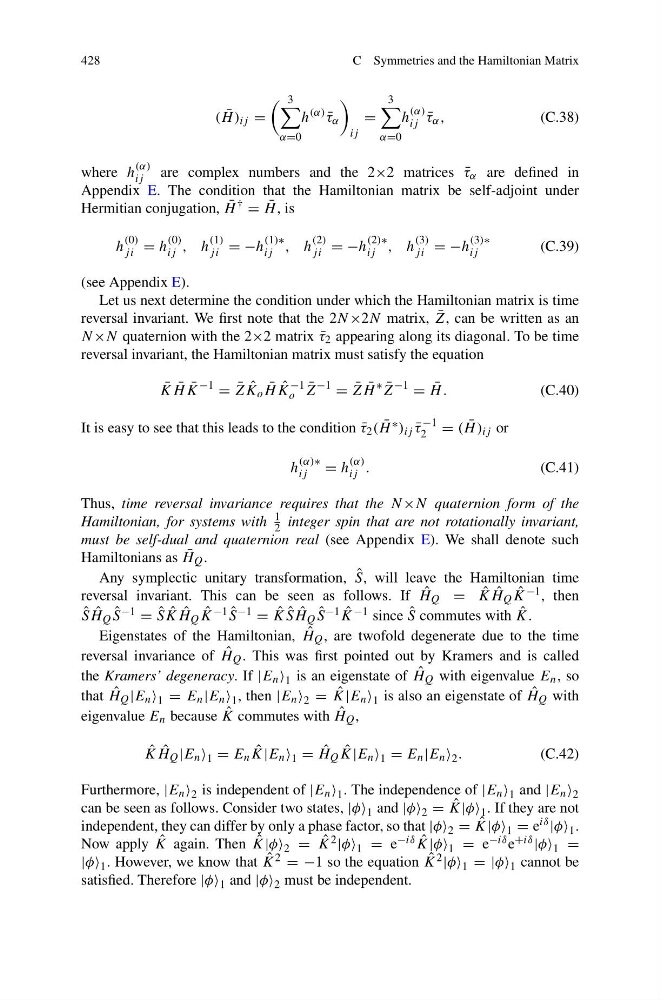
( ¯
H ) ij =
3
α=0
h
(α)
¯
τ α
ij
=
3
α=0
h
(α)
ij ¯
τ α ,
(C.38)
where h
(α)
ij
are complex numbers and the 2×2 matrices ¯
τ α are defined in
Appendix E. The condition that the Hamiltonian matrix be self-adjoint under
Hermitian conjugation, ¯
H † = ¯
H , is
h
(0)
ji = h
(0)
ij , h
(1)
ji = −h
(1)∗
ij , h
(2)
ji = −h
(2)∗
ij , h
(3)
ji = −h
(3)∗
ij
(C.39)
(see Appendix E).
Let us next determine the condition under which the Hamiltonian matrix is time
reversal invariant. We first note that the 2N×2N matrix, ¯
Z, can be written as an
N×N quaternion with the 2×2 matrix ¯
τ 2 appearing along its diagonal. To be time
reversal invariant, the Hamiltonian matrix must satisfy the equation
¯
K ¯
H ¯
K
−1
= ¯
Z ˆ
K o ¯
H ˆ
K
−1
o
¯
Z
−1
= ¯
Z ¯
H
∗ ¯
Z
−1
= ¯
H .
(C.40)
It is easy to see that this leads to the condition ¯
τ 2 ( ¯
H ∗ ) ij ¯
τ
−1
2 = ( ¯
H ) ij or
h
(α)∗
ij
= h
(α)
ij .
(C.41)
Thus, time reversal invariance requires that the N×N quaternion form of the
Hamiltonian, for systems with
1
2 integer spin that are not rotationally invariant,
must be self-dual and quaternion real (see Appendix E). We shall denote such
Hamiltonians as ¯
H Q .
Any symplectic unitary transformation, ˆ
S, will leave the Hamiltonian time
reversal invariant. This can be seen as follows. If ˆ
H Q = ˆ
K ˆ
H Q ˆ
K −1 , then
ˆ
S ˆ
H Q ˆ
S −1 = ˆ
S ˆ
K ˆ
H Q ˆ
K −1 ˆ
S −1 = ˆ
K ˆ
S ˆ
H Q ˆ
S −1 ˆ
K −1 since ˆ
S commutes with ˆ
K.
Eigenstates of the Hamiltonian, ˆ
H Q , are twofold degenerate due to the time
reversal invariance of ˆ
H Q . This was first pointed out by Kramers and is called
the Kramers’ degeneracy. If |E n 1 is an eigenstate of ˆ
H Q with eigenvalue E n , so
that ˆ
H Q |E n 1 = E n |E n 1 , then |E n 2 = ˆ
K|E n 1 is also an eigenstate of ˆ
H Q with
eigenvalue E n because ˆ
K commutes with ˆ
H Q ,
ˆ
K ˆ
H Q |E n 1 = E n ˆ
K|E n 1 = ˆ
H Q ˆ
K|E n 1 = E n |E n 2 .
(C.42)
Furthermore, |E n 2 is independent of |E n 1 . The independence of |E n 1 and |E n 2
can be seen as follows. Consider two states, |φ 1 and |φ 2 = ˆ
K|φ 1 . If they are not
independent, they can differ by only a phase factor, so that |φ 2 = ˆ
K|φ 1 = e iδ |φ 1 .
Now apply ˆ
K again. Then ˆ
K|φ 2 = ˆ
K 2 |φ 1 = e −iδ ˆ
K|φ 1 = e −iδ e +iδ |φ 1 =
|φ 1 . However, we know that ˆ
K 2 = −1 so the equation ˆ
K 2 |φ 1 = |φ 1 cannot be
satisfied. Therefore |φ 1 and |φ 2 must be independent.
C Symmetries and the Hamiltonian Matrix
( ¯
H ) ij =
3
α=0
h
(α)
¯
τ α
ij
=
3
α=0
h
(α)
ij ¯
τ α ,
(C.38)
where h
(α)
ij
are complex numbers and the 2×2 matrices ¯
τ α are defined in
Appendix E. The condition that the Hamiltonian matrix be self-adjoint under
Hermitian conjugation, ¯
H † = ¯
H , is
h
(0)
ji = h
(0)
ij , h
(1)
ji = −h
(1)∗
ij , h
(2)
ji = −h
(2)∗
ij , h
(3)
ji = −h
(3)∗
ij
(C.39)
(see Appendix E).
Let us next determine the condition under which the Hamiltonian matrix is time
reversal invariant. We first note that the 2N×2N matrix, ¯
Z, can be written as an
N×N quaternion with the 2×2 matrix ¯
τ 2 appearing along its diagonal. To be time
reversal invariant, the Hamiltonian matrix must satisfy the equation
¯
K ¯
H ¯
K
−1
= ¯
Z ˆ
K o ¯
H ˆ
K
−1
o
¯
Z
−1
= ¯
Z ¯
H
∗ ¯
Z
−1
= ¯
H .
(C.40)
It is easy to see that this leads to the condition ¯
τ 2 ( ¯
H ∗ ) ij ¯
τ
−1
2 = ( ¯
H ) ij or
h
(α)∗
ij
= h
(α)
ij .
(C.41)
Thus, time reversal invariance requires that the N×N quaternion form of the
Hamiltonian, for systems with
1
2 integer spin that are not rotationally invariant,
must be self-dual and quaternion real (see Appendix E). We shall denote such
Hamiltonians as ¯
H Q .
Any symplectic unitary transformation, ˆ
S, will leave the Hamiltonian time
reversal invariant. This can be seen as follows. If ˆ
H Q = ˆ
K ˆ
H Q ˆ
K −1 , then
ˆ
S ˆ
H Q ˆ
S −1 = ˆ
S ˆ
K ˆ
H Q ˆ
K −1 ˆ
S −1 = ˆ
K ˆ
S ˆ
H Q ˆ
S −1 ˆ
K −1 since ˆ
S commutes with ˆ
K.
Eigenstates of the Hamiltonian, ˆ
H Q , are twofold degenerate due to the time
reversal invariance of ˆ
H Q . This was first pointed out by Kramers and is called
the Kramers’ degeneracy. If |E n 1 is an eigenstate of ˆ
H Q with eigenvalue E n , so
that ˆ
H Q |E n 1 = E n |E n 1 , then |E n 2 = ˆ
K|E n 1 is also an eigenstate of ˆ
H Q with
eigenvalue E n because ˆ
K commutes with ˆ
H Q ,
ˆ
K ˆ
H Q |E n 1 = E n ˆ
K|E n 1 = ˆ
H Q ˆ
K|E n 1 = E n |E n 2 .
(C.42)
Furthermore, |E n 2 is independent of |E n 1 . The independence of |E n 1 and |E n 2
can be seen as follows. Consider two states, |φ 1 and |φ 2 = ˆ
K|φ 1 . If they are not
independent, they can differ by only a phase factor, so that |φ 2 = ˆ
K|φ 1 = e iδ |φ 1 .
Now apply ˆ
K again. Then ˆ
K|φ 2 = ˆ
K 2 |φ 1 = e −iδ ˆ
K|φ 1 = e −iδ e +iδ |φ 1 =
|φ 1 . However, we know that ˆ
K 2 = −1 so the equation ˆ
K 2 |φ 1 = |φ 1 cannot be
satisfied. Therefore |φ 1 and |φ 2 must be independent.