

426
C Symmetries and the Hamiltonian Matrix
operator. (For zero spin, ˆ
K = ˆ
K o .) This allows us to write real eigenstates for ˆ
K
(Messiah 1964; Porter 1965; Mehta 1991),
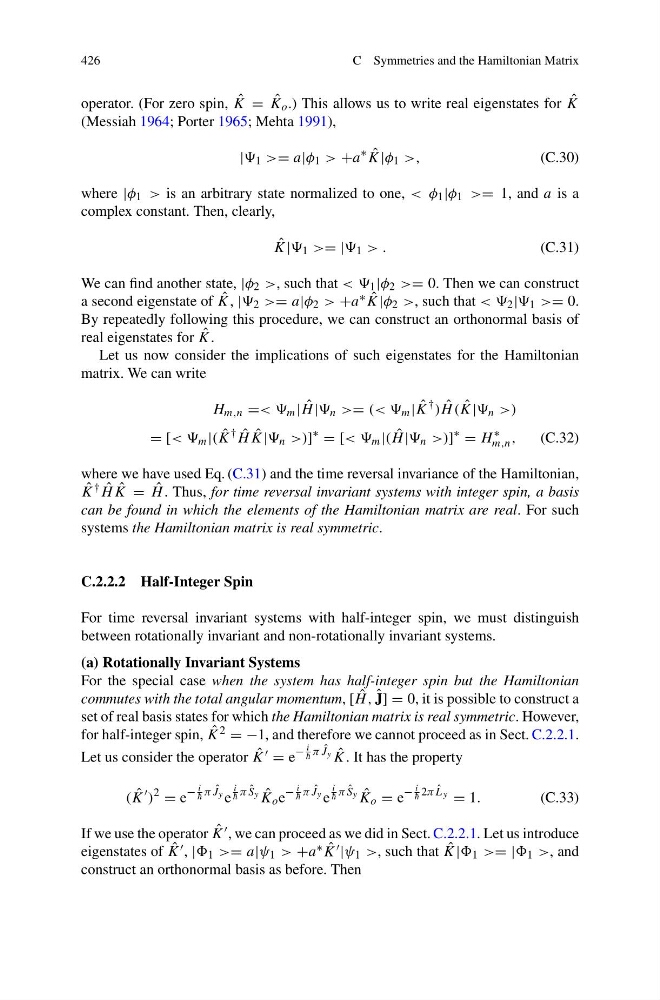
| 1 >= a|φ 1 > +a
∗ ˆ
K|φ 1 >,
(C.30)
where |φ 1 > is an arbitrary state normalized to one, < φ 1 |φ 1 >= 1, and a is a
complex constant. Then, clearly,
ˆ
K| 1 >= | 1 > .
(C.31)
We can find another state, |φ 2 >, such that < < 1 |φ 2 >= 0. Then we can construct
a second eigenstate of ˆ
K, | 2 >= a|φ 2 > +a ∗ ˆ
K|φ 2 >, such that < < 2 | 1 >= 0.
By repeatedly following this procedure, we can construct an orthonormal basis of
real eigenstates for ˆ
K.
Let us now consider the implications of such eigenstates for the Hamiltonian
matrix. We can write
H m,n =< < m | ˆ
H | n >= (< < m | ˆ
K
† ) ˆ
H ( ˆ
K| n >)
= [< < m |( ˆ
K
† ˆ
H ˆ
K| n >)]
∗
= [< < m |( ˆ
H | n >)]
∗
= H
∗
m,n ,
(C.32)
where we have used Eq. (C.31) and the time reversal invariance of the Hamiltonian,
ˆ
K † ˆ
H ˆ
K = ˆ
H . Thus, for time reversal invariant systems with integer spin, a basis
can be found in which the elements of the Hamiltonian matrix are real. For such
systems the Hamiltonian matrix is real symmetric.
C.2.2.2 Half-Integer Spin
For time reversal invariant systems with half-integer spin, we must distinguish
between rotationally invariant and non-rotationally invariant systems.
(a) Rotationally Invariant Systems
For the special case when the system has half-integer spin but the Hamiltonian
commutes with the total angular momentum, [ ˆ
H , ˆ
J] = 0, it is possible to construct a
set of real basis states for which the Hamiltonian matrix is real symmetric. However,
for half-integer spin, ˆ
K 2 = −1, and therefore we cannot proceed as in Sect. C.2.2.1.
Let us consider the operator ˆ
K = e
−
i
¯
h π ˆ
J y ˆ
K. It has the property
( ˆ
K
)
2
= e
−
i
¯
h π ˆ
J y e
i
¯
h π ˆ
S y ˆ
K o e
−
i
¯
h π ˆ
J y e
i
¯
h π ˆ
S y ˆ
K o = e
−
i
¯
h 2π ˆ
L y = 1.
(C.33)
If we use the operator ˆ
K , we can proceed as we did in Sect. C.2.2.1. Let us introduce
eigenstates of ˆ
K , | 1 >= a|ψ 1 > +a ∗ ˆ
K |ψ 1 >, such that ˆ
K| 1 >= | 1 >, and
construct an orthonormal basis as before. Then
C Symmetries and the Hamiltonian Matrix
operator. (For zero spin, ˆ
K = ˆ
K o .) This allows us to write real eigenstates for ˆ
K
(Messiah 1964; Porter 1965; Mehta 1991),
| 1 >= a|φ 1 > +a
∗ ˆ
K|φ 1 >,
(C.30)
where |φ 1 > is an arbitrary state normalized to one, < φ 1 |φ 1 >= 1, and a is a
complex constant. Then, clearly,
ˆ
K| 1 >= | 1 > .
(C.31)
We can find another state, |φ 2 >, such that < < 1 |φ 2 >= 0. Then we can construct
a second eigenstate of ˆ
K, | 2 >= a|φ 2 > +a ∗ ˆ
K|φ 2 >, such that < < 2 | 1 >= 0.
By repeatedly following this procedure, we can construct an orthonormal basis of
real eigenstates for ˆ
K.
Let us now consider the implications of such eigenstates for the Hamiltonian
matrix. We can write
H m,n =< < m | ˆ
H | n >= (< < m | ˆ
K
† ) ˆ
H ( ˆ
K| n >)
= [< < m |( ˆ
K
† ˆ
H ˆ
K| n >)]
∗
= [< < m |( ˆ
H | n >)]
∗
= H
∗
m,n ,
(C.32)
where we have used Eq. (C.31) and the time reversal invariance of the Hamiltonian,
ˆ
K † ˆ
H ˆ
K = ˆ
H . Thus, for time reversal invariant systems with integer spin, a basis
can be found in which the elements of the Hamiltonian matrix are real. For such
systems the Hamiltonian matrix is real symmetric.
C.2.2.2 Half-Integer Spin
For time reversal invariant systems with half-integer spin, we must distinguish
between rotationally invariant and non-rotationally invariant systems.
(a) Rotationally Invariant Systems
For the special case when the system has half-integer spin but the Hamiltonian
commutes with the total angular momentum, [ ˆ
H , ˆ
J] = 0, it is possible to construct a
set of real basis states for which the Hamiltonian matrix is real symmetric. However,
for half-integer spin, ˆ
K 2 = −1, and therefore we cannot proceed as in Sect. C.2.2.1.
Let us consider the operator ˆ
K = e
−
i
¯
h π ˆ
J y ˆ
K. It has the property
( ˆ
K
)
2
= e
−
i
¯
h π ˆ
J y e
i
¯
h π ˆ
S y ˆ
K o e
−
i
¯
h π ˆ
J y e
i
¯
h π ˆ
S y ˆ
K o = e
−
i
¯
h 2π ˆ
L y = 1.
(C.33)
If we use the operator ˆ
K , we can proceed as we did in Sect. C.2.2.1. Let us introduce
eigenstates of ˆ
K , | 1 >= a|ψ 1 > +a ∗ ˆ
K |ψ 1 >, such that ˆ
K| 1 >= | 1 >, and
construct an orthonormal basis as before. Then