

410
B Simple Models
f
2
= B +
(B 2 + E o ) and e
2
= B −
(B 2 + E o ).
(B.19)
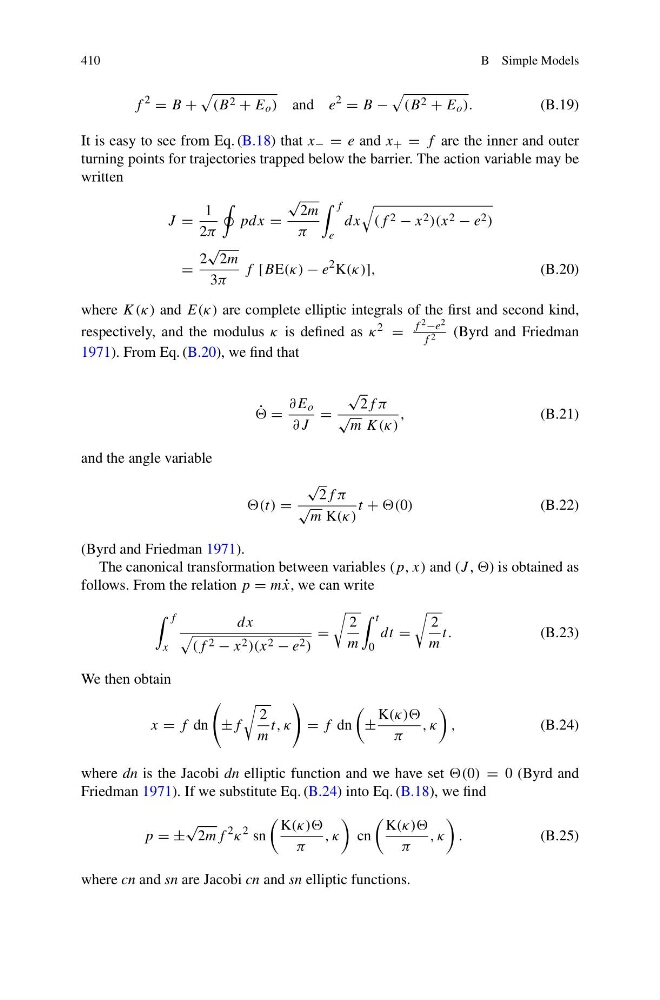
It is easy to see from Eq. (B.18) that x − = e and x + = f are the inner and outer
turning points for trajectories trapped below the barrier. The action variable may be
written
J =
1
2π
pdx =
√
2m
π
f
e
dx
(f 2 − x 2 )(x 2 − e 2 )
=
2
√
2m
3π
f [BE(κ) − e
2 K(κ)],
(B.20)
where K(κ) and E(κ) are complete elliptic integrals of the first and second kind,
respectively, and the modulus κ is defined as κ 2 =
f 2 −e 2
f 2
(Byrd and Friedman
1971). From Eq. (B.20), we find that
˙
=
∂E o
∂J
=
√
2f π
√
m K(κ)
,
(B.21)
and the angle variable
=
√
2f π
√
m K(κ)
t + (0)
(B.22)
(Byrd and Friedman 1971).
The canonical transformation between variables (p, x) and (J , ) is obtained as
follows. From the relation p = m ˙
x, we can write
f
x
dx
(f 2 − x 2 )(x 2 − e 2 )
=
2
m
t
0
dt =
2
m
t.
(B.23)
We then obtain
x = f dn
±f
2
m
t, κ
= f dn
±
K(κ))
π
, κ
,
(B.24)
where dn is the Jacobi dn elliptic function and we have set (0) = 0 (Byrd and
Friedman 1971). If we substitute Eq. (B.24) into Eq. (B.18), we find
p = ±
√
2mf
2 κ
2 sn
K(κ))
π
, κ
cn
K(κ))
π
, κ
.
(B.25)
where cn and sn are Jacobi cn and sn elliptic functions.
B Simple Models
f
2
= B +
(B 2 + E o ) and e
2
= B −
(B 2 + E o ).
(B.19)
It is easy to see from Eq. (B.18) that x − = e and x + = f are the inner and outer
turning points for trajectories trapped below the barrier. The action variable may be
written
J =
1
2π
pdx =
√
2m
π
f
e
dx
(f 2 − x 2 )(x 2 − e 2 )
=
2
√
2m
3π
f [BE(κ) − e
2 K(κ)],
(B.20)
where K(κ) and E(κ) are complete elliptic integrals of the first and second kind,
respectively, and the modulus κ is defined as κ 2 =
f 2 −e 2
f 2
(Byrd and Friedman
1971). From Eq. (B.20), we find that
˙
=
∂E o
∂J
=
√
2f π
√
m K(κ)
,
(B.21)
and the angle variable
=
√
2f π
√
m K(κ)
t + (0)
(B.22)
(Byrd and Friedman 1971).
The canonical transformation between variables (p, x) and (J , ) is obtained as
follows. From the relation p = m ˙
x, we can write
f
x
dx
(f 2 − x 2 )(x 2 − e 2 )
=
2
m
t
0
dt =
2
m
t.
(B.23)
We then obtain
x = f dn
±f
2
m
t, κ
= f dn
±
K(κ))
π
, κ
,
(B.24)
where dn is the Jacobi dn elliptic function and we have set (0) = 0 (Byrd and
Friedman 1971). If we substitute Eq. (B.24) into Eq. (B.18), we find
p = ±
√
2mf
2 κ
2 sn
K(κ))
π
, κ
cn
K(κ))
π
, κ
.
(B.25)
where cn and sn are Jacobi cn and sn elliptic functions.