

26
2 Fundamental Concepts
and
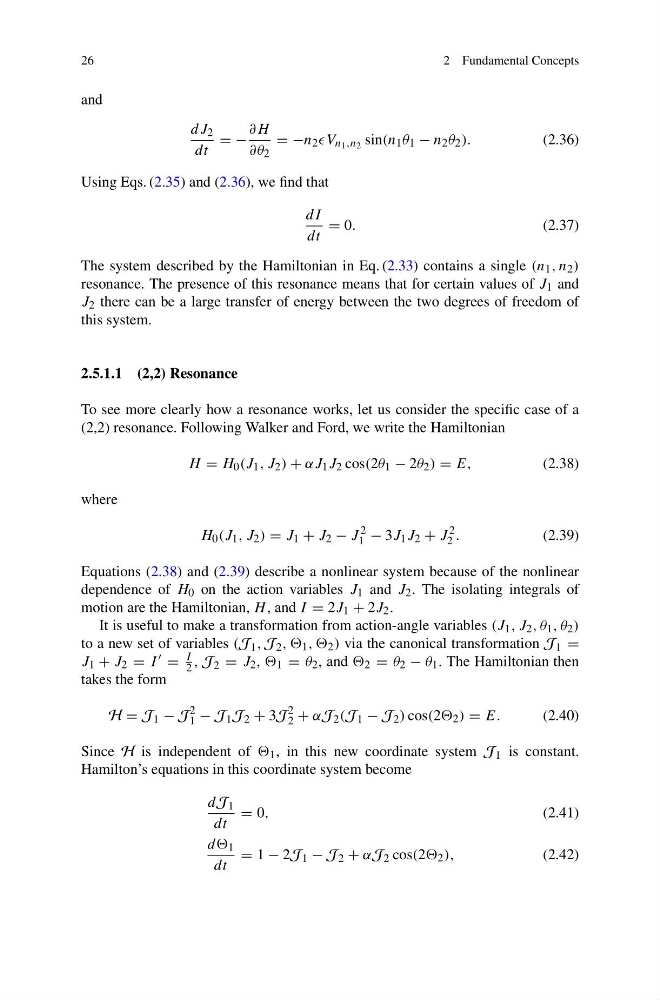
dJ 2
dt
= −
∂H
∂θ 2
= −n 2 V n 1 ,n 2 sin(n 1 θ 1 − n 2 θ 2 ).
(2.36)
Using Eqs. (2.35) and (2.36), we find that
dI
dt
= 0.
(2.37)
The system described by the Hamiltonian in Eq. (2.33) contains a single (n 1 , n 2 )
resonance. The presence of this resonance means that for certain values of J 1 and
J 2 there can be a large transfer of energy between the two degrees of freedom of
this system.
2.5.1.1 (2,2) Resonance
To see more clearly how a resonance works, let us consider the specific case of a
(2,2) resonance. Following Walker and Ford, we write the Hamiltonian
H = H 0 (J 1 , J 2 ) + αJ 1 J 2 cos(2θ 1 − 2θ 2 ) = E,
(2.38)
where
H 0 (J 1 , J 2 ) = J 1 + J 2 − J
2
1 − 3J 1 J 2 + J
2
2 .
(2.39)
Equations (2.38) and (2.39) describe a nonlinear system because of the nonlinear
dependence of H 0 on the action variables J 1 and J 2 . The isolating integrals of
motion are the Hamiltonian, H , and I = 2J 1 + 2J 2 .
It is useful to make a transformation from action-angle variables (J 1 , J 2 , θ 1 , θ 2 )
to a new set of variables (J 1 , J 2 , , 1 , , 2 ) via the canonical transformation J 1 =
J 1 + J 2 = I =
I
2 , J 2 = J 2 , 1 = θ 2 , and 2 = θ 2 − θ 1 . The Hamiltonian then
takes the form
H = J 1 − J
2
1 − J 1 J 2 + 3J
2
2 + αJ 2 (J 1 − J 2 ) cos(2 2 ) = E.
(2.40)
Since H is independent of 1 , in this new coordinate system J 1 is constant.
Hamilton’s equations in this coordinate system become
dJ 1
dt
= 0,
(2.41)
dd 1
dt
= 1 − 2J 1 − J 2 + αJ 2 cos(2 2 ),
(2.42)
2 Fundamental Concepts
and
dJ 2
dt
= −
∂H
∂θ 2
= −n 2 V n 1 ,n 2 sin(n 1 θ 1 − n 2 θ 2 ).
(2.36)
Using Eqs. (2.35) and (2.36), we find that
dI
dt
= 0.
(2.37)
The system described by the Hamiltonian in Eq. (2.33) contains a single (n 1 , n 2 )
resonance. The presence of this resonance means that for certain values of J 1 and
J 2 there can be a large transfer of energy between the two degrees of freedom of
this system.
2.5.1.1 (2,2) Resonance
To see more clearly how a resonance works, let us consider the specific case of a
(2,2) resonance. Following Walker and Ford, we write the Hamiltonian
H = H 0 (J 1 , J 2 ) + αJ 1 J 2 cos(2θ 1 − 2θ 2 ) = E,
(2.38)
where
H 0 (J 1 , J 2 ) = J 1 + J 2 − J
2
1 − 3J 1 J 2 + J
2
2 .
(2.39)
Equations (2.38) and (2.39) describe a nonlinear system because of the nonlinear
dependence of H 0 on the action variables J 1 and J 2 . The isolating integrals of
motion are the Hamiltonian, H , and I = 2J 1 + 2J 2 .
It is useful to make a transformation from action-angle variables (J 1 , J 2 , θ 1 , θ 2 )
to a new set of variables (J 1 , J 2 , , 1 , , 2 ) via the canonical transformation J 1 =
J 1 + J 2 = I =
I
2 , J 2 = J 2 , 1 = θ 2 , and 2 = θ 2 − θ 1 . The Hamiltonian then
takes the form
H = J 1 − J
2
1 − J 1 J 2 + 3J
2
2 + αJ 2 (J 1 − J 2 ) cos(2 2 ) = E.
(2.40)
Since H is independent of 1 , in this new coordinate system J 1 is constant.
Hamilton’s equations in this coordinate system become
dJ 1
dt
= 0,
(2.41)
dd 1
dt
= 1 − 2J 1 − J 2 + αJ 2 cos(2 2 ),
(2.42)