

364
10 Time-Periodic Quantum Systems
where
δ T (t) =
∞
q=−∞
δ(t − qT ) =
2
T
∞
k=1
cos
2πkt
T
+
1
T
(10.43)
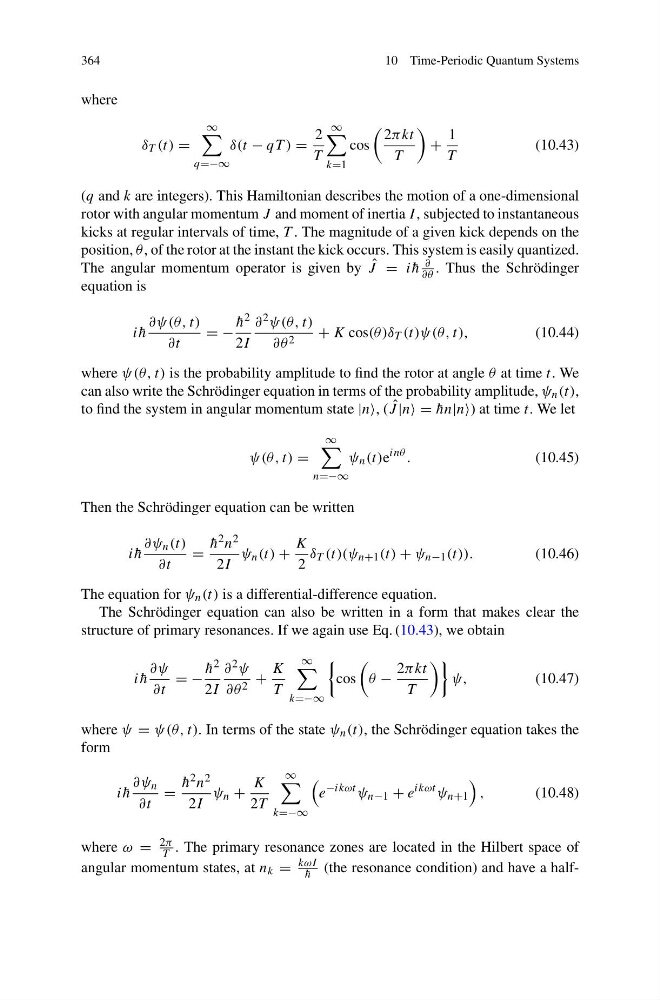
(q and k are integers). This Hamiltonian describes the motion of a one-dimensional
rotor with angular momentum J and moment of inertia I , subjected to instantaneous
kicks at regular intervals of time, T . The magnitude of a given kick depends on the
position, θ , of the rotor at the instant the kick occurs. This system is easily quantized.
The angular momentum operator is given by ˆ
J = i ¯
h
∂
∂θ . Thus the Schrödinger
equation is
i ¯
h
∂ψ(θ, t)
∂t
= −
¯
h 2
2I
∂ 2 ψ(θ, t)
∂θ 2
+ K cos(θ )δ T (t)ψ(θ, t),
(10.44)
where ψ(θ, t) is the probability amplitude to find the rotor at angle θ at time t. We
can also write the Schrödinger equation in terms of the probability amplitude, ψ n (t),
to find the system in angular momentum state |n, ( ˆ
J |n = ¯
hn|n) at time t. We let
ψ(θ, t) =
∞
n=−∞
ψ n (t)e
inθ .
(10.45)
Then the Schrödinger equation can be written
i ¯
h
∂ψ n (t)
∂t
=
¯
h 2 n 2
2I
ψ n (t) +
K
2
δ T (t)(ψ n+1 (t) + ψ n−1 (t)).
(10.46)
The equation for ψ n (t) is a differential-difference equation.
The Schrödinger equation can also be written in a form that makes clear the
structure of primary resonances. If we again use Eq. (10.43), we obtain
i ¯
h
∂ψ
∂t
= −
¯
h 2
2I
∂ 2 ψ
∂θ 2 +
K
T
∞
k=−∞
cos
θ −
2πkt
T
ψ,
(10.47)
where ψ = ψ(θ, t). In terms of the state ψ n (t), the Schrödinger equation takes the
form
i ¯
h
∂ψ n
∂t
=
¯
h 2 n 2
2I
ψ n +
K
2T
∞
k=−∞
e
−ikωt ψ n−1 + e
ikωt ψ n+1
,
(10.48)
where ω =
2π
T . The primary resonance zones are located in the Hilbert space of
angular momentum states, at n k =
kωI
¯
h (the resonance condition) and have a half-
10 Time-Periodic Quantum Systems
where
δ T (t) =
∞
q=−∞
δ(t − qT ) =
2
T
∞
k=1
cos
2πkt
T
+
1
T
(10.43)
(q and k are integers). This Hamiltonian describes the motion of a one-dimensional
rotor with angular momentum J and moment of inertia I , subjected to instantaneous
kicks at regular intervals of time, T . The magnitude of a given kick depends on the
position, θ , of the rotor at the instant the kick occurs. This system is easily quantized.
The angular momentum operator is given by ˆ
J = i ¯
h
∂
∂θ . Thus the Schrödinger
equation is
i ¯
h
∂ψ(θ, t)
∂t
= −
¯
h 2
2I
∂ 2 ψ(θ, t)
∂θ 2
+ K cos(θ )δ T (t)ψ(θ, t),
(10.44)
where ψ(θ, t) is the probability amplitude to find the rotor at angle θ at time t. We
can also write the Schrödinger equation in terms of the probability amplitude, ψ n (t),
to find the system in angular momentum state |n, ( ˆ
J |n = ¯
hn|n) at time t. We let
ψ(θ, t) =
∞
n=−∞
ψ n (t)e
inθ .
(10.45)
Then the Schrödinger equation can be written
i ¯
h
∂ψ n (t)
∂t
=
¯
h 2 n 2
2I
ψ n (t) +
K
2
δ T (t)(ψ n+1 (t) + ψ n−1 (t)).
(10.46)
The equation for ψ n (t) is a differential-difference equation.
The Schrödinger equation can also be written in a form that makes clear the
structure of primary resonances. If we again use Eq. (10.43), we obtain
i ¯
h
∂ψ
∂t
= −
¯
h 2
2I
∂ 2 ψ
∂θ 2 +
K
T
∞
k=−∞
cos
θ −
2πkt
T
ψ,
(10.47)
where ψ = ψ(θ, t). In terms of the state ψ n (t), the Schrödinger equation takes the
form
i ¯
h
∂ψ n
∂t
=
¯
h 2 n 2
2I
ψ n +
K
2T
∞
k=−∞
e
−ikωt ψ n−1 + e
ikωt ψ n+1
,
(10.48)
where ω =
2π
T . The primary resonance zones are located in the Hilbert space of
angular momentum states, at n k =
kωI
¯
h (the resonance condition) and have a half-