

10.4 Dynamics of a Driven Bounded Particle
357
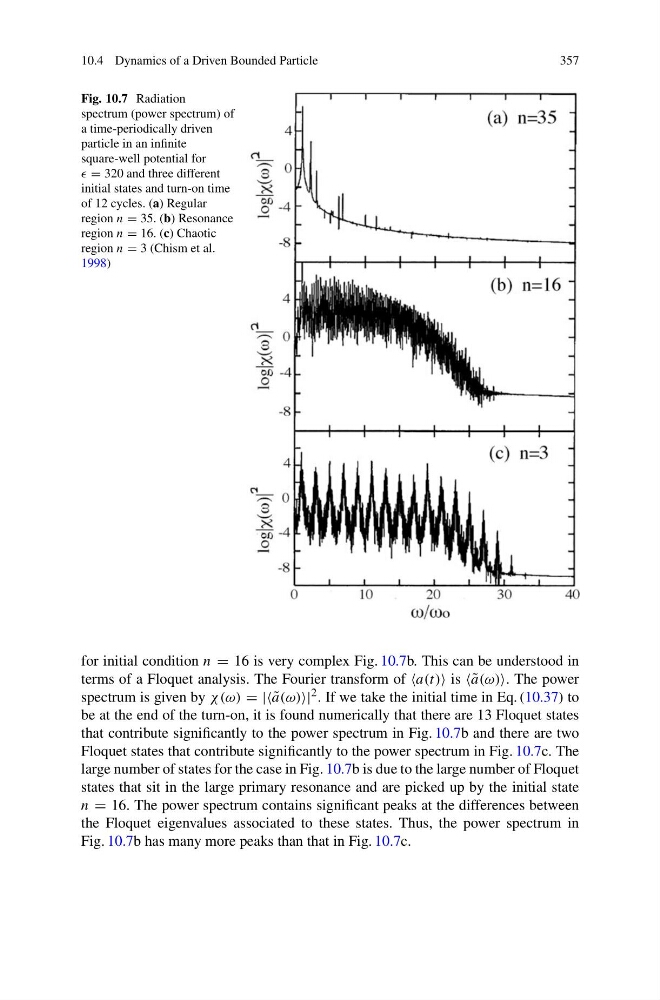
Fig. 10.7 Radiation
spectrum (power spectrum) of
a time-periodically driven
particle in an infinite
square-well potential for
= 320 and three different
initial states and turn-on time
of 12 cycles. (a) Regular
region n = 35. (b) Resonance
region n = 16. (c) Chaotic
region n = 3 (Chism et al.
1998)
for initial condition n = 16 is very complex Fig. 10.7b. This can be understood in
terms of a Floquet analysis. The Fourier transform of a(t) is ˜
a(ω). The power
spectrum is given by χ(ω) = ||˜ a(ω) 2 . If we take the initial time in Eq. (10.37) to
be at the end of the turn-on, it is found numerically that there are 13 Floquet states
that contribute significantly to the power spectrum in Fig. 10.7b and there are two
Floquet states that contribute significantly to the power spectrum in Fig. 10.7c. The
large number of states for the case in Fig. 10.7b is due to the large number of Floquet
states that sit in the large primary resonance and are picked up by the initial state
n = 16. The power spectrum contains significant peaks at the differences between
the Floquet eigenvalues associated to these states. Thus, the power spectrum in
Fig. 10.7b has many more peaks than that in Fig. 10.7c.
357
Fig. 10.7 Radiation
spectrum (power spectrum) of
a time-periodically driven
particle in an infinite
square-well potential for
= 320 and three different
initial states and turn-on time
of 12 cycles. (a) Regular
region n = 35. (b) Resonance
region n = 16. (c) Chaotic
region n = 3 (Chism et al.
1998)
for initial condition n = 16 is very complex Fig. 10.7b. This can be understood in
terms of a Floquet analysis. The Fourier transform of a(t) is ˜
a(ω). The power
spectrum is given by χ(ω) = ||˜ a(ω) 2 . If we take the initial time in Eq. (10.37) to
be at the end of the turn-on, it is found numerically that there are 13 Floquet states
that contribute significantly to the power spectrum in Fig. 10.7b and there are two
Floquet states that contribute significantly to the power spectrum in Fig. 10.7c. The
large number of states for the case in Fig. 10.7b is due to the large number of Floquet
states that sit in the large primary resonance and are picked up by the initial state
n = 16. The power spectrum contains significant peaks at the differences between
the Floquet eigenvalues associated to these states. Thus, the power spectrum in
Fig. 10.7b has many more peaks than that in Fig. 10.7c.