

348
10 Time-Periodic Quantum Systems
, θ
=
σ 2
π
1/4
e
−σ 2 (n−n ) 2 /2 e
−i(n−n )θ ,
(10.27)
where σ −1 is the standard deviation along the angular momentum axis. If we
assume the system has periodic boundary conditions with periodicity 2π in the angle
picture, then we must use a periodic Gaussian wave packet (Chang and Shi 1986),
|φ n ,θ =
1
σ 2 π
1/4 ∞
l=−∞
e
−(θ+2πl−θ ) 2 /2σ 2 e
−i(θ+2πl−θ )n ,
(10.28)
where σ is the standard deviation of the Gaussian wave packet along the angle axis.
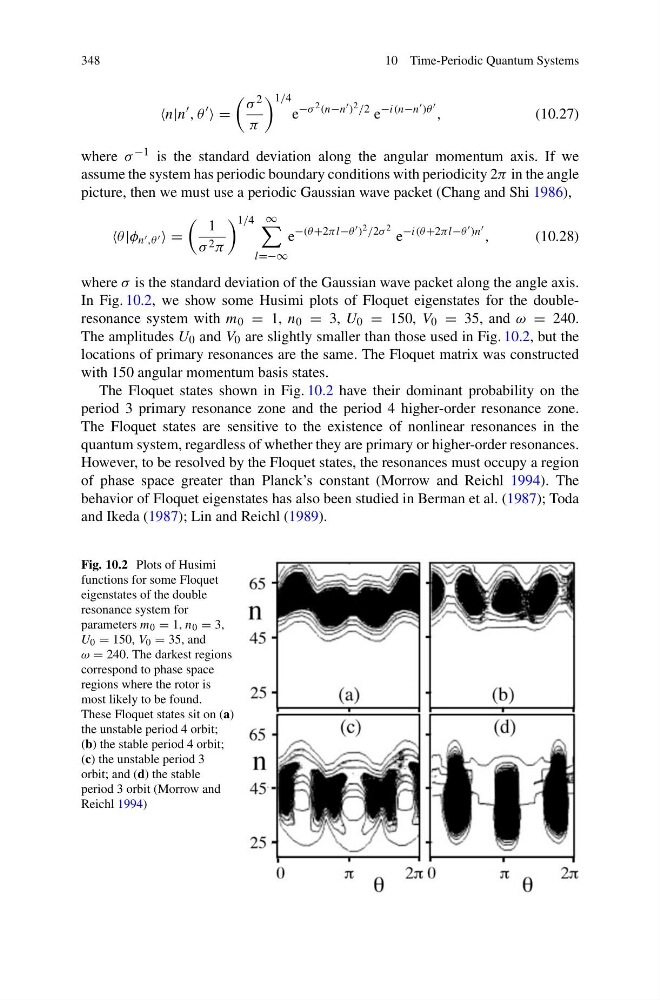
In Fig. 10.2, we show some Husimi plots of Floquet eigenstates for the doubleresonance system with m 0 = 1, n 0 = 3, U 0 = 150, V 0 = 35, and ω = 240.
The amplitudes U 0 and V 0 are slightly smaller than those used in Fig. 10.2, but the
locations of primary resonances are the same. The Floquet matrix was constructed
with 150 angular momentum basis states.
The Floquet states shown in Fig. 10.2 have their dominant probability on the
period 3 primary resonance zone and the period 4 higher-order resonance zone.
The Floquet states are sensitive to the existence of nonlinear resonances in the
quantum system, regardless of whether they are primary or higher-order resonances.
However, to be resolved by the Floquet states, the resonances must occupy a region
of phase space greater than Planck’s constant (Morrow and Reichl 1994). The
behavior of Floquet eigenstates has also been studied in Berman et al. (1987); Toda
and Ikeda (1987); Lin and Reichl (1989).
Fig. 10.2 Plots of Husimi
functions for some Floquet
eigenstates of the double
resonance system for
parameters m 0 = 1, n 0 = 3,
U 0 = 150, V 0 = 35, and
ω = 240. The darkest regions
correspond to phase space
regions where the rotor is
most likely to be found.
These Floquet states sit on (a)
the unstable period 4 orbit;
(b) the stable period 4 orbit;
(c) the unstable period 3
orbit; and (d) the stable
period 3 orbit (Morrow and
Reichl 1994)
10 Time-Periodic Quantum Systems
, θ
=
σ 2
π
1/4
e
−σ 2 (n−n ) 2 /2 e
−i(n−n )θ ,
(10.27)
where σ −1 is the standard deviation along the angular momentum axis. If we
assume the system has periodic boundary conditions with periodicity 2π in the angle
picture, then we must use a periodic Gaussian wave packet (Chang and Shi 1986),
|φ n ,θ =
1
σ 2 π
1/4 ∞
l=−∞
e
−(θ+2πl−θ ) 2 /2σ 2 e
−i(θ+2πl−θ )n ,
(10.28)
where σ is the standard deviation of the Gaussian wave packet along the angle axis.
In Fig. 10.2, we show some Husimi plots of Floquet eigenstates for the doubleresonance system with m 0 = 1, n 0 = 3, U 0 = 150, V 0 = 35, and ω = 240.
The amplitudes U 0 and V 0 are slightly smaller than those used in Fig. 10.2, but the
locations of primary resonances are the same. The Floquet matrix was constructed
with 150 angular momentum basis states.
The Floquet states shown in Fig. 10.2 have their dominant probability on the
period 3 primary resonance zone and the period 4 higher-order resonance zone.
The Floquet states are sensitive to the existence of nonlinear resonances in the
quantum system, regardless of whether they are primary or higher-order resonances.
However, to be resolved by the Floquet states, the resonances must occupy a region
of phase space greater than Planck’s constant (Morrow and Reichl 1994). The
behavior of Floquet eigenstates has also been studied in Berman et al. (1987); Toda
and Ikeda (1987); Lin and Reichl (1989).
Fig. 10.2 Plots of Husimi
functions for some Floquet
eigenstates of the double
resonance system for
parameters m 0 = 1, n 0 = 3,
U 0 = 150, V 0 = 35, and
ω = 240. The darkest regions
correspond to phase space
regions where the rotor is
most likely to be found.
These Floquet states sit on (a)
the unstable period 4 orbit;
(b) the stable period 4 orbit;
(c) the unstable period 3
orbit; and (d) the stable
period 3 orbit (Morrow and
Reichl 1994)