

336
9 Semiclassical Theory: Path Integrals
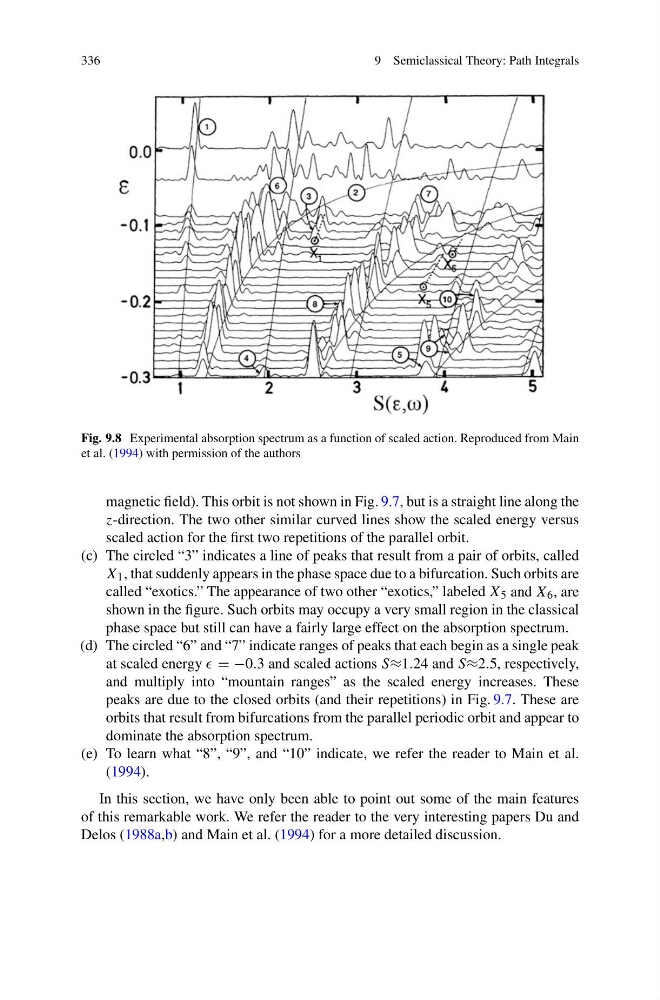
Fig. 9.8 Experimental absorption spectrum as a function of scaled action. Reproduced from Main
et al. (1994) with permission of the authors
magnetic field). This orbit is not shown in Fig. 9.7, but is a straight line along the
z-direction. The two other similar curved lines show the scaled energy versus
scaled action for the first two repetitions of the parallel orbit.
(c) The circled “3” indicates a line of peaks that result from a pair of orbits, called
X 1 , that suddenly appears in the phase space due to a bifurcation. Such orbits are
called “exotics.” The appearance of two other “exotics,” labeled X 5 and X 6 , are
shown in the figure. Such orbits may occupy a very small region in the classical
phase space but still can have a fairly large effect on the absorption spectrum.
(d) The circled “6” and “7” indicate ranges of peaks that each begin as a single peak
at scaled energy = −0.3 and scaled actions S≈1.24 and S≈2.5, respectively,
and multiply into “mountain ranges” as the scaled energy increases. These
peaks are due to the closed orbits (and their repetitions) in Fig. 9.7. These are
orbits that result from bifurcations from the parallel periodic orbit and appear to
dominate the absorption spectrum.
(e) To learn what “8”, “9”, and “10” indicate, we refer the reader to Main et al.
(1994).
In this section, we have only been able to point out some of the main features
of this remarkable work. We refer the reader to the very interesting papers Du and
Delos (1988a,b) and Main et al. (1994) for a more detailed discussion.
9 Semiclassical Theory: Path Integrals
Fig. 9.8 Experimental absorption spectrum as a function of scaled action. Reproduced from Main
et al. (1994) with permission of the authors
magnetic field). This orbit is not shown in Fig. 9.7, but is a straight line along the
z-direction. The two other similar curved lines show the scaled energy versus
scaled action for the first two repetitions of the parallel orbit.
(c) The circled “3” indicates a line of peaks that result from a pair of orbits, called
X 1 , that suddenly appears in the phase space due to a bifurcation. Such orbits are
called “exotics.” The appearance of two other “exotics,” labeled X 5 and X 6 , are
shown in the figure. Such orbits may occupy a very small region in the classical
phase space but still can have a fairly large effect on the absorption spectrum.
(d) The circled “6” and “7” indicate ranges of peaks that each begin as a single peak
at scaled energy = −0.3 and scaled actions S≈1.24 and S≈2.5, respectively,
and multiply into “mountain ranges” as the scaled energy increases. These
peaks are due to the closed orbits (and their repetitions) in Fig. 9.7. These are
orbits that result from bifurcations from the parallel periodic orbit and appear to
dominate the absorption spectrum.
(e) To learn what “8”, “9”, and “10” indicate, we refer the reader to Main et al.
(1994).
In this section, we have only been able to point out some of the main features
of this remarkable work. We refer the reader to the very interesting papers Du and
Delos (1988a,b) and Main et al. (1994) for a more detailed discussion.