

9.8 Diamagnetic Hydrogen
331
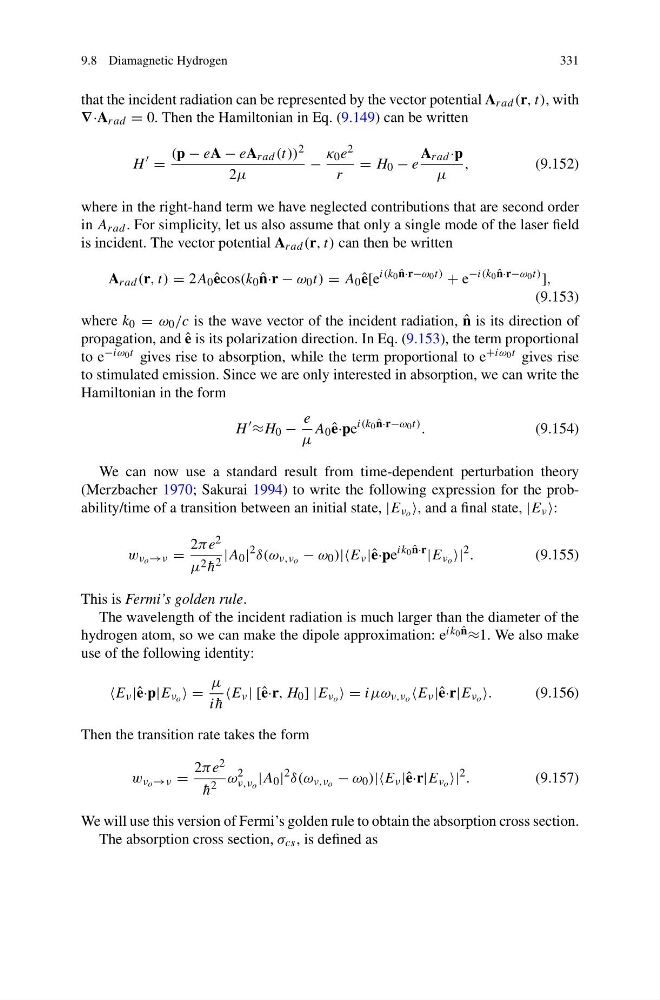
that the incident radiation can be represented by the vector potential A rad (r, t), with
∇·A rad = 0. Then the Hamiltonian in Eq. (9.149) can be written
H
=
(p − eA − eA rad (t)) 2
2μ
−
κ 0 e 2
r
= H 0 − e
A rad ·p
μ
,
(9.152)
where in the right-hand term we have neglected contributions that are second order
in A rad . For simplicity, let us also assume that only a single mode of the laser field
is incident. The vector potential A rad (r, t) can then be written
A rad (r, t) = 2A 0 ˆ
ecos(k 0 ˆ
n·r − ω 0 t) = A 0 ˆ
e[e
i(k 0 ˆ
n·r−ω 0 t)
+ e
−i(k 0 ˆ
n·r−ω 0 t)
],
(9.153)
where k 0 = ω 0 /c is the wave vector of the incident radiation, ˆ
n is its direction of
propagation, and ˆ
e is its polarization direction. In Eq. (9.153), the term proportional
to e −iω 0 t gives rise to absorption, while the term proportional to e +iω 0 t gives rise
to stimulated emission. Since we are only interested in absorption, we can write the
Hamiltonian in the form
H
≈H 0 −
e
μ
A 0 ˆ
e·pe
i(k 0 ˆ
n·r−ω 0 t) .
(9.154)
We can now use a standard result from time-dependent perturbation theory
(Merzbacher 1970; Sakurai 1994) to write the following expression for the probability/time of a transition between an initial state, |E ν o , and a final state, |E ν :
w ν o →ν =
2πe 2
μ 2 ¯
h 2 |A 0 |
2 δ(ω ν,ν o − ω 0 )||E ν |ˆ e·pe
ik 0 ˆ
n·r
|E ν o |
2 .
(9.155)
This is Fermi’s golden rule.
The wavelength of the incident radiation is much larger than the diameter of the
hydrogen atom, so we can make the dipole approximation: e ik 0 ˆ
n ≈1. We also make
use of the following identity:
E ν |ˆ e·p|E ν o =
μ
i ¯
h
E ν | [ˆ e·r, H 0 ] |E ν o = iμω ν,ν o E ν |ˆ e·r|E ν o .
(9.156)
Then the transition rate takes the form
w ν o →ν =
2πe 2
¯
h 2 ω
2
ν,ν o
|A 0 |
2 δ(ω ν,ν o − ω 0 )||E ν |ˆ e·r|E ν o |
2 .
(9.157)
We will use this version of Fermi’s golden rule to obtain the absorption cross section.
The absorption cross section, σ cs , is defined as
331
that the incident radiation can be represented by the vector potential A rad (r, t), with
∇·A rad = 0. Then the Hamiltonian in Eq. (9.149) can be written
H
=
(p − eA − eA rad (t)) 2
2μ
−
κ 0 e 2
r
= H 0 − e
A rad ·p
μ
,
(9.152)
where in the right-hand term we have neglected contributions that are second order
in A rad . For simplicity, let us also assume that only a single mode of the laser field
is incident. The vector potential A rad (r, t) can then be written
A rad (r, t) = 2A 0 ˆ
ecos(k 0 ˆ
n·r − ω 0 t) = A 0 ˆ
e[e
i(k 0 ˆ
n·r−ω 0 t)
+ e
−i(k 0 ˆ
n·r−ω 0 t)
],
(9.153)
where k 0 = ω 0 /c is the wave vector of the incident radiation, ˆ
n is its direction of
propagation, and ˆ
e is its polarization direction. In Eq. (9.153), the term proportional
to e −iω 0 t gives rise to absorption, while the term proportional to e +iω 0 t gives rise
to stimulated emission. Since we are only interested in absorption, we can write the
Hamiltonian in the form
H
≈H 0 −
e
μ
A 0 ˆ
e·pe
i(k 0 ˆ
n·r−ω 0 t) .
(9.154)
We can now use a standard result from time-dependent perturbation theory
(Merzbacher 1970; Sakurai 1994) to write the following expression for the probability/time of a transition between an initial state, |E ν o , and a final state, |E ν :
w ν o →ν =
2πe 2
μ 2 ¯
h 2 |A 0 |
2 δ(ω ν,ν o − ω 0 )||E ν |ˆ e·pe
ik 0 ˆ
n·r
|E ν o |
2 .
(9.155)
This is Fermi’s golden rule.
The wavelength of the incident radiation is much larger than the diameter of the
hydrogen atom, so we can make the dipole approximation: e ik 0 ˆ
n ≈1. We also make
use of the following identity:
E ν |ˆ e·p|E ν o =
μ
i ¯
h
E ν | [ˆ e·r, H 0 ] |E ν o = iμω ν,ν o E ν |ˆ e·r|E ν o .
(9.156)
Then the transition rate takes the form
w ν o →ν =
2πe 2
¯
h 2 ω
2
ν,ν o
|A 0 |
2 δ(ω ν,ν o − ω 0 )||E ν |ˆ e·r|E ν o |
2 .
(9.157)
We will use this version of Fermi’s golden rule to obtain the absorption cross section.
The absorption cross section, σ cs , is defined as