

8.6 COE and GOE
279
P
C
N ( ¯
U N )dd U N =
2 N(N+1)/2
U N
dd X N
Det[ ¯
1 N + ¯
X 2
N ] (N +1)/2
≡
P
N ( ¯
X N )dd X N = 1
(8.132)
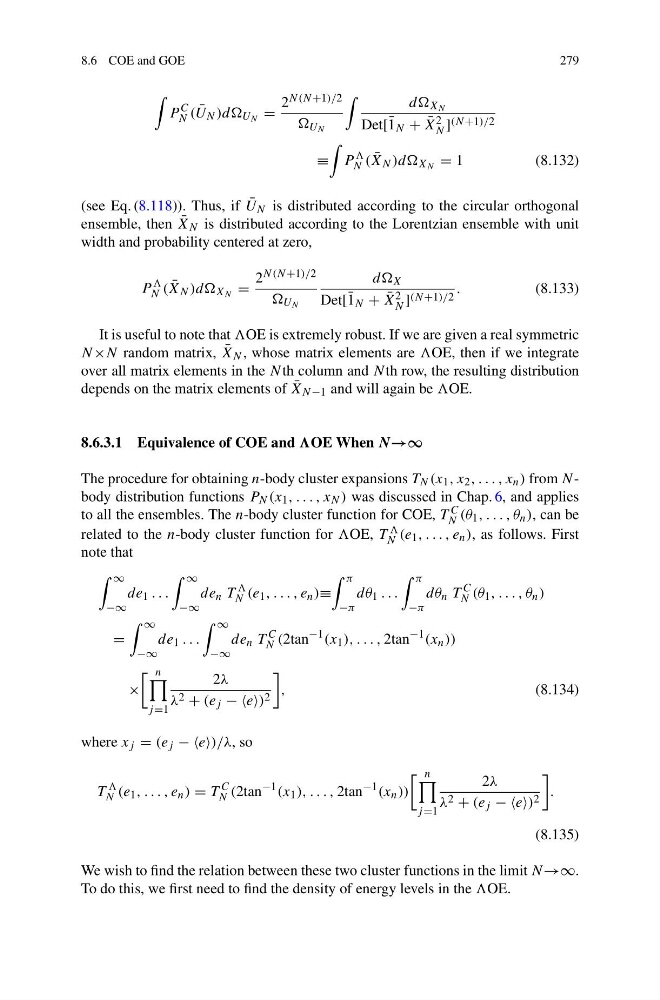
(see Eq. (8.118)). Thus, if ¯
U N is distributed according to the circular orthogonal
ensemble, then ¯
X N is distributed according to the Lorentzian ensemble with unit
width and probability centered at zero,
P
N ( ¯
X N )dd X N =
2 N(N+1)/2
U N
dd X
Det[ ¯
1 N + ¯
X 2
N ] (N +1)/2
.
(8.133)
It is useful to note that OE is extremely robust. If we are given a real symmetric
N ×N random matrix, ¯
X N , whose matrix elements are OE, then if we integrate
over all matrix elements in the Nth column and Nth row, the resulting distribution
depends on the matrix elements of ¯
X N −1 and will again be OE.
8.6.3.1 Equivalence of COE and OE When N→∞
The procedure for obtaining n-body cluster expansions T N (x 1 , x 2 , . . . , x n ) from Nbody distribution functions P N (x 1 , . . . , x N ) was discussed in Chap. 6, and applies
to all the ensembles. The n-body cluster function for COE, T C
N (θ 1 , . . . , θ n ), can be
related to the n-body cluster function for OE, T
N (e 1 , . . . , e n ), as follows. First
note that
∞
−∞
de 1 . . .
∞
−∞
de n T
N (e 1 , . . . , e n )≡
π
−π
dθ 1 . . .
π
−π
dθ n T
C
N (θ 1 , . . . , θ n )
=
∞
−∞
de 1 . . .
∞
−∞
de n T
C
N (2tan
−1 (x 1 ), . . . , 2tan
−1 (x n ))
×
n
j =1
2λ
λ 2 + (e j − −e) 2
,
(8.134)
where x j = (e j − −e)/λ, so
T
N (e 1 , . . . , e n ) = T
C
N (2tan
−1 (x 1 ), . . . , 2tan
−1 (x n ))
n
j =1
2λ
λ 2 + (e j − −e) 2
.
(8.135)
We wish to find the relation between these two cluster functions in the limit N→∞.
To do this, we first need to find the density of energy levels in the OE.
279
P
C
N ( ¯
U N )dd U N =
2 N(N+1)/2
U N
dd X N
Det[ ¯
1 N + ¯
X 2
N ] (N +1)/2
≡
P
N ( ¯
X N )dd X N = 1
(8.132)
(see Eq. (8.118)). Thus, if ¯
U N is distributed according to the circular orthogonal
ensemble, then ¯
X N is distributed according to the Lorentzian ensemble with unit
width and probability centered at zero,
P
N ( ¯
X N )dd X N =
2 N(N+1)/2
U N
dd X
Det[ ¯
1 N + ¯
X 2
N ] (N +1)/2
.
(8.133)
It is useful to note that OE is extremely robust. If we are given a real symmetric
N ×N random matrix, ¯
X N , whose matrix elements are OE, then if we integrate
over all matrix elements in the Nth column and Nth row, the resulting distribution
depends on the matrix elements of ¯
X N −1 and will again be OE.
8.6.3.1 Equivalence of COE and OE When N→∞
The procedure for obtaining n-body cluster expansions T N (x 1 , x 2 , . . . , x n ) from Nbody distribution functions P N (x 1 , . . . , x N ) was discussed in Chap. 6, and applies
to all the ensembles. The n-body cluster function for COE, T C
N (θ 1 , . . . , θ n ), can be
related to the n-body cluster function for OE, T
N (e 1 , . . . , e n ), as follows. First
note that
∞
−∞
de 1 . . .
∞
−∞
de n T
N (e 1 , . . . , e n )≡
π
−π
dθ 1 . . .
π
−π
dθ n T
C
N (θ 1 , . . . , θ n )
=
∞
−∞
de 1 . . .
∞
−∞
de n T
C
N (2tan
−1 (x 1 ), . . . , 2tan
−1 (x n ))
×
n
j =1
2λ
λ 2 + (e j − −e) 2
,
(8.134)
where x j = (e j − −e)/λ, so
T
N (e 1 , . . . , e n ) = T
C
N (2tan
−1 (x 1 ), . . . , 2tan
−1 (x n ))
n
j =1
2λ
λ 2 + (e j − −e) 2
.
(8.135)
We wish to find the relation between these two cluster functions in the limit N→∞.
To do this, we first need to find the density of energy levels in the OE.