

8.4 Wigner–Smith and Partial Delay Times
261
since Det[ ¯
A· ¯
B −1 ] = Det[ ¯
A]Det[ ¯
B −1 ] = Det[ ¯
A]/Det[ ¯
B] and Det[ ¯
U ] = 1. In
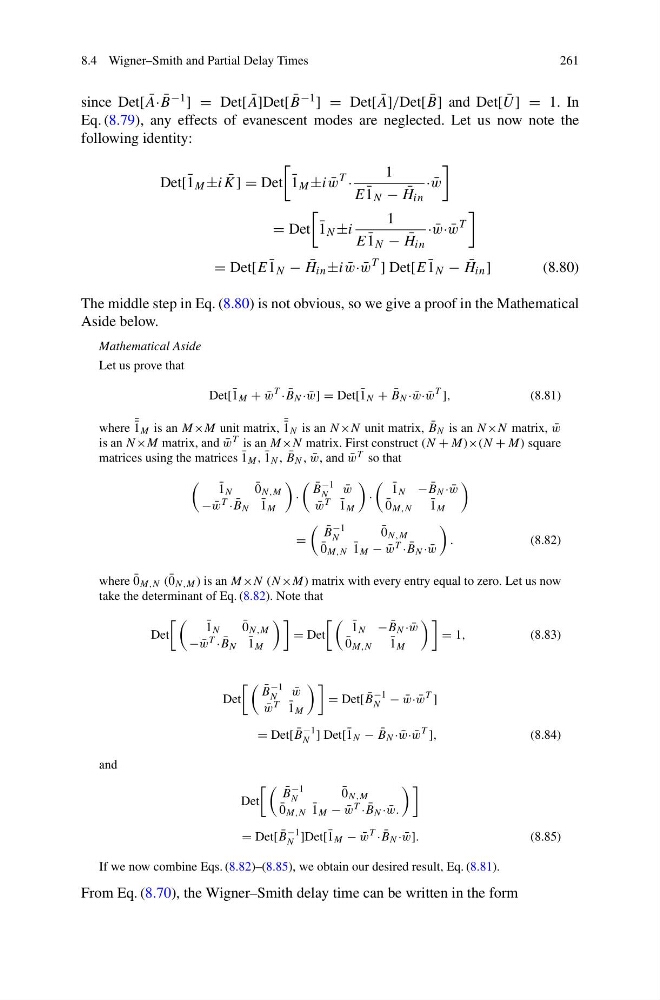
Eq. (8.79), any effects of evanescent modes are neglected. Let us now note the
following identity:
Det[ ¯
1 M ±i ¯
K] = Det
¯
1 M ±i ¯
w
T
·
1
E ¯
1 N − ¯
H in
· ¯
w
= Det
¯
1 N ±i
1
E ¯
1 N − ¯
H in
· ¯
w· ¯
w
T
= Det[E ¯
1 N − ¯
H in ±i ¯
w· ¯
w
T
] Det[E ¯
1 N − ¯
H in ]
(8.80)
The middle step in Eq. (8.80) is not obvious, so we give a proof in the Mathematical
Aside below.
Mathematical Aside
Let us prove that
Det[ ¯
1 M + ¯
w
T · ¯
B N · ¯
w] = Det[ ¯
1 N + ¯
B N · ¯
w· ¯
w
T ],
(8.81)
where ¯ ¯
1 M is an M×M unit matrix, ¯ ¯
1 N is an N ×N unit matrix, ¯
B N is an N ×N matrix, ¯
w
is an N ×M matrix, and ¯
w T is an M×N matrix. First construct (N + M)×(N + M) square
matrices using the matrices ¯
1 M , ¯
1 N , ¯
B N , ¯
w, and ¯
w T so that
¯
1 N
¯
0 N,M
− ¯
w T · ¯
B N ¯
1 M
·
¯
B
−1
N
¯
w
¯
w T ¯
1 M
·
¯
1 N − ¯
B N · ¯
w
¯
0 M,N
¯
1 M
=
¯
B
−1
N
¯
0 N,M
¯
0 M,N ¯
1 M − ¯
w T · ¯
B N · ¯
w
.
(8.82)
where ¯
0 M,N ( ¯
0 N,M ) is an M×N (N ×M) matrix with every entry equal to zero. Let us now
take the determinant of Eq. (8.82). Note that
Det
¯
1 N
¯
0 N,M
− ¯
w T · ¯
B N ¯
1 M
= Det
¯
1 N − ¯
B N · ¯
w
¯
0 M,N
¯
1 M
= 1,
(8.83)
Det
¯
B
−1
N
¯
w
¯
w T ¯
1 M
= Det[ ¯
B
−1
N − ¯
w· ¯
w
T ]
= Det[ ¯
B
−1
N ] Det[ ¯
1 N − ¯
B N · ¯
w· ¯
w
T ],
(8.84)
and
Det
¯
B
−1
N
¯
0 N,M
¯
0 M,N ¯
1 M − ¯
w T · ¯
B N · ¯
w.
= Det[ ¯
B
−1
N ]Det[ ¯
1 M − ¯
w
T · ¯
B N · ¯
w].
(8.85)
If we now combine Eqs. (8.82)–(8.85), we obtain our desired result, Eq. (8.81).
From Eq. (8.70), the Wigner–Smith delay time can be written in the form
261
since Det[ ¯
A· ¯
B −1 ] = Det[ ¯
A]Det[ ¯
B −1 ] = Det[ ¯
A]/Det[ ¯
B] and Det[ ¯
U ] = 1. In
Eq. (8.79), any effects of evanescent modes are neglected. Let us now note the
following identity:
Det[ ¯
1 M ±i ¯
K] = Det
¯
1 M ±i ¯
w
T
·
1
E ¯
1 N − ¯
H in
· ¯
w
= Det
¯
1 N ±i
1
E ¯
1 N − ¯
H in
· ¯
w· ¯
w
T
= Det[E ¯
1 N − ¯
H in ±i ¯
w· ¯
w
T
] Det[E ¯
1 N − ¯
H in ]
(8.80)
The middle step in Eq. (8.80) is not obvious, so we give a proof in the Mathematical
Aside below.
Mathematical Aside
Let us prove that
Det[ ¯
1 M + ¯
w
T · ¯
B N · ¯
w] = Det[ ¯
1 N + ¯
B N · ¯
w· ¯
w
T ],
(8.81)
where ¯ ¯
1 M is an M×M unit matrix, ¯ ¯
1 N is an N ×N unit matrix, ¯
B N is an N ×N matrix, ¯
w
is an N ×M matrix, and ¯
w T is an M×N matrix. First construct (N + M)×(N + M) square
matrices using the matrices ¯
1 M , ¯
1 N , ¯
B N , ¯
w, and ¯
w T so that
¯
1 N
¯
0 N,M
− ¯
w T · ¯
B N ¯
1 M
·
¯
B
−1
N
¯
w
¯
w T ¯
1 M
·
¯
1 N − ¯
B N · ¯
w
¯
0 M,N
¯
1 M
=
¯
B
−1
N
¯
0 N,M
¯
0 M,N ¯
1 M − ¯
w T · ¯
B N · ¯
w
.
(8.82)
where ¯
0 M,N ( ¯
0 N,M ) is an M×N (N ×M) matrix with every entry equal to zero. Let us now
take the determinant of Eq. (8.82). Note that
Det
¯
1 N
¯
0 N,M
− ¯
w T · ¯
B N ¯
1 M
= Det
¯
1 N − ¯
B N · ¯
w
¯
0 M,N
¯
1 M
= 1,
(8.83)
Det
¯
B
−1
N
¯
w
¯
w T ¯
1 M
= Det[ ¯
B
−1
N − ¯
w· ¯
w
T ]
= Det[ ¯
B
−1
N ] Det[ ¯
1 N − ¯
B N · ¯
w· ¯
w
T ],
(8.84)
and
Det
¯
B
−1
N
¯
0 N,M
¯
0 M,N ¯
1 M − ¯
w T · ¯
B N · ¯
w.
= Det[ ¯
B
−1
N ]Det[ ¯
1 M − ¯
w
T · ¯
B N · ¯
w].
(8.85)
If we now combine Eqs. (8.82)–(8.85), we obtain our desired result, Eq. (8.81).
From Eq. (8.70), the Wigner–Smith delay time can be written in the form