

254
8 Manifestations of Chaos in Quantum Scattering Processes
¯
K = ¯
w
T
·
1
E ¯
1 N − ¯
H in
· ¯
w,
(8.50)
where ¯
1 N is the N×N unit matrix, ¯
H in is the N×N matrix of cavity eigenvalues,
¯
H in =
⎛
⎜
⎜
⎜
⎝
λ 1 0 . . . 0
0 λ 2 . . . 0
. . .
. . .
. . .
. . .
0 0 . . . λ N
⎞
⎟
⎟
⎟
⎠
,
(8.51)
and ¯
w is the N ×M coupling matrix,
( ¯
w) j,n =
w j,n (x l ) = φ j,n (x l )
¯
h 2 k n
2m ,
if j = 1, . . . , N, n = 1, . . . , M l ;
w j,n (x r ) = φ j,n (x r )
¯
h 2 k n
2m , if j = 1, . . . , N, n = M l + 1, . . . , M.
(8.52)
The M×N matrix, ¯
w T , is the transpose of ¯
w.
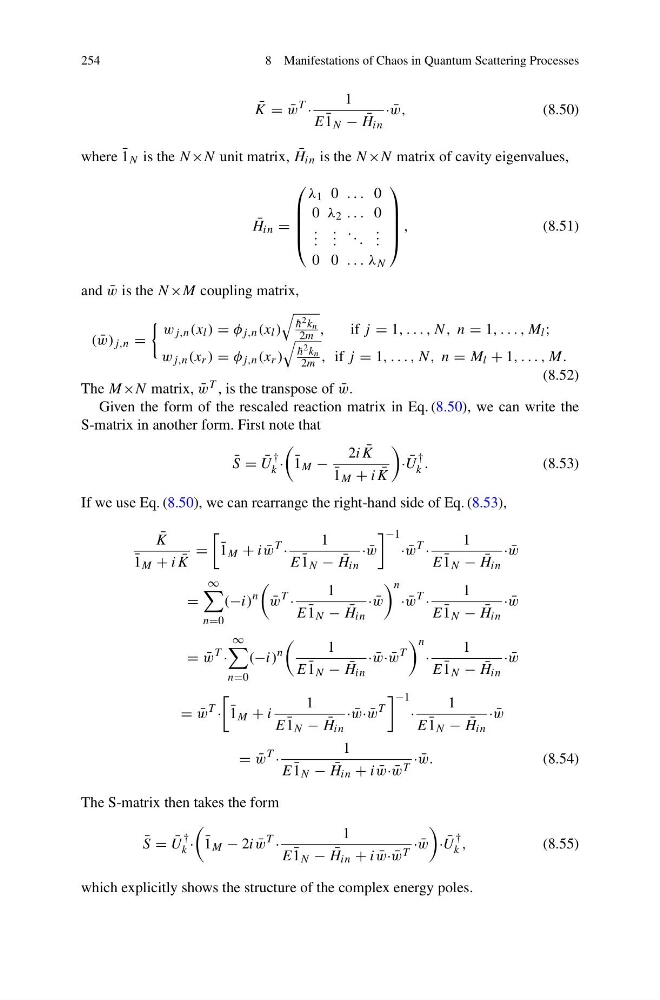
Given the form of the rescaled reaction matrix in Eq. (8.50), we can write the
S-matrix in another form. First note that
¯
S = ¯
U
†
k ·
¯
1 M −
2i ¯
K
¯
1 M + i ¯
K
· ¯
U
†
k .
(8.53)
If we use Eq. (8.50), we can rearrange the right-hand side of Eq. (8.53),
¯
K
¯
1 M + i ¯
K
=
¯
1 M + i ¯
w
T
·
1
E ¯
1 N − ¯
H in
· ¯
w
−1
· ¯
w
T
·
1
E ¯
1 N − ¯
H in
· ¯
w
=
∞
n=0
(−i)
n
¯
w
T
·
1
E ¯
1 N − ¯
H in
· ¯
w
n
· ¯
w
T
·
1
E ¯
1 N − ¯
H in
· ¯
w
= ¯
w
T
·
∞
n=0
(−i)
n
1
E ¯
1 N − ¯
H in
· ¯
w· ¯
w
T
n
·
1
E ¯
1 N − ¯
H in
· ¯
w
= ¯
w
T
·
¯
1 M + i
1
E ¯
1 N − ¯
H in
· ¯
w· ¯
w
T
−1
·
1
E ¯
1 N − ¯
H in
· ¯
w
= ¯
w
T
·
1
E ¯
1 N − ¯
H in + i ¯
w· ¯
w T
· ¯
w.
(8.54)
The S-matrix then takes the form
¯
S = ¯
U
†
k ·
¯
1 M − 2i ¯
w
T
·
1
E ¯
1 N − ¯
H in + i ¯
w· ¯
w T
· ¯
w
· ¯
U
†
k ,
(8.55)
which explicitly shows the structure of the complex energy poles.
8 Manifestations of Chaos in Quantum Scattering Processes
¯
K = ¯
w
T
·
1
E ¯
1 N − ¯
H in
· ¯
w,
(8.50)
where ¯
1 N is the N×N unit matrix, ¯
H in is the N×N matrix of cavity eigenvalues,
¯
H in =
⎛
⎜
⎜
⎜
⎝
λ 1 0 . . . 0
0 λ 2 . . . 0
. . .
. . .
. . .
. . .
0 0 . . . λ N
⎞
⎟
⎟
⎟
⎠
,
(8.51)
and ¯
w is the N ×M coupling matrix,
( ¯
w) j,n =
w j,n (x l ) = φ j,n (x l )
¯
h 2 k n
2m ,
if j = 1, . . . , N, n = 1, . . . , M l ;
w j,n (x r ) = φ j,n (x r )
¯
h 2 k n
2m , if j = 1, . . . , N, n = M l + 1, . . . , M.
(8.52)
The M×N matrix, ¯
w T , is the transpose of ¯
w.
Given the form of the rescaled reaction matrix in Eq. (8.50), we can write the
S-matrix in another form. First note that
¯
S = ¯
U
†
k ·
¯
1 M −
2i ¯
K
¯
1 M + i ¯
K
· ¯
U
†
k .
(8.53)
If we use Eq. (8.50), we can rearrange the right-hand side of Eq. (8.53),
¯
K
¯
1 M + i ¯
K
=
¯
1 M + i ¯
w
T
·
1
E ¯
1 N − ¯
H in
· ¯
w
−1
· ¯
w
T
·
1
E ¯
1 N − ¯
H in
· ¯
w
=
∞
n=0
(−i)
n
¯
w
T
·
1
E ¯
1 N − ¯
H in
· ¯
w
n
· ¯
w
T
·
1
E ¯
1 N − ¯
H in
· ¯
w
= ¯
w
T
·
∞
n=0
(−i)
n
1
E ¯
1 N − ¯
H in
· ¯
w· ¯
w
T
n
·
1
E ¯
1 N − ¯
H in
· ¯
w
= ¯
w
T
·
¯
1 M + i
1
E ¯
1 N − ¯
H in
· ¯
w· ¯
w
T
−1
·
1
E ¯
1 N − ¯
H in
· ¯
w
= ¯
w
T
·
1
E ¯
1 N − ¯
H in + i ¯
w· ¯
w T
· ¯
w.
(8.54)
The S-matrix then takes the form
¯
S = ¯
U
†
k ·
¯
1 M − 2i ¯
w
T
·
1
E ¯
1 N − ¯
H in + i ¯
w· ¯
w T
· ¯
w
· ¯
U
†
k ,
(8.55)
which explicitly shows the structure of the complex energy poles.