

7.5 Quantum Billiards
209
¯
h 2
2m
∇
2
+ E
ψ(x, y) = 0,
(7.26)
assuming that the wave function, ψ, goes to zero on the boundaries of the billiard.
To obtain a “pure” sequence, they chose states of odd-odd parity by assuming that
ψ = 0 along the lines x = 0 and y = 0 as well as on the boundaries. This
removed the effect of the discrete reflection symmetry on the spectrum. Their results
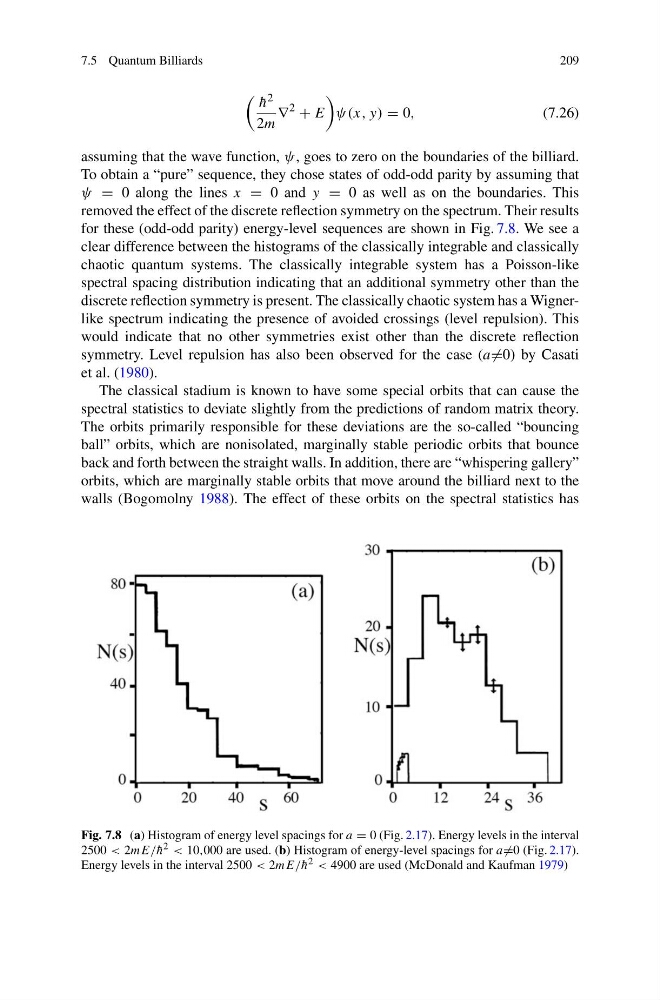
for these (odd-odd parity) energy-level sequences are shown in Fig. 7.8. We see a
clear difference between the histograms of the classically integrable and classically
chaotic quantum systems. The classically integrable system has a Poisson-like
spectral spacing distribution indicating that an additional symmetry other than the
discrete reflection symmetry is present. The classically chaotic system has a Wignerlike spectrum indicating the presence of avoided crossings (level repulsion). This
would indicate that no other symmetries exist other than the discrete reflection
symmetry. Level repulsion has also been observed for the case (a =0) by Casati
et al. (1980).
The classical stadium is known to have some special orbits that can cause the
spectral statistics to deviate slightly from the predictions of random matrix theory.
The orbits primarily responsible for these deviations are the so-called “bouncing
ball” orbits, which are nonisolated, marginally stable periodic orbits that bounce
back and forth between the straight walls. In addition, there are “whispering gallery”
orbits, which are marginally stable orbits that move around the billiard next to the
walls (Bogomolny 1988). The effect of these orbits on the spectral statistics has
Fig. 7.8 (a) Histogram of energy level spacings for a = 0 (Fig. 2.17). Energy levels in the interval
2500 < 2mE/ ¯
h 2 < 10,000 are used. (b) Histogram of energy-level spacings for a =0 (Fig. 2.17).
Energy levels in the interval 2500 < 2mE/ ¯
h 2 < 4900 are used (McDonald and Kaufman 1979)
209
¯
h 2
2m
∇
2
+ E
ψ(x, y) = 0,
(7.26)
assuming that the wave function, ψ, goes to zero on the boundaries of the billiard.
To obtain a “pure” sequence, they chose states of odd-odd parity by assuming that
ψ = 0 along the lines x = 0 and y = 0 as well as on the boundaries. This
removed the effect of the discrete reflection symmetry on the spectrum. Their results
for these (odd-odd parity) energy-level sequences are shown in Fig. 7.8. We see a
clear difference between the histograms of the classically integrable and classically
chaotic quantum systems. The classically integrable system has a Poisson-like
spectral spacing distribution indicating that an additional symmetry other than the
discrete reflection symmetry is present. The classically chaotic system has a Wignerlike spectrum indicating the presence of avoided crossings (level repulsion). This
would indicate that no other symmetries exist other than the discrete reflection
symmetry. Level repulsion has also been observed for the case (a =0) by Casati
et al. (1980).
The classical stadium is known to have some special orbits that can cause the
spectral statistics to deviate slightly from the predictions of random matrix theory.
The orbits primarily responsible for these deviations are the so-called “bouncing
ball” orbits, which are nonisolated, marginally stable periodic orbits that bounce
back and forth between the straight walls. In addition, there are “whispering gallery”
orbits, which are marginally stable orbits that move around the billiard next to the
walls (Bogomolny 1988). The effect of these orbits on the spectral statistics has
Fig. 7.8 (a) Histogram of energy level spacings for a = 0 (Fig. 2.17). Energy levels in the interval
2500 < 2mE/ ¯
h 2 < 10,000 are used. (b) Histogram of energy-level spacings for a =0 (Fig. 2.17).
Energy levels in the interval 2500 < 2mE/ ¯
h 2 < 4900 are used (McDonald and Kaufman 1979)