

7.3 Symmetries and Degeneracy
201
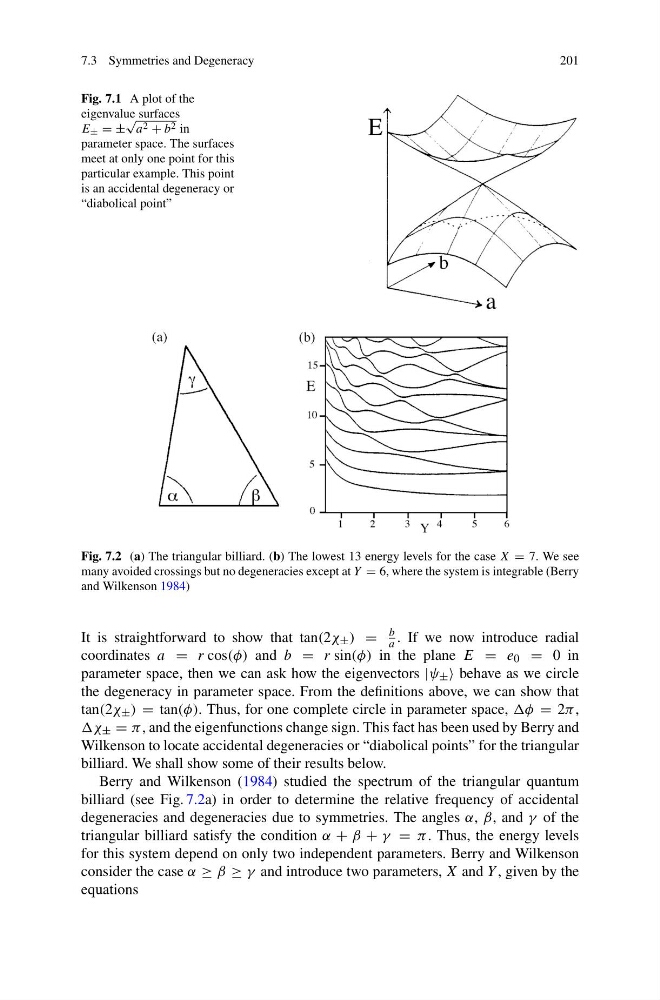
Fig. 7.1 A plot of the
eigenvalue surfaces
E ± = ±
√
a 2 + b 2 in
parameter space. The surfaces
meet at only one point for this
particular example. This point
is an accidental degeneracy or
“diabolical point”
Fig. 7.2 (a) The triangular billiard. (b) The lowest 13 energy levels for the case X = 7. We see
many avoided crossings but no degeneracies except at Y = 6, where the system is integrable (Berry
and Wilkenson 1984)
It is straightforward to show that tan(2χ ± ) =
b
a . If we now introduce radial
coordinates a = r cos(φ) and b = r sin(φ) in the plane E = e 0 = 0 in
parameter space, then we can ask how the eigenvectors |ψ ± behave as we circle
the degeneracy in parameter space. From the definitions above, we can show that
tan(2χ ± ) = tan(φ). Thus, for one complete circle in parameter space, = 2π ,
± = π , and the eigenfunctions change sign. This fact has been used by Berry and
Wilkenson to locate accidental degeneracies or “diabolical points” for the triangular
billiard. We shall show some of their results below.
Berry and Wilkenson (1984) studied the spectrum of the triangular quantum
billiard (see Fig. 7.2a) in order to determine the relative frequency of accidental
degeneracies and degeneracies due to symmetries. The angles α, β, and γ of the
triangular billiard satisfy the condition α + β + γ = π . Thus, the energy levels
for this system depend on only two independent parameters. Berry and Wilkenson
consider the case α ≥ β ≥ γ and introduce two parameters, X and Y , given by the
equations
201
Fig. 7.1 A plot of the
eigenvalue surfaces
E ± = ±
√
a 2 + b 2 in
parameter space. The surfaces
meet at only one point for this
particular example. This point
is an accidental degeneracy or
“diabolical point”
Fig. 7.2 (a) The triangular billiard. (b) The lowest 13 energy levels for the case X = 7. We see
many avoided crossings but no degeneracies except at Y = 6, where the system is integrable (Berry
and Wilkenson 1984)
It is straightforward to show that tan(2χ ± ) =
b
a . If we now introduce radial
coordinates a = r cos(φ) and b = r sin(φ) in the plane E = e 0 = 0 in
parameter space, then we can ask how the eigenvectors |ψ ± behave as we circle
the degeneracy in parameter space. From the definitions above, we can show that
tan(2χ ± ) = tan(φ). Thus, for one complete circle in parameter space, = 2π ,
± = π , and the eigenfunctions change sign. This fact has been used by Berry and
Wilkenson to locate accidental degeneracies or “diabolical points” for the triangular
billiard. We shall show some of their results below.
Berry and Wilkenson (1984) studied the spectrum of the triangular quantum
billiard (see Fig. 7.2a) in order to determine the relative frequency of accidental
degeneracies and degeneracies due to symmetries. The angles α, β, and γ of the
triangular billiard satisfy the condition α + β + γ = π . Thus, the energy levels
for this system depend on only two independent parameters. Berry and Wilkenson
consider the case α ≥ β ≥ γ and introduce two parameters, X and Y , given by the
equations