

7.2 Quantum Integrability
199
sin
¯
h
2
∂
∂q 1H
∂
∂p 1I
+
∂
∂q 2H
∂
∂p 2I
−
∂
∂p 1H
∂
∂q 1I
−
∂
∂p 2H
∂
∂q 2I
× H (p 1 , p 2 , q 1 , q 2 )I (p 1 , p 2 , q 1 , q 2 ) = 0,
(7.3)
where
∂
∂q iH
and
∂
∂p iH
(i = 1, 2) act on the function H , and
∂
∂q iI
and
∂
∂p iI
(i = 1, 2)
act on the function ˆ
I . We shall now consider two of the integrable systems found by
Hietarinta.
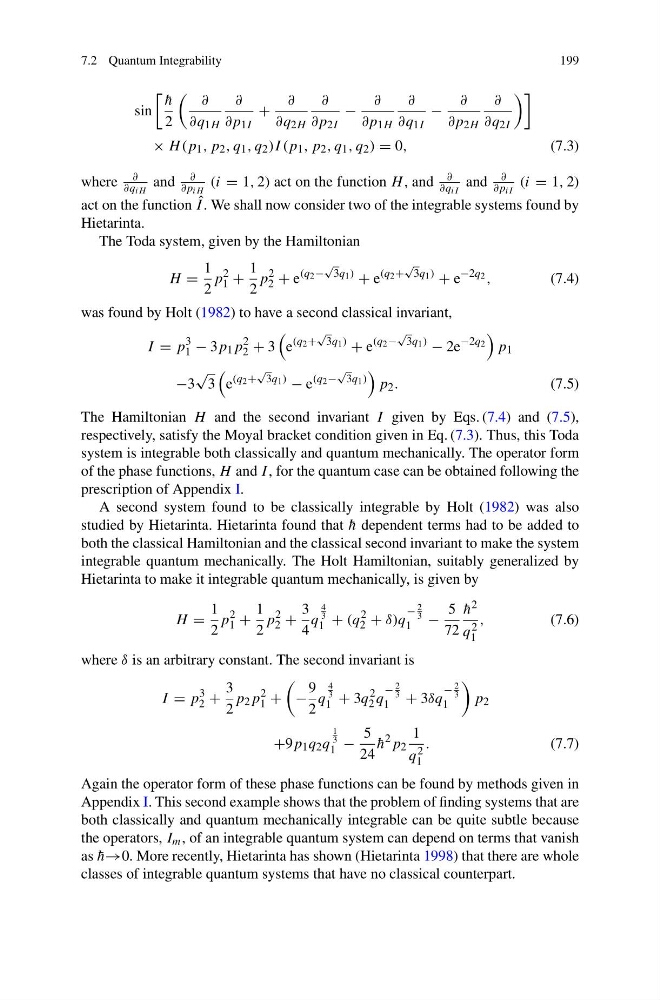
The Toda system, given by the Hamiltonian
H =
1
2
p
2
1 +
1
2
p
2
2 + e
(q 2 −
√
3q 1 )
+ e
(q 2 +
√
3q 1 )
+ e
−2q 2 ,
(7.4)
was found by Holt (1982) to have a second classical invariant,
I = p
3
1 − 3p 1 p
2
2 + 3
e
(q 2 +
√
3q 1 )
+ e
(q 2 −
√
3q 1 )
− 2e
−2q 2
p 1
−3
√
3
e
(q 2 +
√
3q 1 )
− e
(q 2 −
√
3q 1 )
p 2 .
(7.5)
The Hamiltonian H and the second invariant I given by Eqs. (7.4) and (7.5),
respectively, satisfy the Moyal bracket condition given in Eq. (7.3). Thus, this Toda
system is integrable both classically and quantum mechanically. The operator form
of the phase functions, H and I , for the quantum case can be obtained following the
prescription of Appendix I.
A second system found to be classically integrable by Holt (1982) was also
studied by Hietarinta. Hietarinta found that ¯
h dependent terms had to be added to
both the classical Hamiltonian and the classical second invariant to make the system
integrable quantum mechanically. The Holt Hamiltonian, suitably generalized by
Hietarinta to make it integrable quantum mechanically, is given by
H =
1
2
p
2
1 +
1
2
p
2
2 +
3
4
q
4
3
1 + (q
2
2 + δ)q
−
2
3
1 −
5
72
¯
h 2
q 2
1
,
(7.6)
where δ is an arbitrary constant. The second invariant is
I = p
3
2 +
3
2
p 2 p
2
1 +
−
9
2
q
4
3
1 + 3q
2
2 q
−
2
3
1 + 3δq
−
2
3
1
p 2
+9p 1 q 2 q
1
3
1 −
5
24
¯
h
2 p 2
1
q 2
1
.
(7.7)
Again the operator form of these phase functions can be found by methods given in
Appendix I. This second example shows that the problem of finding systems that are
both classically and quantum mechanically integrable can be quite subtle because
the operators, I m , of an integrable quantum system can depend on terms that vanish
as ¯
h→0. More recently, Hietarinta has shown (Hietarinta 1998) that there are whole
classes of integrable quantum systems that have no classical counterpart.
199
sin
¯
h
2
∂
∂q 1H
∂
∂p 1I
+
∂
∂q 2H
∂
∂p 2I
−
∂
∂p 1H
∂
∂q 1I
−
∂
∂p 2H
∂
∂q 2I
× H (p 1 , p 2 , q 1 , q 2 )I (p 1 , p 2 , q 1 , q 2 ) = 0,
(7.3)
where
∂
∂q iH
and
∂
∂p iH
(i = 1, 2) act on the function H , and
∂
∂q iI
and
∂
∂p iI
(i = 1, 2)
act on the function ˆ
I . We shall now consider two of the integrable systems found by
Hietarinta.
The Toda system, given by the Hamiltonian
H =
1
2
p
2
1 +
1
2
p
2
2 + e
(q 2 −
√
3q 1 )
+ e
(q 2 +
√
3q 1 )
+ e
−2q 2 ,
(7.4)
was found by Holt (1982) to have a second classical invariant,
I = p
3
1 − 3p 1 p
2
2 + 3
e
(q 2 +
√
3q 1 )
+ e
(q 2 −
√
3q 1 )
− 2e
−2q 2
p 1
−3
√
3
e
(q 2 +
√
3q 1 )
− e
(q 2 −
√
3q 1 )
p 2 .
(7.5)
The Hamiltonian H and the second invariant I given by Eqs. (7.4) and (7.5),
respectively, satisfy the Moyal bracket condition given in Eq. (7.3). Thus, this Toda
system is integrable both classically and quantum mechanically. The operator form
of the phase functions, H and I , for the quantum case can be obtained following the
prescription of Appendix I.
A second system found to be classically integrable by Holt (1982) was also
studied by Hietarinta. Hietarinta found that ¯
h dependent terms had to be added to
both the classical Hamiltonian and the classical second invariant to make the system
integrable quantum mechanically. The Holt Hamiltonian, suitably generalized by
Hietarinta to make it integrable quantum mechanically, is given by
H =
1
2
p
2
1 +
1
2
p
2
2 +
3
4
q
4
3
1 + (q
2
2 + δ)q
−
2
3
1 −
5
72
¯
h 2
q 2
1
,
(7.6)
where δ is an arbitrary constant. The second invariant is
I = p
3
2 +
3
2
p 2 p
2
1 +
−
9
2
q
4
3
1 + 3q
2
2 q
−
2
3
1 + 3δq
−
2
3
1
p 2
+9p 1 q 2 q
1
3
1 −
5
24
¯
h
2 p 2
1
q 2
1
.
(7.7)
Again the operator form of these phase functions can be found by methods given in
Appendix I. This second example shows that the problem of finding systems that are
both classically and quantum mechanically integrable can be quite subtle because
the operators, I m , of an integrable quantum system can depend on terms that vanish
as ¯
h→0. More recently, Hietarinta has shown (Hietarinta 1998) that there are whole
classes of integrable quantum systems that have no classical counterpart.