

188
6 Quantum Dynamics and Random Matrix Theory
isolated system, this means that the energy is constant, and it is equally likely to
find the system in equal areas of the energy surface.
Fully chaotic systems are ergodic. In order to achieve an ergodic state, there
needs to be hard-sphere type interactions between the particles. Therefore, ideal
gases are actually interacting hard-sphere gases which are chaotic, but for which the
hard-sphere volumes can be neglected relative to the volume of the box containing
the particles. It is in that sense that we show that a chaotic gas is a thermalized gas.
Let us consider an eigenstate of a gas of N particles in a cubic box of volume
V = L 3 , and specifically require that it lies on the N-particle energy surface S ¯
E
in the phase space. This surface has phase space dimension 6N-1, which is huge.
There will be many eigenstates with energy ¯
E.
Imagine, for example, that the gas of N particles consists of hard-sphere particles,
but that the excluded volume due to the hard spheres can be neglected relative to
the volume of the system. Then, we are only concerned with the kinetic energy.
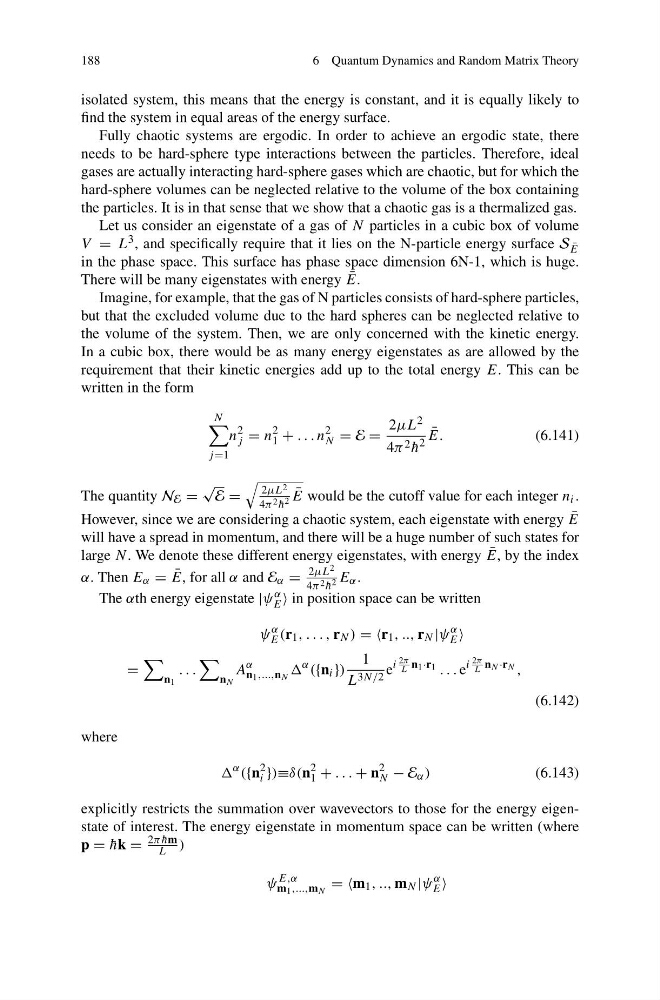
In a cubic box, there would be as many energy eigenstates as are allowed by the
requirement that their kinetic energies add up to the total energy E. This can be
written in the form
N
j =1
n
2
j = n
2
1 + . . . n
2
N = E =
2μL 2
4π 2 ¯
h 2
¯
E.
(6.141)
The quantity N E =
√
E =
2μL 2
4π 2 ¯
h 2
¯
E would be the cutoff value for each integer n i .
However, since we are considering a chaotic system, each eigenstate with energy ¯
E
will have a spread in momentum, and there will be a huge number of such states for
large N. We denote these different energy eigenstates, with energy ¯
E, by the index
α. Then E α = ¯
E, for all α and E α =
2μL 2
4π 2 ¯
h 2 E α .
The αth energy eigenstate |ψ α
E in position space can be written
ψ
α
E (r 1 , . . . , r N ) = =r 1 , .., r N |ψ
α
E
=
n 1
. . .
n N
A
α
n 1 ,...,n N
α ({n i })
1
L 3N/2 e
i
2π
L n 1 ·r 1 . . . e
i
2π
L n N ·r N ,
(6.142)
where
α ({n
2
i })≡δ(n
2
1 + . . . + n
2
N − E α )
(6.143)
explicitly restricts the summation over wavevectors to those for the energy eigenstate of interest. The energy eigenstate in momentum space can be written (where
p = ¯
hk =
2π ¯
hm
L )
ψ
E,α
m 1 ,...,m N
= =m 1 , .., m N |ψ
α
E
6 Quantum Dynamics and Random Matrix Theory
isolated system, this means that the energy is constant, and it is equally likely to
find the system in equal areas of the energy surface.
Fully chaotic systems are ergodic. In order to achieve an ergodic state, there
needs to be hard-sphere type interactions between the particles. Therefore, ideal
gases are actually interacting hard-sphere gases which are chaotic, but for which the
hard-sphere volumes can be neglected relative to the volume of the box containing
the particles. It is in that sense that we show that a chaotic gas is a thermalized gas.
Let us consider an eigenstate of a gas of N particles in a cubic box of volume
V = L 3 , and specifically require that it lies on the N-particle energy surface S ¯
E
in the phase space. This surface has phase space dimension 6N-1, which is huge.
There will be many eigenstates with energy ¯
E.
Imagine, for example, that the gas of N particles consists of hard-sphere particles,
but that the excluded volume due to the hard spheres can be neglected relative to
the volume of the system. Then, we are only concerned with the kinetic energy.
In a cubic box, there would be as many energy eigenstates as are allowed by the
requirement that their kinetic energies add up to the total energy E. This can be
written in the form
N
j =1
n
2
j = n
2
1 + . . . n
2
N = E =
2μL 2
4π 2 ¯
h 2
¯
E.
(6.141)
The quantity N E =
√
E =
2μL 2
4π 2 ¯
h 2
¯
E would be the cutoff value for each integer n i .
However, since we are considering a chaotic system, each eigenstate with energy ¯
E
will have a spread in momentum, and there will be a huge number of such states for
large N. We denote these different energy eigenstates, with energy ¯
E, by the index
α. Then E α = ¯
E, for all α and E α =
2μL 2
4π 2 ¯
h 2 E α .
The αth energy eigenstate |ψ α
E in position space can be written
ψ
α
E (r 1 , . . . , r N ) = =r 1 , .., r N |ψ
α
E
=
n 1
. . .
n N
A
α
n 1 ,...,n N
α ({n i })
1
L 3N/2 e
i
2π
L n 1 ·r 1 . . . e
i
2π
L n N ·r N ,
(6.142)
where
α ({n
2
i })≡δ(n
2
1 + . . . + n
2
N − E α )
(6.143)
explicitly restricts the summation over wavevectors to those for the energy eigenstate of interest. The energy eigenstate in momentum space can be written (where
p = ¯
hk =
2π ¯
hm
L )
ψ
E,α
m 1 ,...,m N
= =m 1 , .., m N |ψ
α
E