

6.2 Invariant Measure for the GOE
159
¯
O
T
= ¯
O
−1 so ¯
O
T
· ¯
O = ¯
O· ¯
O
T
= ¯
1,
(6.4)
where ¯
1 is an N×N unit matrix. The matrix H R can be written
¯
H R = ¯
O· ¯
E R · ¯
O
T ,
(6.5)
where ¯
E R is the diagonal N×N matrix containing eigenvalues of ¯
H R ,
¯
E R =
⎛
⎜
⎜
⎜
⎝
e 1 0 . . . 0
0 e 2 . . . 0
. . .
. . .
. . .
. . .
0 0 . . . e N
⎞
⎟
⎟
⎟
⎠
,
(6.6)
and ¯
O is composed of the eigenvectors of ¯
H R . The matrix ¯
H R contains N(N + 1)/2
independent matrix elements. The matrix ¯
E R contains N independent matrix elements. Therefore, the orthogonal matrix ¯
O contains only N(N − 1)/2 independent
matrix elements.
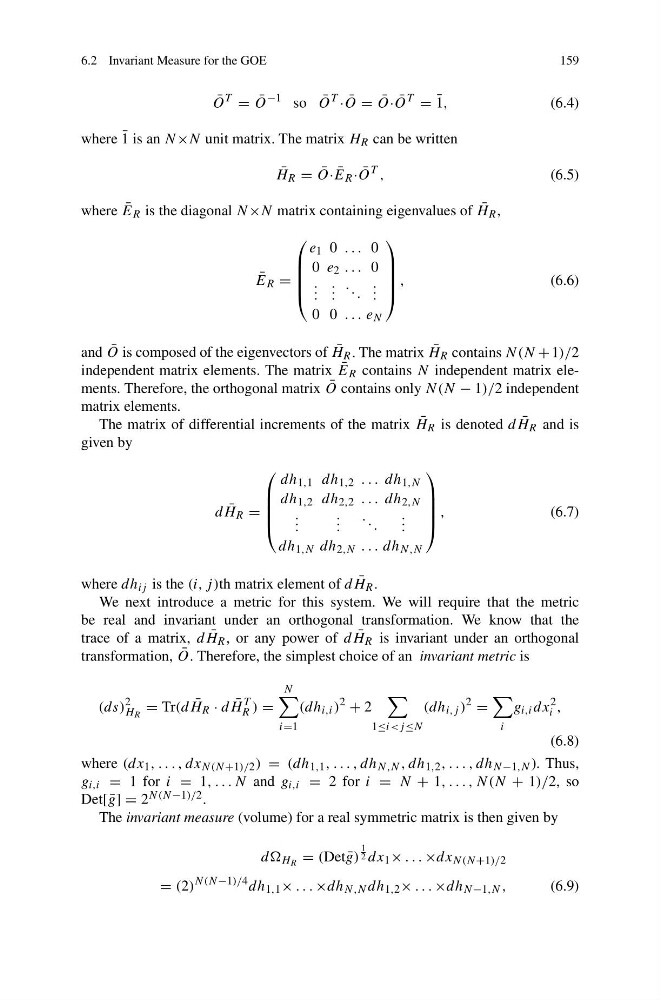
The matrix of differential increments of the matrix ¯
H R is denoted d ¯
H R and is
given by
d ¯
H R =
⎛
⎜
⎜
⎜
⎝
dh 1,1 dh 1,2 . . . dh 1,N
dh 1,2 dh 2,2 . . . dh 2,N
. . .
. . .
. . .
. . .
dh 1,N dh 2,N . . . dh N,N
⎞
⎟
⎟
⎟
⎠
,
(6.7)
where dh ij is the (i, j )th matrix element of d ¯
H R .
We next introduce a metric for this system. We will require that the metric
be real and invariant under an orthogonal transformation. We know that the
trace of a matrix, d ¯
H R , or any power of d ¯
H R is invariant under an orthogonal
transformation, ¯
O. Therefore, the simplest choice of an invariant metric is
(ds)
2
H R
= Tr(d ¯
H R · d ¯
H
T
R ) =
N
i=1
(dh i,i )
2
+ 2
1≤i
2
=
i
g i,i dx
2
i ,
(6.8)
where (dx 1 , . . . , dx N(N+1)/2 ) = (dh 1,1 , . . . , dh N,N , dh 1,2 , . . . , dh N −1,N ). Thus,
g i,i = 1 for i = 1, . . . N and g i,i = 2 for i = N + 1, . . . , N(N + 1)/2, so
Det[ ¯
g] = 2 N(N−1)/2 .
The invariant measure (volume) for a real symmetric matrix is then given by
dd H R = (Det ¯
g)
1
2 dx 1 × . . . ×dx N(N+1)/2
= (2)
N(N−1)/4 dh 1,1 × . . . ×dh N,N dh 1,2 × . . . ×dh N −1,N ,
(6.9)
159
¯
O
T
= ¯
O
−1 so ¯
O
T
· ¯
O = ¯
O· ¯
O
T
= ¯
1,
(6.4)
where ¯
1 is an N×N unit matrix. The matrix H R can be written
¯
H R = ¯
O· ¯
E R · ¯
O
T ,
(6.5)
where ¯
E R is the diagonal N×N matrix containing eigenvalues of ¯
H R ,
¯
E R =
⎛
⎜
⎜
⎜
⎝
e 1 0 . . . 0
0 e 2 . . . 0
. . .
. . .
. . .
. . .
0 0 . . . e N
⎞
⎟
⎟
⎟
⎠
,
(6.6)
and ¯
O is composed of the eigenvectors of ¯
H R . The matrix ¯
H R contains N(N + 1)/2
independent matrix elements. The matrix ¯
E R contains N independent matrix elements. Therefore, the orthogonal matrix ¯
O contains only N(N − 1)/2 independent
matrix elements.
The matrix of differential increments of the matrix ¯
H R is denoted d ¯
H R and is
given by
d ¯
H R =
⎛
⎜
⎜
⎜
⎝
dh 1,1 dh 1,2 . . . dh 1,N
dh 1,2 dh 2,2 . . . dh 2,N
. . .
. . .
. . .
. . .
dh 1,N dh 2,N . . . dh N,N
⎞
⎟
⎟
⎟
⎠
,
(6.7)
where dh ij is the (i, j )th matrix element of d ¯
H R .
We next introduce a metric for this system. We will require that the metric
be real and invariant under an orthogonal transformation. We know that the
trace of a matrix, d ¯
H R , or any power of d ¯
H R is invariant under an orthogonal
transformation, ¯
O. Therefore, the simplest choice of an invariant metric is
(ds)
2
H R
= Tr(d ¯
H R · d ¯
H
T
R ) =
N
i=1
(dh i,i )
2
+ 2
1≤i
2
=
i
g i,i dx
2
i ,
(6.8)
where (dx 1 , . . . , dx N(N+1)/2 ) = (dh 1,1 , . . . , dh N,N , dh 1,2 , . . . , dh N −1,N ). Thus,
g i,i = 1 for i = 1, . . . N and g i,i = 2 for i = N + 1, . . . , N(N + 1)/2, so
Det[ ¯
g] = 2 N(N−1)/2 .
The invariant measure (volume) for a real symmetric matrix is then given by
dd H R = (Det ¯
g)
1
2 dx 1 × . . . ×dx N(N+1)/2
= (2)
N(N−1)/4 dh 1,1 × . . . ×dh N,N dh 1,2 × . . . ×dh N −1,N ,
(6.9)