

6.1 Introduction
157
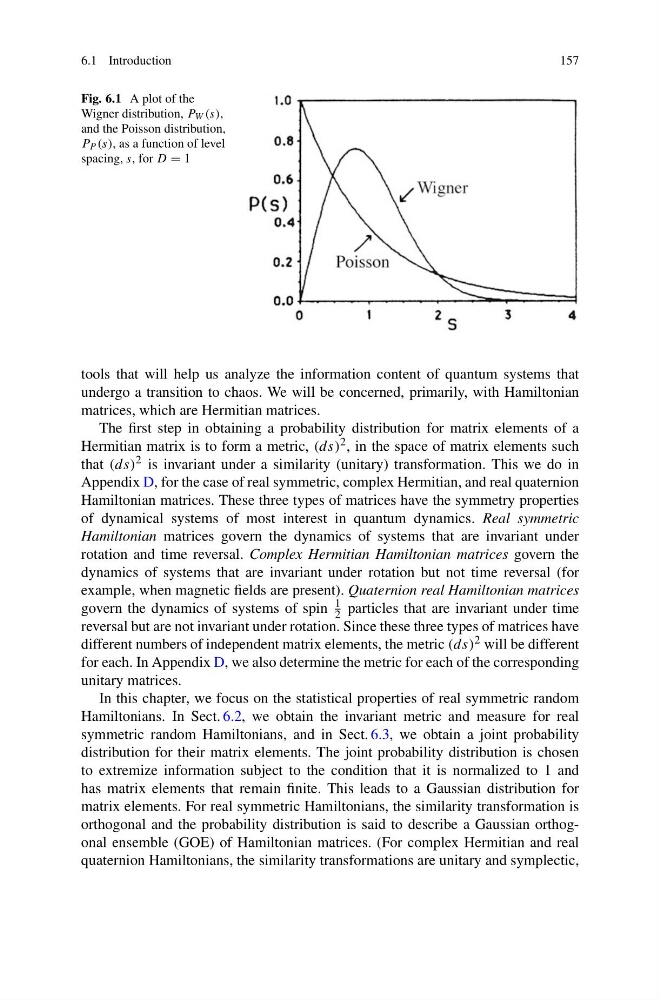
Fig. 6.1 A plot of the
Wigner distribution, P W (s),
and the Poisson distribution,
P P (s), as a function of level
spacing, s, for D = 1
tools that will help us analyze the information content of quantum systems that
undergo a transition to chaos. We will be concerned, primarily, with Hamiltonian
matrices, which are Hermitian matrices.
The first step in obtaining a probability distribution for matrix elements of a
Hermitian matrix is to form a metric, (ds) 2 , in the space of matrix elements such
that (ds) 2 is invariant under a similarity (unitary) transformation. This we do in
Appendix D, for the case of real symmetric, complex Hermitian, and real quaternion
Hamiltonian matrices. These three types of matrices have the symmetry properties
of dynamical systems of most interest in quantum dynamics. Real symmetric
Hamiltonian matrices govern the dynamics of systems that are invariant under
rotation and time reversal. Complex Hermitian Hamiltonian matrices govern the
dynamics of systems that are invariant under rotation but not time reversal (for
example, when magnetic fields are present). Quaternion real Hamiltonian matrices
govern the dynamics of systems of spin
1
2 particles that are invariant under time
reversal but are not invariant under rotation. Since these three types of matrices have
different numbers of independent matrix elements, the metric (ds) 2 will be different
for each. In Appendix D, we also determine the metric for each of the corresponding
unitary matrices.
In this chapter, we focus on the statistical properties of real symmetric random
Hamiltonians. In Sect. 6.2, we obtain the invariant metric and measure for real
symmetric random Hamiltonians, and in Sect. 6.3, we obtain a joint probability
distribution for their matrix elements. The joint probability distribution is chosen
to extremize information subject to the condition that it is normalized to 1 and
has matrix elements that remain finite. This leads to a Gaussian distribution for
matrix elements. For real symmetric Hamiltonians, the similarity transformation is
orthogonal and the probability distribution is said to describe a Gaussian orthogonal ensemble (GOE) of Hamiltonian matrices. (For complex Hermitian and real
quaternion Hamiltonians, the similarity transformations are unitary and symplectic,
157
Fig. 6.1 A plot of the
Wigner distribution, P W (s),
and the Poisson distribution,
P P (s), as a function of level
spacing, s, for D = 1
tools that will help us analyze the information content of quantum systems that
undergo a transition to chaos. We will be concerned, primarily, with Hamiltonian
matrices, which are Hermitian matrices.
The first step in obtaining a probability distribution for matrix elements of a
Hermitian matrix is to form a metric, (ds) 2 , in the space of matrix elements such
that (ds) 2 is invariant under a similarity (unitary) transformation. This we do in
Appendix D, for the case of real symmetric, complex Hermitian, and real quaternion
Hamiltonian matrices. These three types of matrices have the symmetry properties
of dynamical systems of most interest in quantum dynamics. Real symmetric
Hamiltonian matrices govern the dynamics of systems that are invariant under
rotation and time reversal. Complex Hermitian Hamiltonian matrices govern the
dynamics of systems that are invariant under rotation but not time reversal (for
example, when magnetic fields are present). Quaternion real Hamiltonian matrices
govern the dynamics of systems of spin
1
2 particles that are invariant under time
reversal but are not invariant under rotation. Since these three types of matrices have
different numbers of independent matrix elements, the metric (ds) 2 will be different
for each. In Appendix D, we also determine the metric for each of the corresponding
unitary matrices.
In this chapter, we focus on the statistical properties of real symmetric random
Hamiltonians. In Sect. 6.2, we obtain the invariant metric and measure for real
symmetric random Hamiltonians, and in Sect. 6.3, we obtain a joint probability
distribution for their matrix elements. The joint probability distribution is chosen
to extremize information subject to the condition that it is normalized to 1 and
has matrix elements that remain finite. This leads to a Gaussian distribution for
matrix elements. For real symmetric Hamiltonians, the similarity transformation is
orthogonal and the probability distribution is said to describe a Gaussian orthogonal ensemble (GOE) of Hamiltonian matrices. (For complex Hermitian and real
quaternion Hamiltonians, the similarity transformations are unitary and symplectic,