

5.4 Graphical Evolution of the Arnol’d Web
139
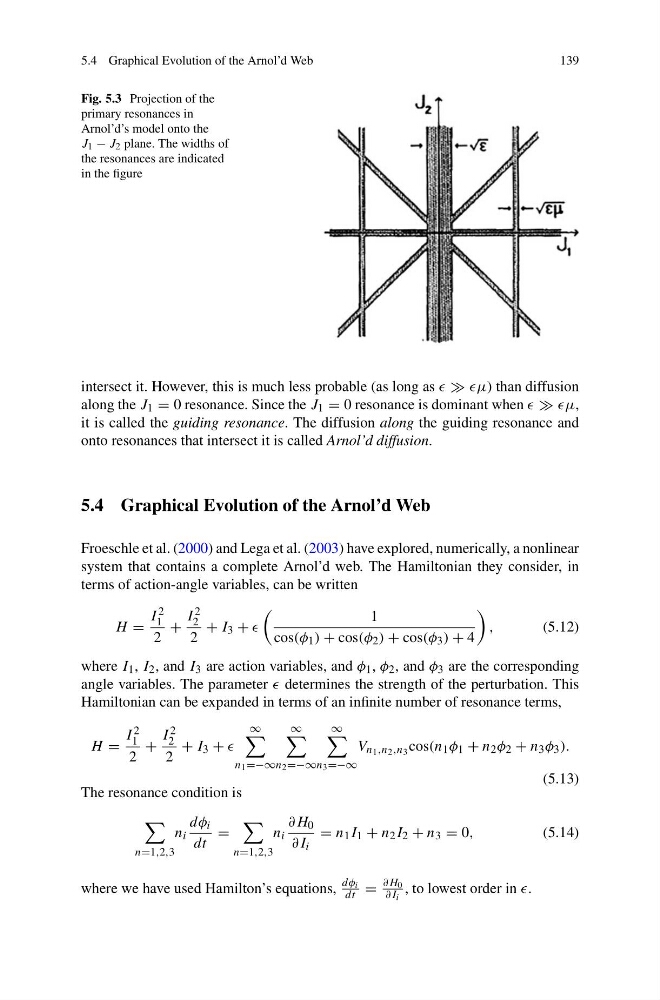
Fig. 5.3 Projection of the
primary resonances in
Arnol’d’s model onto the
J 1 − J 2 plane. The widths of
the resonances are indicated
in the figure
intersect it. However, this is much less probable (as long as μ) than diffusion
along the J 1 = 0 resonance. Since the J 1 = 0 resonance is dominant when
it is called the guiding resonance. The diffusion along the guiding resonance and
onto resonances that intersect it is called Arnol’d diffusion.
5.4 Graphical Evolution of the Arnol’d Web
Froeschle et al. (2000) and Lega et al. (2003) have explored, numerically, a nonlinear
system that contains a complete Arnol’d web. The Hamiltonian they consider, in
terms of action-angle variables, can be written
H =
I 2
1
2
+
I 2
2
2
+ I 3 +
1
cos(φ 1 ) + cos(φ 2 ) + cos(φ 3 ) + 4
,
(5.12)
where I 1 , I 2 , and I 3 are action variables, and φ 1 , φ 2 , and φ 3 are the corresponding
angle variables. The parameter determines the strength of the perturbation. This
Hamiltonian can be expanded in terms of an infinite number of resonance terms,
H =
I 2
1
2
+
I 2
2
2
+ I 3 +
∞
n 1 =−∞
∞
n 2 =−∞
∞
n 3 =−∞
V n 1 ,n 2 ,n 3 cos(n 1 φ 1 + n 2 φ 2 + n 3 φ 3 ).
(5.13)
The resonance condition is
n=1,2,3
n i
dφ i
dt
=
n=1,2,3
n i
∂H 0
∂I i
= n 1 I 1 + n 2 I 2 + n 3 = 0,
(5.14)
where we have used Hamilton’s equations,
dφ i
dt =
∂H 0
∂I i
, to lowest order in
139
Fig. 5.3 Projection of the
primary resonances in
Arnol’d’s model onto the
J 1 − J 2 plane. The widths of
the resonances are indicated
in the figure
intersect it. However, this is much less probable (as long as μ) than diffusion
along the J 1 = 0 resonance. Since the J 1 = 0 resonance is dominant when
it is called the guiding resonance. The diffusion along the guiding resonance and
onto resonances that intersect it is called Arnol’d diffusion.
5.4 Graphical Evolution of the Arnol’d Web
Froeschle et al. (2000) and Lega et al. (2003) have explored, numerically, a nonlinear
system that contains a complete Arnol’d web. The Hamiltonian they consider, in
terms of action-angle variables, can be written
H =
I 2
1
2
+
I 2
2
2
+ I 3 +
1
cos(φ 1 ) + cos(φ 2 ) + cos(φ 3 ) + 4
,
(5.12)
where I 1 , I 2 , and I 3 are action variables, and φ 1 , φ 2 , and φ 3 are the corresponding
angle variables. The parameter determines the strength of the perturbation. This
Hamiltonian can be expanded in terms of an infinite number of resonance terms,
H =
I 2
1
2
+
I 2
2
2
+ I 3 +
∞
n 1 =−∞
∞
n 2 =−∞
∞
n 3 =−∞
V n 1 ,n 2 ,n 3 cos(n 1 φ 1 + n 2 φ 2 + n 3 φ 3 ).
(5.13)
The resonance condition is
n=1,2,3
n i
dφ i
dt
=
n=1,2,3
n i
∂H 0
∂I i
= n 1 I 1 + n 2 I 2 + n 3 = 0,
(5.14)
where we have used Hamilton’s equations,
dφ i
dt =
∂H 0
∂I i
, to lowest order in