

124
4 Chaotic Scattering
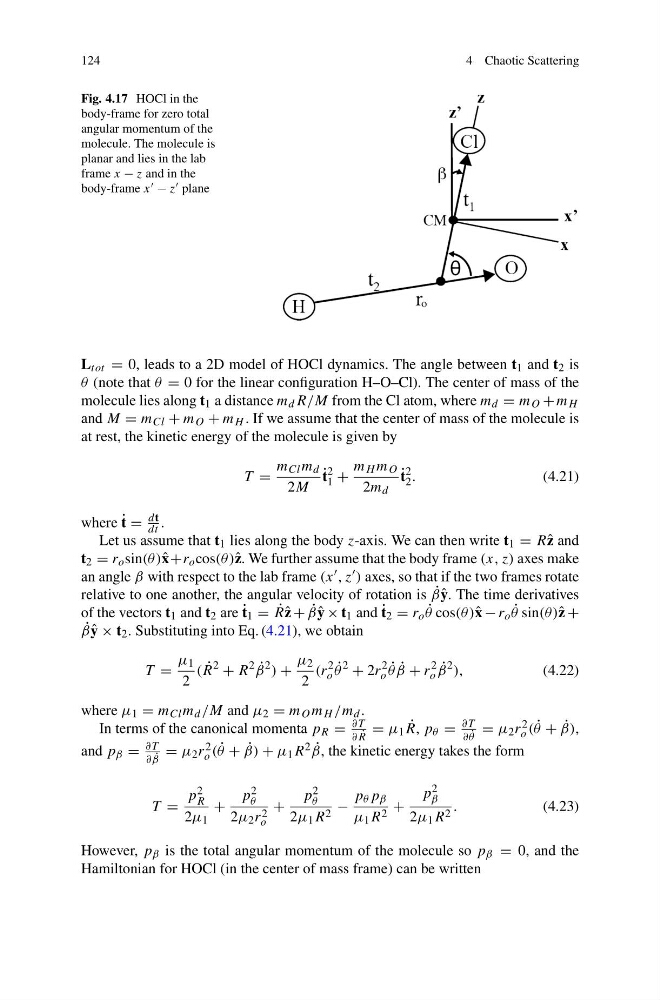
Fig. 4.17 HOCl in the
body-frame for zero total
angular momentum of the
molecule. The molecule is
planar and lies in the lab
frame x − z and in the
body-frame x − z plane
L tot = 0, leads to a 2D model of HOCl dynamics. The angle between t 1 and t 2 is
θ (note that θ = 0 for the linear configuration H–O–Cl). The center of mass of the
molecule lies along t 1 a distance m d R/M from the Cl atom, where m d = m O + m H
and M = m Cl + m O + m H . If we assume that the center of mass of the molecule is
at rest, the kinetic energy of the molecule is given by
T =
m Cl m d
2M
˙ t
2
1 +
m H m O
2m d
˙ t
2
2 .
(4.21)
where ˙ t =
dt
dt .
Let us assume that t 1 lies along the body z-axis. We can then write t 1 = Rˆ z and
t 2 = r o sin(θ )ˆ x+r o cos(θ )ˆ z. We further assume that the body frame (x, z) axes make
an angle β with respect to the lab frame (x , z ) axes, so that if the two frames rotate
relative to one another, the angular velocity of rotation is ˙
β ˆ
y. The time derivatives
of the vectors t 1 and t 2 are ˙ t 1 = ˙
Rˆ z + ˙
β ˆ
y × t 1 and ˙ t 2 = r o ˙
θ cos(θ )ˆ x − r o ˙
θ sin(θ )ˆ z +
˙
β ˆ
y × t 2 . Substituting into Eq. (4.21), we obtain
T =
μ 1
2
( ˙
R
2
+ R
2 ˙
β
2 ) +
μ 2
2
(r
2
o
˙
θ
2
+ 2r
2
o
˙
θ ˙
β + r
2
o
˙
β
2 ),
(4.22)
where μ 1 = m Cl m d /M and μ 2 = m O m H /m d .
In terms of the canonical momenta p R =
∂T
∂ ˙
R
= μ 1 ˙
R, p θ =
∂T
∂ ˙
θ
= μ 2 r 2
o ( ˙
θ + ˙
β),
and p β =
∂T
∂ ˙
β
= μ 2 r 2
o ( ˙
θ + ˙
β) + μ 1 R 2 ˙
β, the kinetic energy takes the form
T =
p 2
R
2μ 1
+
p 2
θ
2μ 2 r 2
o
+
p 2
θ
2μ 1 R 2 −
p θ p β
μ 1 R 2 +
p 2
β
2μ 1 R 2 .
(4.23)
However, p β is the total angular momentum of the molecule so p β = 0, and the
Hamiltonian for HOCl (in the center of mass frame) can be written
4 Chaotic Scattering
Fig. 4.17 HOCl in the
body-frame for zero total
angular momentum of the
molecule. The molecule is
planar and lies in the lab
frame x − z and in the
body-frame x − z plane
L tot = 0, leads to a 2D model of HOCl dynamics. The angle between t 1 and t 2 is
θ (note that θ = 0 for the linear configuration H–O–Cl). The center of mass of the
molecule lies along t 1 a distance m d R/M from the Cl atom, where m d = m O + m H
and M = m Cl + m O + m H . If we assume that the center of mass of the molecule is
at rest, the kinetic energy of the molecule is given by
T =
m Cl m d
2M
˙ t
2
1 +
m H m O
2m d
˙ t
2
2 .
(4.21)
where ˙ t =
dt
dt .
Let us assume that t 1 lies along the body z-axis. We can then write t 1 = Rˆ z and
t 2 = r o sin(θ )ˆ x+r o cos(θ )ˆ z. We further assume that the body frame (x, z) axes make
an angle β with respect to the lab frame (x , z ) axes, so that if the two frames rotate
relative to one another, the angular velocity of rotation is ˙
β ˆ
y. The time derivatives
of the vectors t 1 and t 2 are ˙ t 1 = ˙
Rˆ z + ˙
β ˆ
y × t 1 and ˙ t 2 = r o ˙
θ cos(θ )ˆ x − r o ˙
θ sin(θ )ˆ z +
˙
β ˆ
y × t 2 . Substituting into Eq. (4.21), we obtain
T =
μ 1
2
( ˙
R
2
+ R
2 ˙
β
2 ) +
μ 2
2
(r
2
o
˙
θ
2
+ 2r
2
o
˙
θ ˙
β + r
2
o
˙
β
2 ),
(4.22)
where μ 1 = m Cl m d /M and μ 2 = m O m H /m d .
In terms of the canonical momenta p R =
∂T
∂ ˙
R
= μ 1 ˙
R, p θ =
∂T
∂ ˙
θ
= μ 2 r 2
o ( ˙
θ + ˙
β),
and p β =
∂T
∂ ˙
β
= μ 2 r 2
o ( ˙
θ + ˙
β) + μ 1 R 2 ˙
β, the kinetic energy takes the form
T =
p 2
R
2μ 1
+
p 2
θ
2μ 2 r 2
o
+
p 2
θ
2μ 1 R 2 −
p θ p β
μ 1 R 2 +
p 2
β
2μ 1 R 2 .
(4.23)
However, p β is the total angular momentum of the molecule so p β = 0, and the
Hamiltonian for HOCl (in the center of mass frame) can be written