

102
4 Chaotic Scattering
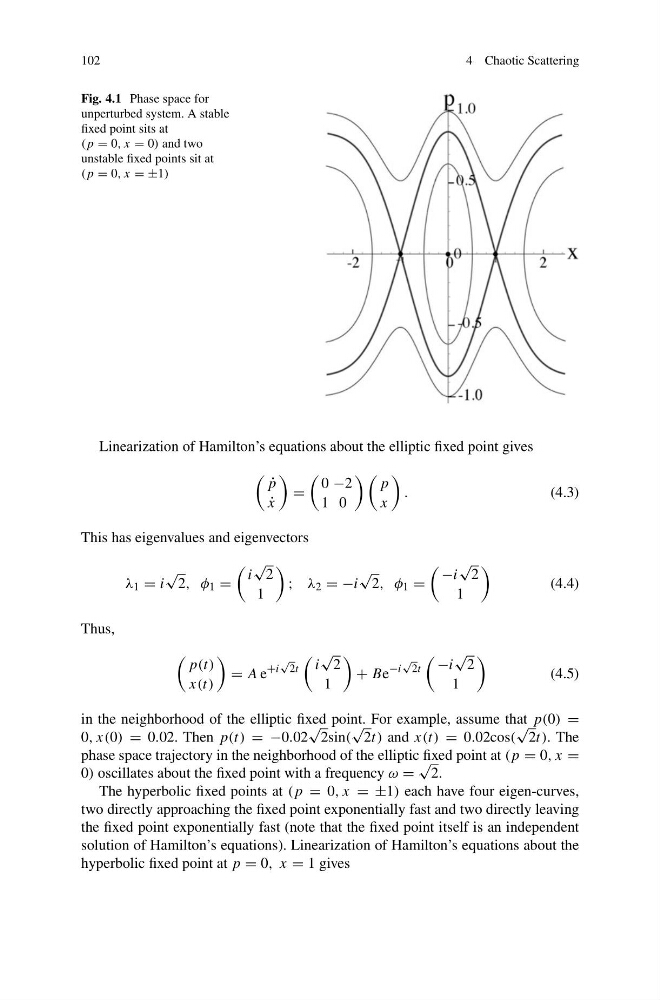
Fig. 4.1 Phase space for
unperturbed system. A stable
fixed point sits at
(p = 0, x = 0) and two
unstable fixed points sit at
(p = 0, x = ±1)
Linearization of Hamilton’s equations about the elliptic fixed point gives
˙
p
˙
x
=
0 −2
1 0
p
x
.
(4.3)
This has eigenvalues and eigenvectors
λ 1 = i
√
2, φ 1 =
i
√
2
1
; λ 2 = −i
√
2, φ 1 =
−i
√
2
1
(4.4)
Thus,
p(t)
x(t)
= A e
+i
√
2t
i
√
2
1
+ Be
−i
√
2t
−i
√
2
1
(4.5)
in the neighborhood of the elliptic fixed point. For example, assume that p(0) =
0, x(0) = 0.02. Then p(t) = −0.02
√
2sin(
√
2t) and x(t) = 0.02cos(
√
2t). The
phase space trajectory in the neighborhood of the elliptic fixed point at (p = 0, x =
0) oscillates about the fixed point with a frequency ω =
√
2.
The hyperbolic fixed points at (p = 0, x = ±1) each have four eigen-curves,
two directly approaching the fixed point exponentially fast and two directly leaving
the fixed point exponentially fast (note that the fixed point itself is an independent
solution of Hamilton’s equations). Linearization of Hamilton’s equations about the
hyperbolic fixed point at p = 0, x = 1 gives
4 Chaotic Scattering
Fig. 4.1 Phase space for
unperturbed system. A stable
fixed point sits at
(p = 0, x = 0) and two
unstable fixed points sit at
(p = 0, x = ±1)
Linearization of Hamilton’s equations about the elliptic fixed point gives
˙
p
˙
x
=
0 −2
1 0
p
x
.
(4.3)
This has eigenvalues and eigenvectors
λ 1 = i
√
2, φ 1 =
i
√
2
1
; λ 2 = −i
√
2, φ 1 =
−i
√
2
1
(4.4)
Thus,
p(t)
x(t)
= A e
+i
√
2t
i
√
2
1
+ Be
−i
√
2t
−i
√
2
1
(4.5)
in the neighborhood of the elliptic fixed point. For example, assume that p(0) =
0, x(0) = 0.02. Then p(t) = −0.02
√
2sin(
√
2t) and x(t) = 0.02cos(
√
2t). The
phase space trajectory in the neighborhood of the elliptic fixed point at (p = 0, x =
0) oscillates about the fixed point with a frequency ω =
√
2.
The hyperbolic fixed points at (p = 0, x = ±1) each have four eigen-curves,
two directly approaching the fixed point exponentially fast and two directly leaving
the fixed point exponentially fast (note that the fixed point itself is an independent
solution of Hamilton’s equations). Linearization of Hamilton’s equations about the
hyperbolic fixed point at p = 0, x = 1 gives