

of an air quality index is not only dependent on the local precursor emissions but
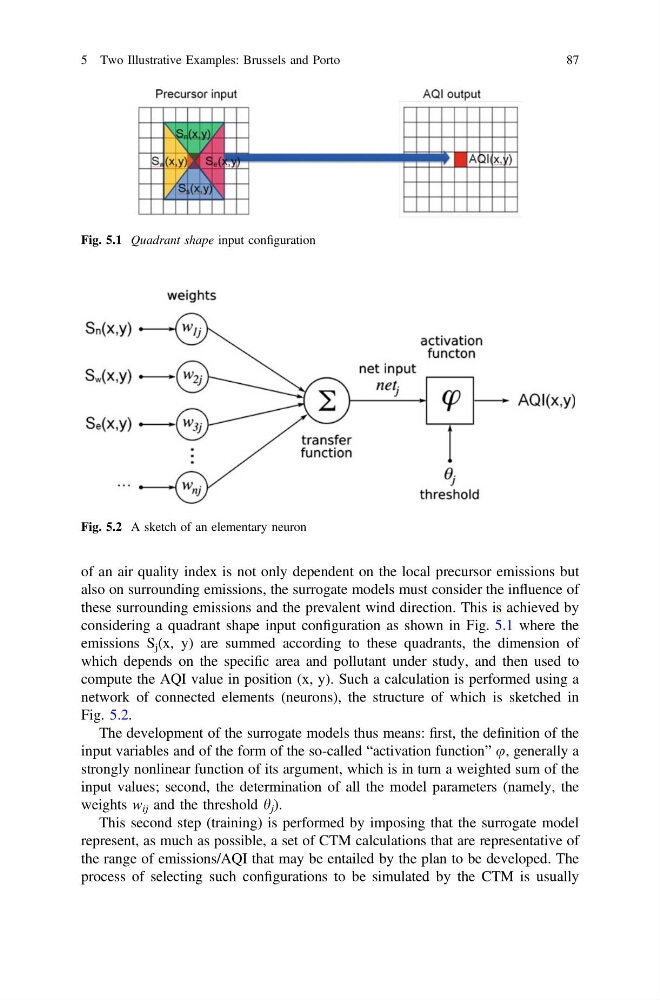
also on surrounding emissions, the surrogate models must consider the influence of
these surrounding emissions and the prevalent wind direction. This is achieved by
considering a quadrant shape input configuration as shown in Fig. 5.1 where the
emissions S j (x, y) are summed according to these quadrants, the dimension of
which depends on the specific area and pollutant under study, and then used to
compute the AQI value in position (x, y). Such a calculation is performed using a
network of connected elements (neurons), the structure of which is sketched in
Fig. 5.2.
The development of the surrogate models thus means: first, the definition of the
input variables and of the form of the so-called “activation function” u, generally a
strongly nonlinear function of its argument, which is in turn a weighted sum of the
input values; second, the determination of all the model parameters (namely, the
weights w ij and the threshold h j ).
This second step (training) is performed by imposing that the surrogate model
represent, as much as possible, a set of CTM calculations that are representative of
the range of emissions/AQI that may be entailed by the plan to be developed. The
process of selecting such configurations to be simulated by the CTM is usually
Fig. 5.1 Quadrant shape input configuration
Fig. 5.2 A sketch of an elementary neuron
5 Two Illustrative Examples: Brussels and Porto
87
also on surrounding emissions, the surrogate models must consider the influence of
these surrounding emissions and the prevalent wind direction. This is achieved by
considering a quadrant shape input configuration as shown in Fig. 5.1 where the
emissions S j (x, y) are summed according to these quadrants, the dimension of
which depends on the specific area and pollutant under study, and then used to
compute the AQI value in position (x, y). Such a calculation is performed using a
network of connected elements (neurons), the structure of which is sketched in
Fig. 5.2.
The development of the surrogate models thus means: first, the definition of the
input variables and of the form of the so-called “activation function” u, generally a
strongly nonlinear function of its argument, which is in turn a weighted sum of the
input values; second, the determination of all the model parameters (namely, the
weights w ij and the threshold h j ).
This second step (training) is performed by imposing that the surrogate model
represent, as much as possible, a set of CTM calculations that are representative of
the range of emissions/AQI that may be entailed by the plan to be developed. The
process of selecting such configurations to be simulated by the CTM is usually
Fig. 5.1 Quadrant shape input configuration
Fig. 5.2 A sketch of an elementary neuron
5 Two Illustrative Examples: Brussels and Porto
87