

the database contributions, coming form 7 MS) are usually assumed to be based on
the most updated methods. Seven studies stored in the database are classified as
‘Other’. Countries represent the study area in 20 % of cases, regions in 25 % and
agglomeration or urban level in 30 % of the cases (the remaining percentage refers
to other types of focus which could not be classified in these categories). The
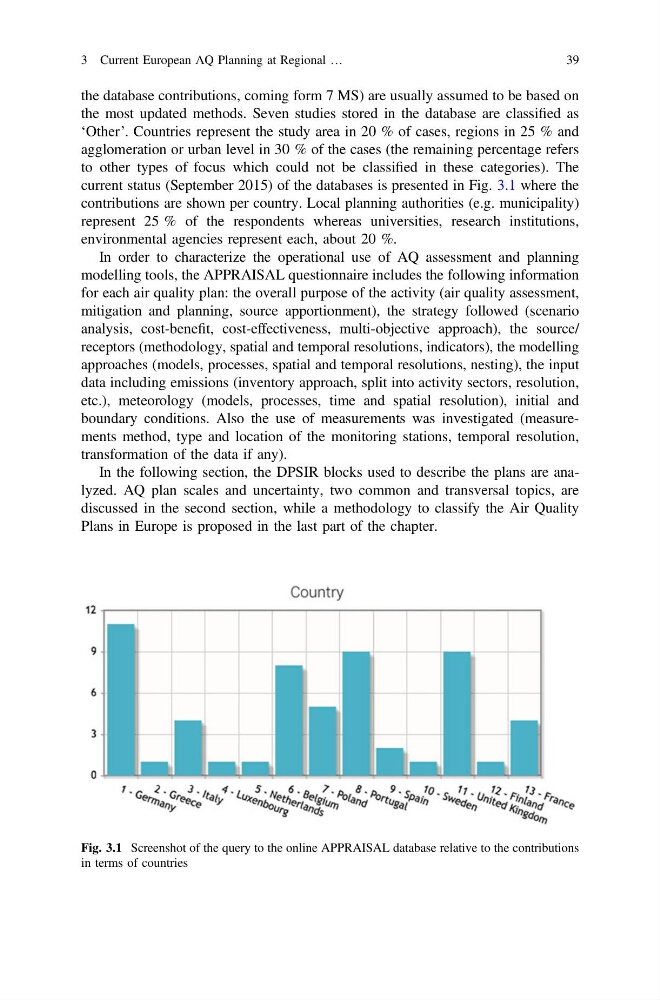
current status (September 2015) of the databases is presented in Fig. 3.1 where the
contributions are shown per country. Local planning authorities (e.g. municipality)
represent 25 % of the respondents whereas universities, research institutions,
environmental agencies represent each, about 20 %.
In order to characterize the operational use of AQ assessment and planning
modelling tools, the APPRAISAL questionnaire includes the following information
for each air quality plan: the overall purpose of the activity (air quality assessment,
mitigation and planning, source apportionment), the strategy followed (scenario
analysis, cost-benefit, cost-effectiveness, multi-objective approach), the source/
receptors (methodology, spatial and temporal resolutions, indicators), the modelling
approaches (models, processes, spatial and temporal resolutions, nesting), the input
data including emissions (inventory approach, split into activity sectors, resolution,
etc.), meteorology (models, processes, time and spatial resolution), initial and
boundary conditions. Also the use of measurements was investigated (measurements method, type and location of the monitoring stations, temporal resolution,
transformation of the data if any).
In the following section, the DPSIR blocks used to describe the plans are analyzed. AQ plan scales and uncertainty, two common and transversal topics, are
discussed in the second section, while a methodology to classify the Air Quality
Plans in Europe is proposed in the last part of the chapter.
Fig. 3.1 Screenshot of the query to the online APPRAISAL database relative to the contributions
in terms of countries
3 Current European AQ Planning at Regional …
39
the most updated methods. Seven studies stored in the database are classified as
‘Other’. Countries represent the study area in 20 % of cases, regions in 25 % and
agglomeration or urban level in 30 % of the cases (the remaining percentage refers
to other types of focus which could not be classified in these categories). The
current status (September 2015) of the databases is presented in Fig. 3.1 where the
contributions are shown per country. Local planning authorities (e.g. municipality)
represent 25 % of the respondents whereas universities, research institutions,
environmental agencies represent each, about 20 %.
In order to characterize the operational use of AQ assessment and planning
modelling tools, the APPRAISAL questionnaire includes the following information
for each air quality plan: the overall purpose of the activity (air quality assessment,
mitigation and planning, source apportionment), the strategy followed (scenario
analysis, cost-benefit, cost-effectiveness, multi-objective approach), the source/
receptors (methodology, spatial and temporal resolutions, indicators), the modelling
approaches (models, processes, spatial and temporal resolutions, nesting), the input
data including emissions (inventory approach, split into activity sectors, resolution,
etc.), meteorology (models, processes, time and spatial resolution), initial and
boundary conditions. Also the use of measurements was investigated (measurements method, type and location of the monitoring stations, temporal resolution,
transformation of the data if any).
In the following section, the DPSIR blocks used to describe the plans are analyzed. AQ plan scales and uncertainty, two common and transversal topics, are
discussed in the second section, while a methodology to classify the Air Quality
Plans in Europe is proposed in the last part of the chapter.
Fig. 3.1 Screenshot of the query to the online APPRAISAL database relative to the contributions
in terms of countries
3 Current European AQ Planning at Regional …
39