

More specifically, all regional and local plans are to be compatible with national
and international policies. These “scale” issues are discussed in the next sections.
2.3 A Detailed Analysis of the IAM Framework Modules
In this section, all the five building blocks of the IAM framework will be discussed
in detail, considering their “input”, “functionality”, “output”, “synergies among
scales” and “uncertainty”. The “functionality” is the core part of the description,
and defines the cause-effect relationship between input and output.
2.3.1 Drivers
The basic function of the DRIVERS block is to model the development of key
driving activities (i.e. road traffic, off-road traffic and machinery, residential combustion, centralized energy production, industry, agriculture) over time (Amann
et al. 2011). It thereby provides input to the PRESSURES block in the form of, e.g.,
road traffic kilometres driven, residential heating fuel consumption, etc. (dis)aggregated in such a way that it includes emission-wise relevant classification of
sectors, sources and technologies.
To provide relevant information to the PRESSURES block, DRIVERS have to
be quantified with specific measurable variables. For instance, special attention has
been given in European plans to the sectors that are important for urban air quality
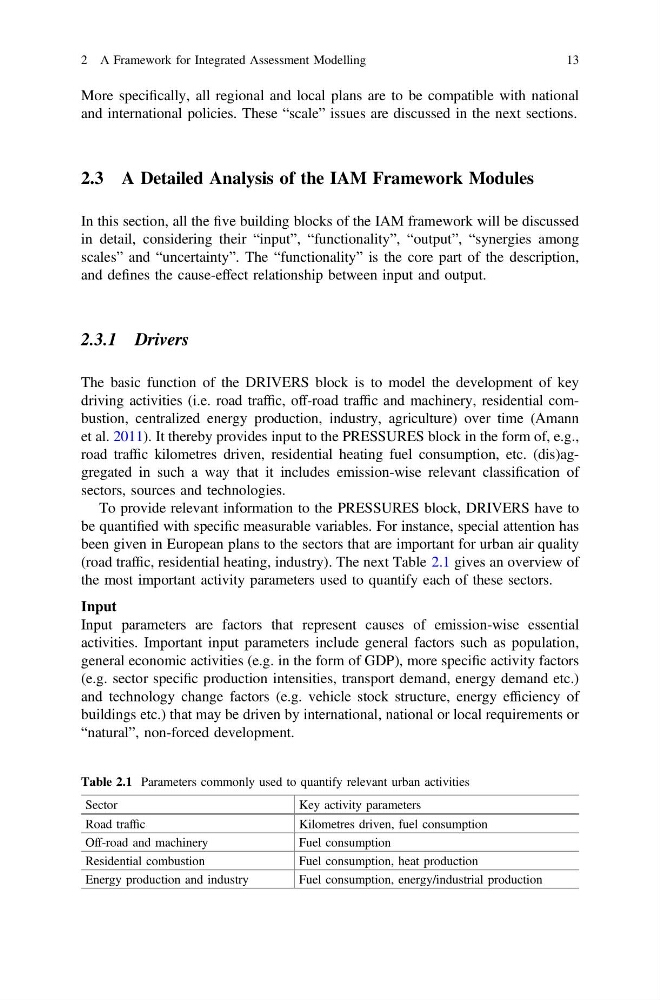
(road traffic, residential heating, industry). The next Table 2.1 gives an overview of
the most important activity parameters used to quantify each of these sectors.
Input
Input parameters are factors that represent causes of emission-wise essential
activities. Important input parameters include general factors such as population,
general economic activities (e.g. in the form of GDP), more specific activity factors
(e.g. sector specific production intensities, transport demand, energy demand etc.)
and technology change factors (e.g. vehicle stock structure, energy efficiency of
buildings etc.) that may be driven by international, national or local requirements or
“natural”, non-forced development.
Table 2.1 Parameters commonly used to quantify relevant urban activities
Sector
Key activity parameters
Road traffic
Kilometres driven, fuel consumption
Off-road and machinery
Fuel consumption
Residential combustion
Fuel consumption, heat production
Energy production and industry
Fuel consumption, energy/industrial production
2 A Framework for Integrated Assessment Modelling
13
and international policies. These “scale” issues are discussed in the next sections.
2.3 A Detailed Analysis of the IAM Framework Modules
In this section, all the five building blocks of the IAM framework will be discussed
in detail, considering their “input”, “functionality”, “output”, “synergies among
scales” and “uncertainty”. The “functionality” is the core part of the description,
and defines the cause-effect relationship between input and output.
2.3.1 Drivers
The basic function of the DRIVERS block is to model the development of key
driving activities (i.e. road traffic, off-road traffic and machinery, residential combustion, centralized energy production, industry, agriculture) over time (Amann
et al. 2011). It thereby provides input to the PRESSURES block in the form of, e.g.,
road traffic kilometres driven, residential heating fuel consumption, etc. (dis)aggregated in such a way that it includes emission-wise relevant classification of
sectors, sources and technologies.
To provide relevant information to the PRESSURES block, DRIVERS have to
be quantified with specific measurable variables. For instance, special attention has
been given in European plans to the sectors that are important for urban air quality
(road traffic, residential heating, industry). The next Table 2.1 gives an overview of
the most important activity parameters used to quantify each of these sectors.
Input
Input parameters are factors that represent causes of emission-wise essential
activities. Important input parameters include general factors such as population,
general economic activities (e.g. in the form of GDP), more specific activity factors
(e.g. sector specific production intensities, transport demand, energy demand etc.)
and technology change factors (e.g. vehicle stock structure, energy efficiency of
buildings etc.) that may be driven by international, national or local requirements or
“natural”, non-forced development.
Table 2.1 Parameters commonly used to quantify relevant urban activities
Sector
Key activity parameters
Road traffic
Kilometres driven, fuel consumption
Off-road and machinery
Fuel consumption
Residential combustion
Fuel consumption, heat production
Energy production and industry
Fuel consumption, energy/industrial production
2 A Framework for Integrated Assessment Modelling
13