

5.4.2 The Chemical Transport Model
The Air Pollution Model (TAPM) (Hurley et al. 2005) was used for the simulation
of different mitigation scenarios. It is a 3-D Eulerian model with nesting capabilities, which predicts meteorology and air pollution concentrations. It simulates the
transport, dispersion and chemistry of atmospheric pollutants, at both local and
regional scale, and it is suitable for long term simulations (e.g. a full year) since it is
not strongly time-demanding in terms of computational efforts. Point, line and
area/volume source emissions are considered. The model has two components: the
meteorological prognostic and the air pollution concentrations component. The
meteorological module of TAPM is an incompressible, optionally non-hydrostatic,
primitive equation model with terrain-following coordinates for 3D simulations.
The results from the meteorological module are one of the inputs to the air pollution
component. The gas-phase chemistry mode of TAPM was used, which is based on
the semi-empirical mechanism called Generic Reaction Set (GRS), including also
the reactions of SO 2 and PM, having 10 reactions for 13 species. The TAPM model
was applied to the Great Porto Area (150 km  150 km) for one entire reference
year (2012) with a 2 km by 2 km spatial resolution (see Fig. 5.9) using disaggregated emissions from the Portuguese 2009 emission inventory, which is the most
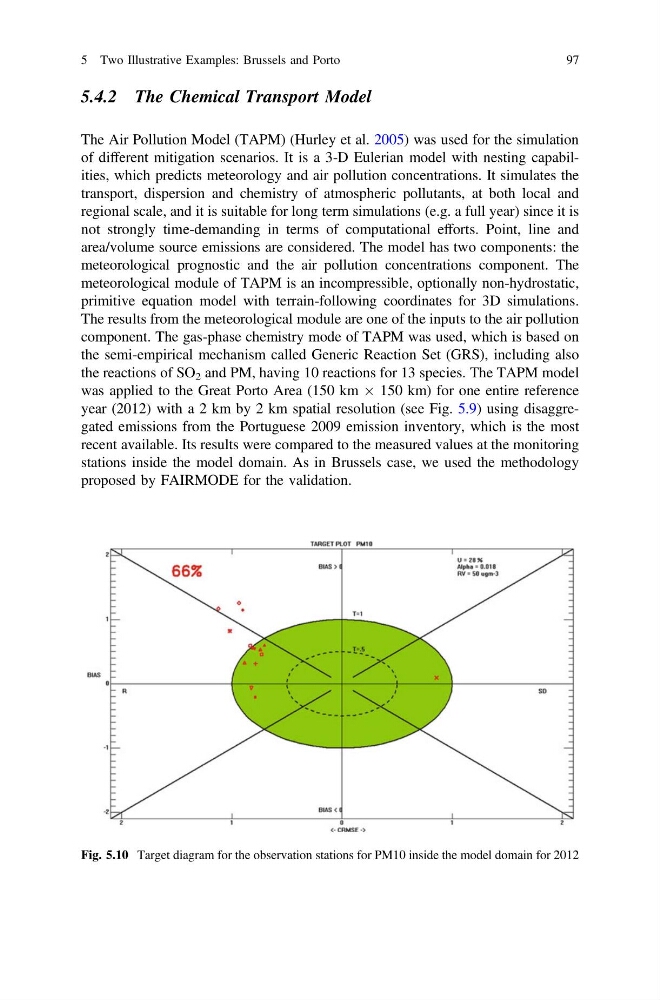
recent available. Its results were compared to the measured values at the monitoring
stations inside the model domain. As in Brussels case, we used the methodology
proposed by FAIRMODE for the validation.
Fig. 5.10 Target diagram for the observation stations for PM10 inside the model domain for 2012
5 Two Illustrative Examples: Brussels and Porto
97
The Air Pollution Model (TAPM) (Hurley et al. 2005) was used for the simulation
of different mitigation scenarios. It is a 3-D Eulerian model with nesting capabilities, which predicts meteorology and air pollution concentrations. It simulates the
transport, dispersion and chemistry of atmospheric pollutants, at both local and
regional scale, and it is suitable for long term simulations (e.g. a full year) since it is
not strongly time-demanding in terms of computational efforts. Point, line and
area/volume source emissions are considered. The model has two components: the
meteorological prognostic and the air pollution concentrations component. The
meteorological module of TAPM is an incompressible, optionally non-hydrostatic,
primitive equation model with terrain-following coordinates for 3D simulations.
The results from the meteorological module are one of the inputs to the air pollution
component. The gas-phase chemistry mode of TAPM was used, which is based on
the semi-empirical mechanism called Generic Reaction Set (GRS), including also
the reactions of SO 2 and PM, having 10 reactions for 13 species. The TAPM model
was applied to the Great Porto Area (150 km  150 km) for one entire reference
year (2012) with a 2 km by 2 km spatial resolution (see Fig. 5.9) using disaggregated emissions from the Portuguese 2009 emission inventory, which is the most
recent available. Its results were compared to the measured values at the monitoring
stations inside the model domain. As in Brussels case, we used the methodology
proposed by FAIRMODE for the validation.
Fig. 5.10 Target diagram for the observation stations for PM10 inside the model domain for 2012
5 Two Illustrative Examples: Brussels and Porto
97