

Weighted Hurwitz Numbers, τ -Functions, and Matrix Integrals
83
3.1 Adapted Basis, Recursion Operators, Quantum Spectral
Curve
Henceforth, we always set:
s = β
−1 t 0 := (β
−1 , 0, 0, . . . )
(20)
and
τ
(G,β) (t) := τ
(G,β) (t, β
−1 t 0 )
(21)
is a KP τ -function of hypergeometric type.
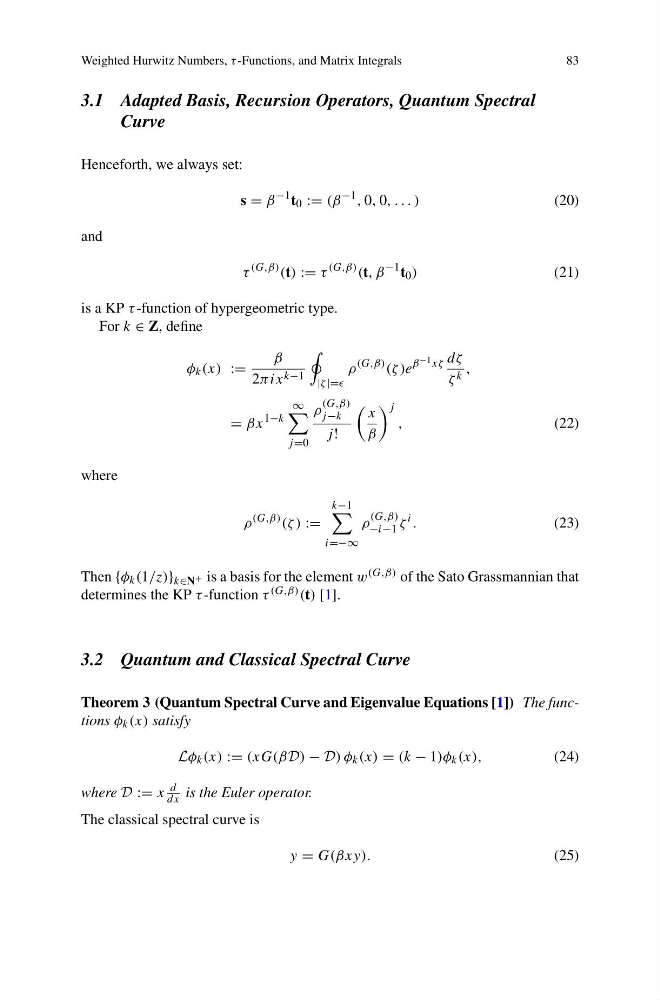
For k ∈ Z, define
φ k (x) :=
β
2πix k−1
|ζ |=
ρ
(G,β) (ζ )e
β −1 xζ dζ
ζ k ,
= βx
1−k
∞
j =0
ρ
(G,β)
j −k
j !
x
β
j
,
(22)
where
ρ
(G,β) (ζ ) :=
k−1
i=−∞
ρ
(G,β)
−i−1 ζ
i .
(23)
Then {φ k (1/z)} k∈N + is a basis for the element w (G,β) of the Sato Grassmannian that
determines the KP τ -function τ (G,β) (t) [1].
3.2 Quantum and Classical Spectral Curve
Theorem 3 (Quantum Spectral Curve and Eigenvalue Equations [1]) The functions φ k (x) satisfy
Lφ k (x) := (xG(βD) − D) φ k (x) = (k − 1)φ k (x),
(24)
where D := x
d
dx is the Euler operator.
The classical spectral curve is
y = G(βxy).
(25)
83
3.1 Adapted Basis, Recursion Operators, Quantum Spectral
Curve
Henceforth, we always set:
s = β
−1 t 0 := (β
−1 , 0, 0, . . . )
(20)
and
τ
(G,β) (t) := τ
(G,β) (t, β
−1 t 0 )
(21)
is a KP τ -function of hypergeometric type.
For k ∈ Z, define
φ k (x) :=
β
2πix k−1
|ζ |=
ρ
(G,β) (ζ )e
β −1 xζ dζ
ζ k ,
= βx
1−k
∞
j =0
ρ
(G,β)
j −k
j !
x
β
j
,
(22)
where
ρ
(G,β) (ζ ) :=
k−1
i=−∞
ρ
(G,β)
−i−1 ζ
i .
(23)
Then {φ k (1/z)} k∈N + is a basis for the element w (G,β) of the Sato Grassmannian that
determines the KP τ -function τ (G,β) (t) [1].
3.2 Quantum and Classical Spectral Curve
Theorem 3 (Quantum Spectral Curve and Eigenvalue Equations [1]) The functions φ k (x) satisfy
Lφ k (x) := (xG(βD) − D) φ k (x) = (k − 1)φ k (x),
(24)
where D := x
d
dx is the Euler operator.
The classical spectral curve is
y = G(βxy).
(25)