

Weighted Hurwitz Numbers, τ -Functions, and Matrix Integrals
81
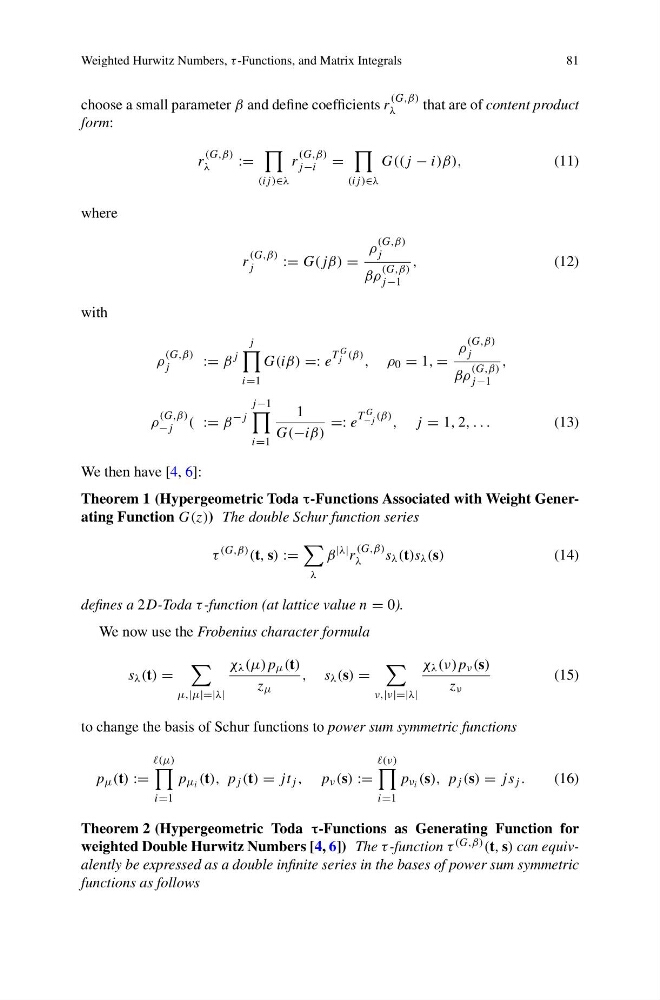
choose a small parameter β and define coefficients r
(G,β)
λ
that are of content product
form:
r
(G,β)
λ
:=
(ij )∈λ
r
(G,β)
j −i =
(ij )∈λ
G((j − i)β),
(11)
where
r
(G,β)
j
:= G(jβ) =
ρ
(G,β)
j
βρ
(G,β)
j −1
,
(12)
with
ρ
(G,β)
j
:= β
j
j
i=1
G(iβ) =: e
T G
j (β) , ρ 0 = 1, =
ρ
(G,β)
j
βρ
(G,β)
j −1
,
ρ
(G,β)
−j ( := β
−j
j −1
i=1
1
G(−iβ)
=: e
T G
−j (β) , j = 1, 2, . . .
(13)
We then have [4, 6]:
Theorem 1 (Hypergeometric Toda τ-Functions Associated with Weight Generating Function G(z)) The double Schur function series
τ
(G,β) (t, s) :=
λ
β
|λ| r
(G,β)
λ
s λ (t)s λ (s)
(14)
defines a 2D-Toda τ -function (at lattice value n = 0).
We now use the Frobenius character formula
s λ (t) =
μ,|μ|=|λ|
χ λ (μ)p μ (t)
z μ
, s λ (s) =
ν,|ν|=|λ|
χ λ (ν)p ν (s)
z ν
(15)
to change the basis of Schur functions to power sum symmetric functions
p μ (t) :=
i=1
p μ i (t), p j (t) = jt j , p ν (s) :=
(ν)
i=1
p ν i (s), p j (s) = js j .
(16)
Theorem 2 (Hypergeometric Toda τ-Functions as Generating Function for
weighted Double Hurwitz Numbers [4, 6]) The τ -function τ (G,β) (t, s) can equivalently be expressed as a double infinite series in the bases of power sum symmetric
functions as follows
81
choose a small parameter β and define coefficients r
(G,β)
λ
that are of content product
form:
r
(G,β)
λ
:=
(ij )∈λ
r
(G,β)
j −i =
(ij )∈λ
G((j − i)β),
(11)
where
r
(G,β)
j
:= G(jβ) =
ρ
(G,β)
j
βρ
(G,β)
j −1
,
(12)
with
ρ
(G,β)
j
:= β
j
j
i=1
G(iβ) =: e
T G
j (β) , ρ 0 = 1, =
ρ
(G,β)
j
βρ
(G,β)
j −1
,
ρ
(G,β)
−j ( := β
−j
j −1
i=1
1
G(−iβ)
=: e
T G
−j (β) , j = 1, 2, . . .
(13)
We then have [4, 6]:
Theorem 1 (Hypergeometric Toda τ-Functions Associated with Weight Generating Function G(z)) The double Schur function series
τ
(G,β) (t, s) :=
λ
β
|λ| r
(G,β)
λ
s λ (t)s λ (s)
(14)
defines a 2D-Toda τ -function (at lattice value n = 0).
We now use the Frobenius character formula
s λ (t) =
μ,|μ|=|λ|
χ λ (μ)p μ (t)
z μ
, s λ (s) =
ν,|ν|=|λ|
χ λ (ν)p ν (s)
z ν
(15)
to change the basis of Schur functions to power sum symmetric functions
p μ (t) :=
i=1
p μ i (t), p j (t) = jt j , p ν (s) :=
(ν)
i=1
p ν i (s), p j (s) = js j .
(16)
Theorem 2 (Hypergeometric Toda τ-Functions as Generating Function for
weighted Double Hurwitz Numbers [4, 6]) The τ -function τ (G,β) (t, s) can equivalently be expressed as a double infinite series in the bases of power sum symmetric
functions as follows