

78
J. Harnad
Sects. 3.2–3.4 are largely drawn from [2, 7], in which further details and proofs of
the main results may be found.
1.1 Geometric Meaning of Classical Hurwitz Numbers
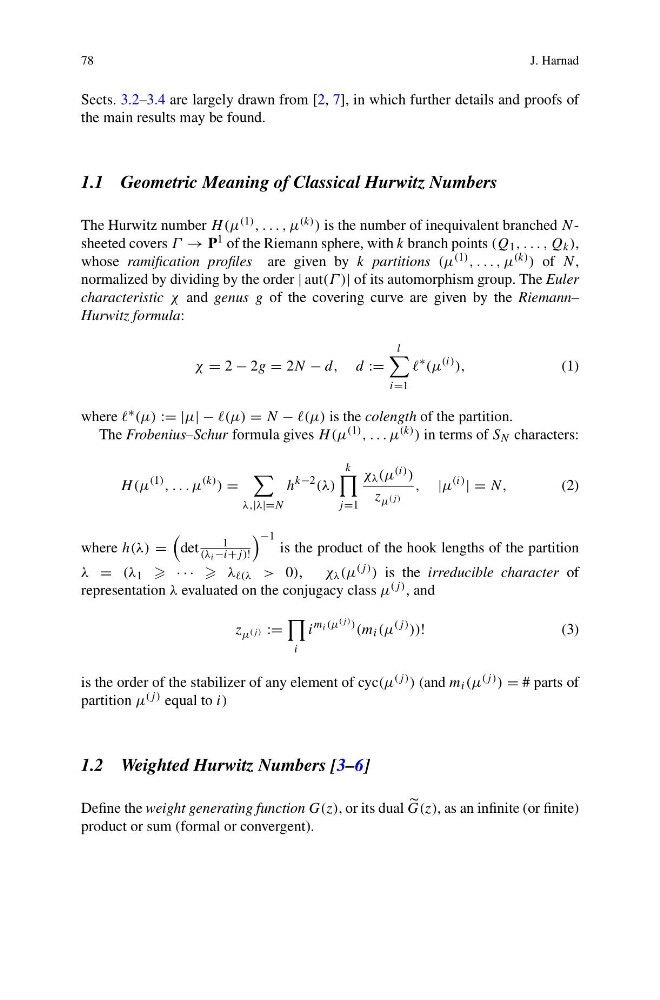
The Hurwitz number H (μ (1) , . . . , μ (k) ) is the number of inequivalent branched Nsheeted covers Γ → P 1 of the Riemann sphere, with k branch points (Q 1 , . . . , Q k ),
whose ramification profiles are given by k partitions (μ (1) , . . . , μ (k) ) of N ,
normalized by dividing by the order | aut(Γ )| of its automorphism group. The Euler
characteristic χ and genus g of the covering curve are given by the Riemann–
Hurwitz formula:
χ = 2 − 2g = 2N − d, d :=
l
i=1
∗ (μ
(i) ),
(1)
where ∗ (μ) := |μ| − = N − (μ) is the colength of the partition.
The Frobenius–Schur formula gives H (μ (1) , . . . μ (k) ) in terms of S N characters:
H (μ
(1) , . . . μ
(k) ) =
λ,|λ|=N
h
k−2 (λ)
k
j =1
χ λ (μ (i) )
z μ (j )
, |μ
(i)
| = N,
(2)
where h(λ) =
det
1
(λ i −i+j)!
−1
is the product of the hook lengths of the partition
λ = (λ 1 · · · λ > 0), χ λ (μ (j ) ) is the irreducible character of
representation λ evaluated on the conjugacy class μ (j ) , and
z μ (j ) :=
i
i
m i (μ (j ) ) (m i (μ
(j ) ))!
(3)
is the order of the stabilizer of any element of cyc(μ (j ) ) (and m i (μ (j ) ) = # parts of
partition μ (j ) equal to i)
1.2 Weighted Hurwitz Numbers [3–6]
Define the weight generating function G(z), or its dual
G(z), as an infinite (or finite)
product or sum (formal or convergent).
J. Harnad
Sects. 3.2–3.4 are largely drawn from [2, 7], in which further details and proofs of
the main results may be found.
1.1 Geometric Meaning of Classical Hurwitz Numbers
The Hurwitz number H (μ (1) , . . . , μ (k) ) is the number of inequivalent branched Nsheeted covers Γ → P 1 of the Riemann sphere, with k branch points (Q 1 , . . . , Q k ),
whose ramification profiles are given by k partitions (μ (1) , . . . , μ (k) ) of N ,
normalized by dividing by the order | aut(Γ )| of its automorphism group. The Euler
characteristic χ and genus g of the covering curve are given by the Riemann–
Hurwitz formula:
χ = 2 − 2g = 2N − d, d :=
l
i=1
∗ (μ
(i) ),
(1)
where ∗ (μ) := |μ| − = N − (μ) is the colength of the partition.
The Frobenius–Schur formula gives H (μ (1) , . . . μ (k) ) in terms of S N characters:
H (μ
(1) , . . . μ
(k) ) =
λ,|λ|=N
h
k−2 (λ)
k
j =1
χ λ (μ (i) )
z μ (j )
, |μ
(i)
| = N,
(2)
where h(λ) =
det
1
(λ i −i+j)!
−1
is the product of the hook lengths of the partition
λ = (λ 1 · · · λ > 0), χ λ (μ (j ) ) is the irreducible character of
representation λ evaluated on the conjugacy class μ (j ) , and
z μ (j ) :=
i
i
m i (μ (j ) ) (m i (μ
(j ) ))!
(3)
is the order of the stabilizer of any element of cyc(μ (j ) ) (and m i (μ (j ) ) = # parts of
partition μ (j ) equal to i)
1.2 Weighted Hurwitz Numbers [3–6]
Define the weight generating function G(z), or its dual
G(z), as an infinite (or finite)
product or sum (formal or convergent).