

616
K. Earl et al.
2
5
10
20
50
100
1×10
–11
2×10
–11
5×10
–11
1×10
–10
2×10
–10
5×10
–10
K 1
│Y
B │
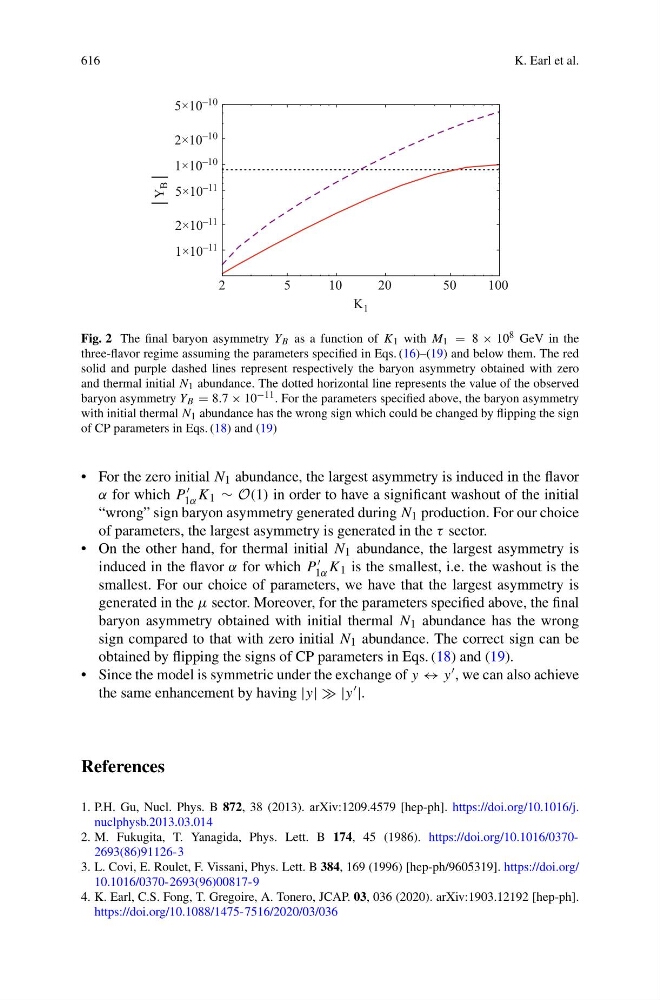
Fig. 2 The final baryon asymmetry Y B as a function of K 1 with M 1 = 8 × 10 8 GeV in the
three-flavor regime assuming the parameters specified in Eqs. (16)–(19) and below them. The red
solid and purple dashed lines represent respectively the baryon asymmetry obtained with zero
and thermal initial N 1 abundance. The dotted horizontal line represents the value of the observed
baryon asymmetry Y B = 8.7 × 10 −11 . For the parameters specified above, the baryon asymmetry
with initial thermal N 1 abundance has the wrong sign which could be changed by flipping the sign
of CP parameters in Eqs. (18) and (19)
• For the zero initial N 1 abundance, the largest asymmetry is induced in the flavor
α for which P
1α K 1 ∼ O(1) in order to have a significant washout of the initial
“wrong” sign baryon asymmetry generated during N 1 production. For our choice
of parameters, the largest asymmetry is generated in the τ sector.
• On the other hand, for thermal initial N 1 abundance, the largest asymmetry is
induced in the flavor α for which P
1α K 1 is the smallest, i.e. the washout is the
smallest. For our choice of parameters, we have that the largest asymmetry is
generated in the μ sector. Moreover, for the parameters specified above, the final
baryon asymmetry obtained with initial thermal N 1 abundance has the wrong
sign compared to that with zero initial N 1 abundance. The correct sign can be
obtained by flipping the signs of CP parameters in Eqs. (18) and (19).
• Since the model is symmetric under the exchange of y ↔ y , we can also achieve
the same enhancement by having |y| | |y |.
References
1. P.H. Gu, Nucl. Phys. B 872, 38 (2013). arXiv:1209.4579 [hep-ph]. https://doi.org/10.1016/j.
nuclphysb.2013.03.014
2. M. Fukugita, T. Yanagida, Phys. Lett. B 174, 45 (1986). https://doi.org/10.1016/03702693(86)91126-3
3. L. Covi, E. Roulet, F. Vissani, Phys. Lett. B 384, 169 (1996) [hep-ph/9605319]. https://doi.org/
10.1016/0370-2693(96)00817-9
4. K. Earl, C.S. Fong, T. Gregoire, A. Tonero, JCAP. 03, 036 (2020). arXiv:1903.12192 [hep-ph].
https://doi.org/10.1088/1475-7516/2020/03/036
K. Earl et al.
2
5
10
20
50
100
1×10
–11
2×10
–11
5×10
–11
1×10
–10
2×10
–10
5×10
–10
K 1
│Y
B │
Fig. 2 The final baryon asymmetry Y B as a function of K 1 with M 1 = 8 × 10 8 GeV in the
three-flavor regime assuming the parameters specified in Eqs. (16)–(19) and below them. The red
solid and purple dashed lines represent respectively the baryon asymmetry obtained with zero
and thermal initial N 1 abundance. The dotted horizontal line represents the value of the observed
baryon asymmetry Y B = 8.7 × 10 −11 . For the parameters specified above, the baryon asymmetry
with initial thermal N 1 abundance has the wrong sign which could be changed by flipping the sign
of CP parameters in Eqs. (18) and (19)
• For the zero initial N 1 abundance, the largest asymmetry is induced in the flavor
α for which P
1α K 1 ∼ O(1) in order to have a significant washout of the initial
“wrong” sign baryon asymmetry generated during N 1 production. For our choice
of parameters, the largest asymmetry is generated in the τ sector.
• On the other hand, for thermal initial N 1 abundance, the largest asymmetry is
induced in the flavor α for which P
1α K 1 is the smallest, i.e. the washout is the
smallest. For our choice of parameters, we have that the largest asymmetry is
generated in the μ sector. Moreover, for the parameters specified above, the final
baryon asymmetry obtained with initial thermal N 1 abundance has the wrong
sign compared to that with zero initial N 1 abundance. The correct sign can be
obtained by flipping the signs of CP parameters in Eqs. (18) and (19).
• Since the model is symmetric under the exchange of y ↔ y , we can also achieve
the same enhancement by having |y| | |y |.
References
1. P.H. Gu, Nucl. Phys. B 872, 38 (2013). arXiv:1209.4579 [hep-ph]. https://doi.org/10.1016/j.
nuclphysb.2013.03.014
2. M. Fukugita, T. Yanagida, Phys. Lett. B 174, 45 (1986). https://doi.org/10.1016/03702693(86)91126-3
3. L. Covi, E. Roulet, F. Vissani, Phys. Lett. B 384, 169 (1996) [hep-ph/9605319]. https://doi.org/
10.1016/0370-2693(96)00817-9
4. K. Earl, C.S. Fong, T. Gregoire, A. Tonero, JCAP. 03, 036 (2020). arXiv:1903.12192 [hep-ph].
https://doi.org/10.1088/1475-7516/2020/03/036