

Mirror Dirac Leptogenesis
613
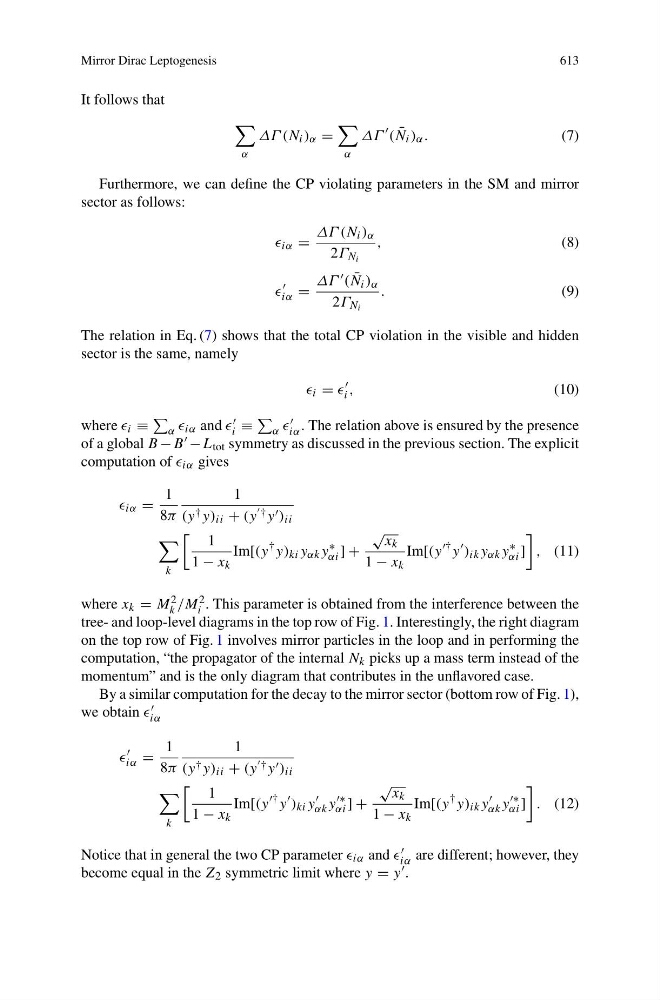
It follows that
α
ΔΓ (N i ) α =
α
ΔΓ
( ¯
N i ) α .
(7)
Furthermore, we can define the CP violating parameters in the SM and mirror
sector as follows:
iα =
ΔΓ (N i ) α
2Γ N i
,
(8)
iα =
ΔΓ ( ¯
N i ) α
2Γ N i
.
(9)
The relation in Eq. (7) shows that the total CP violation in the visible and hidden
sector is the same, namely
i =
i ,
(10)
where i ≡
α iα and
i ≡
α
iα . The relation above is ensured by the presence
of a global B −B −L tot symmetry as discussed in the previous section. The explicit
computation of iα gives
iα =
1
8π
1
(y † y) ii + (y
† y ) ii
k
1
1 − x k
Im[(y
† y) ki y αk y
∗
αi ] +
√ x k
1 − x k
Im[(y
y
) ik y αk y
∗
αi ]
, (11)
where x k = M 2
k /M 2
i . This parameter is obtained from the interference between the
tree- and loop-level diagrams in the top row of Fig. 1. Interestingly, the right diagram
on the top row of Fig. 1 involves mirror particles in the loop and in performing the
computation, “the propagator of the internal N k picks up a mass term instead of the
momentum” and is the only diagram that contributes in the unflavored case.
By a similar computation for the decay to the mirror sector (bottom row of Fig. 1),
we obtain
iα
iα =
1
8π
1
(y † y) ii + (y
† y ) ii
k
1
1 − x k
Im[(y
y
) ki y
αk y
∗
αi ] +
√ x k
1 − x k
Im[(y
† y) ik y
αk y
∗
αi ]
. (12)
Notice that in general the two CP parameter iα and
iα are different; however, they
become equal in the Z 2 symmetric limit where y = y .
613
It follows that
α
ΔΓ (N i ) α =
α
ΔΓ
( ¯
N i ) α .
(7)
Furthermore, we can define the CP violating parameters in the SM and mirror
sector as follows:
iα =
ΔΓ (N i ) α
2Γ N i
,
(8)
iα =
ΔΓ ( ¯
N i ) α
2Γ N i
.
(9)
The relation in Eq. (7) shows that the total CP violation in the visible and hidden
sector is the same, namely
i =
i ,
(10)
where i ≡
α iα and
i ≡
α
iα . The relation above is ensured by the presence
of a global B −B −L tot symmetry as discussed in the previous section. The explicit
computation of iα gives
iα =
1
8π
1
(y † y) ii + (y
† y ) ii
k
1
1 − x k
Im[(y
† y) ki y αk y
∗
αi ] +
√ x k
1 − x k
Im[(y
y
) ik y αk y
∗
αi ]
, (11)
where x k = M 2
k /M 2
i . This parameter is obtained from the interference between the
tree- and loop-level diagrams in the top row of Fig. 1. Interestingly, the right diagram
on the top row of Fig. 1 involves mirror particles in the loop and in performing the
computation, “the propagator of the internal N k picks up a mass term instead of the
momentum” and is the only diagram that contributes in the unflavored case.
By a similar computation for the decay to the mirror sector (bottom row of Fig. 1),
we obtain
iα
iα =
1
8π
1
(y † y) ii + (y
† y ) ii
k
1
1 − x k
Im[(y
y
) ki y
αk y
∗
αi ] +
√ x k
1 − x k
Im[(y
† y) ik y
αk y
∗
αi ]
. (12)
Notice that in general the two CP parameter iα and
iα are different; however, they
become equal in the Z 2 symmetric limit where y = y .