

t-t-h, Top & Bottom Partners, and the Brane Higgs Limit
601
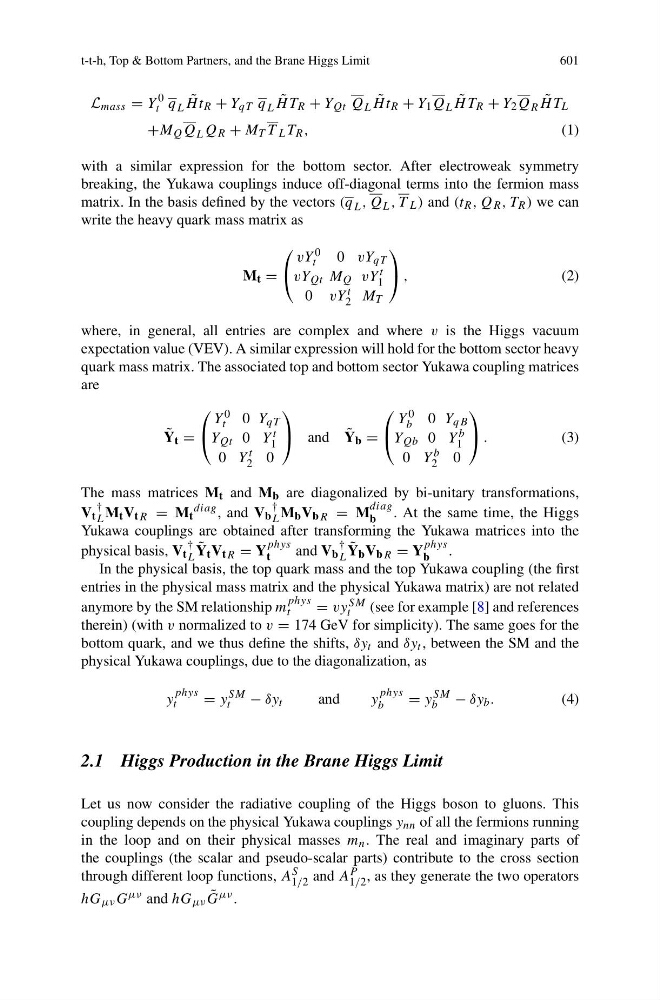
L mass = Y
0
t q L ˜
H t R + Y qT q L ˜
H T R + Y Qt Q L ˜
H t R + Y 1 Q L ˜
H T R + Y 2 Q R ˜
H T L
+M Q Q L Q R + M T T L T R ,
(1)
with a similar expression for the bottom sector. After electroweak symmetry
breaking, the Yukawa couplings induce off-diagonal terms into the fermion mass
matrix. In the basis defined by the vectors (q L , Q L , T L ) and (t R , Q R , T R ) we can
write the heavy quark mass matrix as
M t =
⎛
⎝
vY 0
t
0 vY qT
vY Qt M Q vY t
1
0 vY t
2 M T
⎞
⎠ ,
(2)
where, in general, all entries are complex and where v is the Higgs vacuum
expectation value (VEV). A similar expression will hold for the bottom sector heavy
quark mass matrix. The associated top and bottom sector Yukawa coupling matrices
are
˜
Y t =
⎛
⎝
Y 0
t 0 Y qT
Y Qt 0 Y t
1
0 Y t
2 0
⎞
⎠ and ˜
Y b =
⎛
⎝
Y 0
b 0 Y qB
Y Qb 0 Y b
1
0 Y b
2 0
⎞
⎠ .
(3)
The mass matrices M t and M b are diagonalized by bi-unitary transformations,
V t
†
L M t V tR = M t
diag , and V b
†
L M b V bR = M
diag
b
. At the same time, the Higgs
Yukawa couplings are obtained after transforming the Yukawa matrices into the
physical basis, V t
†
L
˜
Y t V tR = Y
phys
t
and V b
†
L
˜
Y b V bR = Y
phys
b
.
In the physical basis, the top quark mass and the top Yukawa coupling (the first
entries in the physical mass matrix and the physical Yukawa matrix) are not related
anymore by the SM relationship m
phys
t
= vy SM
t
(see for example [8] and references
therein) (with v normalized to v = 174 GeV for simplicity). The same goes for the
bottom quark, and we thus define the shifts, δy t and δy t , between the SM and the
physical Yukawa couplings, due to the diagonalization, as
y
phys
t
= y
SM
t
− δy t
and
y
phys
b
= y
SM
b
− δy b .
(4)
2.1 Higgs Production in the Brane Higgs Limit
Let us now consider the radiative coupling of the Higgs boson to gluons. This
coupling depends on the physical Yukawa couplings y nn of all the fermions running
in the loop and on their physical masses m n . The real and imaginary parts of
the couplings (the scalar and pseudo-scalar parts) contribute to the cross section
through different loop functions, A S
1/2 and A P
1/2 , as they generate the two operators
hG μν G μν and hG μν ˜
G μν .
601
L mass = Y
0
t q L ˜
H t R + Y qT q L ˜
H T R + Y Qt Q L ˜
H t R + Y 1 Q L ˜
H T R + Y 2 Q R ˜
H T L
+M Q Q L Q R + M T T L T R ,
(1)
with a similar expression for the bottom sector. After electroweak symmetry
breaking, the Yukawa couplings induce off-diagonal terms into the fermion mass
matrix. In the basis defined by the vectors (q L , Q L , T L ) and (t R , Q R , T R ) we can
write the heavy quark mass matrix as
M t =
⎛
⎝
vY 0
t
0 vY qT
vY Qt M Q vY t
1
0 vY t
2 M T
⎞
⎠ ,
(2)
where, in general, all entries are complex and where v is the Higgs vacuum
expectation value (VEV). A similar expression will hold for the bottom sector heavy
quark mass matrix. The associated top and bottom sector Yukawa coupling matrices
are
˜
Y t =
⎛
⎝
Y 0
t 0 Y qT
Y Qt 0 Y t
1
0 Y t
2 0
⎞
⎠ and ˜
Y b =
⎛
⎝
Y 0
b 0 Y qB
Y Qb 0 Y b
1
0 Y b
2 0
⎞
⎠ .
(3)
The mass matrices M t and M b are diagonalized by bi-unitary transformations,
V t
†
L M t V tR = M t
diag , and V b
†
L M b V bR = M
diag
b
. At the same time, the Higgs
Yukawa couplings are obtained after transforming the Yukawa matrices into the
physical basis, V t
†
L
˜
Y t V tR = Y
phys
t
and V b
†
L
˜
Y b V bR = Y
phys
b
.
In the physical basis, the top quark mass and the top Yukawa coupling (the first
entries in the physical mass matrix and the physical Yukawa matrix) are not related
anymore by the SM relationship m
phys
t
= vy SM
t
(see for example [8] and references
therein) (with v normalized to v = 174 GeV for simplicity). The same goes for the
bottom quark, and we thus define the shifts, δy t and δy t , between the SM and the
physical Yukawa couplings, due to the diagonalization, as
y
phys
t
= y
SM
t
− δy t
and
y
phys
b
= y
SM
b
− δy b .
(4)
2.1 Higgs Production in the Brane Higgs Limit
Let us now consider the radiative coupling of the Higgs boson to gluons. This
coupling depends on the physical Yukawa couplings y nn of all the fermions running
in the loop and on their physical masses m n . The real and imaginary parts of
the couplings (the scalar and pseudo-scalar parts) contribute to the cross section
through different loop functions, A S
1/2 and A P
1/2 , as they generate the two operators
hG μν G μν and hG μν ˜
G μν .