

578
D. London
2 B-Decay Anomalies
2.1 b → sμ + μ −
b → s transitions, which have ΔQ em = 0, are flavor-changing neutral-current
(FCNC) processes. In the SM, these can arise only at loop level. One such FCNC
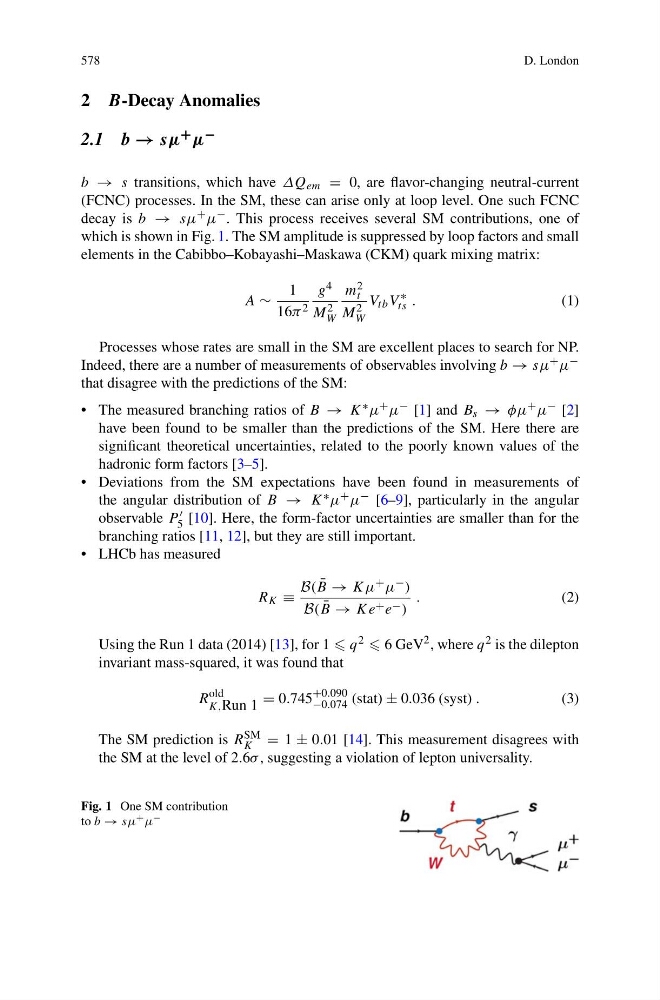
decay is b → sμ + μ − . This process receives several SM contributions, one of
which is shown in Fig. 1. The SM amplitude is suppressed by loop factors and small
elements in the Cabibbo–Kobayashi–Maskawa (CKM) quark mixing matrix:
A ∼
1
16π 2
g 4
M 2
W
m 2
t
M 2
W
V tb V
∗
ts .
(1)
Processes whose rates are small in the SM are excellent places to search for NP.
Indeed, there are a number of measurements of observables involving b → sμ + μ −
that disagree with the predictions of the SM:
• The measured branching ratios of B → K ∗ μ + μ − [1] and B s → φμ + μ − [2]
have been found to be smaller than the predictions of the SM. Here there are
significant theoretical uncertainties, related to the poorly known values of the
hadronic form factors [3–5].
• Deviations from the SM expectations have been found in measurements of
the angular distribution of B → K ∗ μ + μ − [6–9], particularly in the angular
observable P
5 [10]. Here, the form-factor uncertainties are smaller than for the
branching ratios [11, 12], but they are still important.
• LHCb has measured
R K ≡
B( ¯
B → Kμ + μ − )
B( ¯
B → Ke + e − )
.
(2)
Using the Run 1 data (2014) [13], for 1 q 2 6 GeV
2 , where q 2 is the dilepton
invariant mass-squared, it was found that
R
old
K,Run 1 = 0.745
+0.090
−0.074 (stat) ± 0.036 (syst) .
(3)
The SM prediction is R SM
K = 1 ± 0.01 [14]. This measurement disagrees with
the SM at the level of 2.6σ , suggesting a violation of lepton universality.
Fig. 1 One SM contribution
to b → sμ + μ −
D. London
2 B-Decay Anomalies
2.1 b → sμ + μ −
b → s transitions, which have ΔQ em = 0, are flavor-changing neutral-current
(FCNC) processes. In the SM, these can arise only at loop level. One such FCNC
decay is b → sμ + μ − . This process receives several SM contributions, one of
which is shown in Fig. 1. The SM amplitude is suppressed by loop factors and small
elements in the Cabibbo–Kobayashi–Maskawa (CKM) quark mixing matrix:
A ∼
1
16π 2
g 4
M 2
W
m 2
t
M 2
W
V tb V
∗
ts .
(1)
Processes whose rates are small in the SM are excellent places to search for NP.
Indeed, there are a number of measurements of observables involving b → sμ + μ −
that disagree with the predictions of the SM:
• The measured branching ratios of B → K ∗ μ + μ − [1] and B s → φμ + μ − [2]
have been found to be smaller than the predictions of the SM. Here there are
significant theoretical uncertainties, related to the poorly known values of the
hadronic form factors [3–5].
• Deviations from the SM expectations have been found in measurements of
the angular distribution of B → K ∗ μ + μ − [6–9], particularly in the angular
observable P
5 [10]. Here, the form-factor uncertainties are smaller than for the
branching ratios [11, 12], but they are still important.
• LHCb has measured
R K ≡
B( ¯
B → Kμ + μ − )
B( ¯
B → Ke + e − )
.
(2)
Using the Run 1 data (2014) [13], for 1 q 2 6 GeV
2 , where q 2 is the dilepton
invariant mass-squared, it was found that
R
old
K,Run 1 = 0.745
+0.090
−0.074 (stat) ± 0.036 (syst) .
(3)
The SM prediction is R SM
K = 1 ± 0.01 [14]. This measurement disagrees with
the SM at the level of 2.6σ , suggesting a violation of lepton universality.
Fig. 1 One SM contribution
to b → sμ + μ −