

574
J.-F. Fortin and K. Sinha
¯
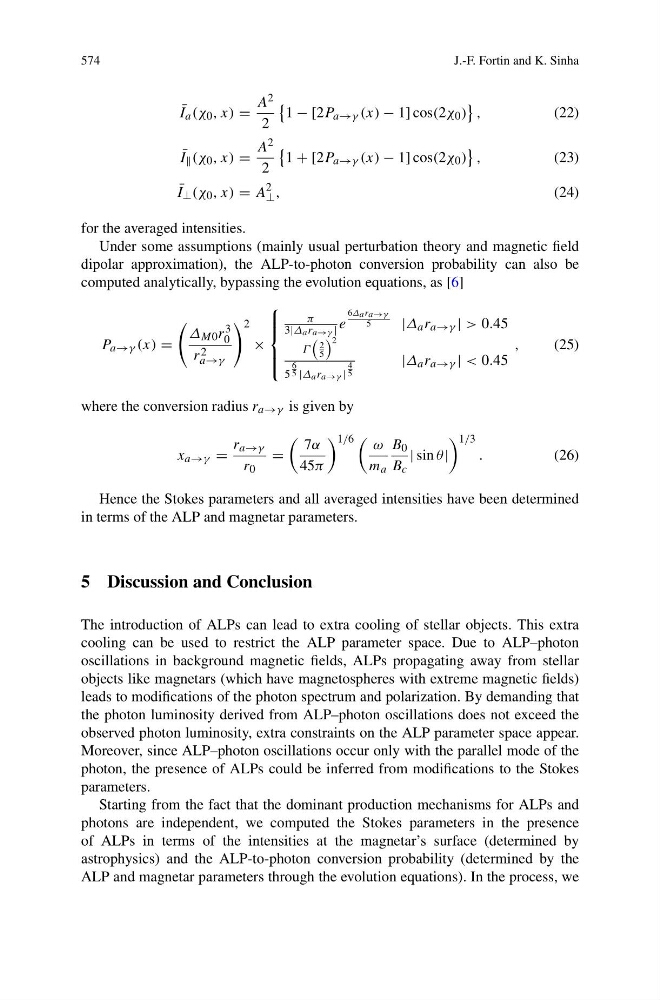
I a (χ 0 , x) =
A 2
2
1 − [2P a→γ (x) − 1] cos(2χ 0 )
,
(22)
¯
I (χ 0 , x) =
A 2
2
1 + [2P a→γ (x) − 1] cos(2χ 0 )
,
(23)
¯
I ⊥ (χ 0 , x) = A
2
⊥ ,
(24)
for the averaged intensities.
Under some assumptions (mainly usual perturbation theory and magnetic field
dipolar approximation), the ALP-to-photon conversion probability can also be
computed analytically, bypassing the evolution equations, as [6]
P a→γ (x) =
Δ M0 r 3
0
r 2
a→γ
2
×
⎧
⎪ ⎪ ⎨
⎪ ⎪ ⎩
π
3|Δ a r a→γ | e
6Δa ra→γ
5
|Δ a r a→γ | > 0.45
Γ
2
5
2
5
6
5 |Δ a r a→γ |
4
5
|Δ a r a→γ | < 0.45
,
(25)
where the conversion radius r a→γ is given by
x a→γ =
r a→γ
r 0
=
7α
45π
1/6
ω
m a
B 0
B c
| sin θ |
1/3
.
(26)
Hence the Stokes parameters and all averaged intensities have been determined
in terms of the ALP and magnetar parameters.
5 Discussion and Conclusion
The introduction of ALPs can lead to extra cooling of stellar objects. This extra
cooling can be used to restrict the ALP parameter space. Due to ALP–photon
oscillations in background magnetic fields, ALPs propagating away from stellar
objects like magnetars (which have magnetospheres with extreme magnetic fields)
leads to modifications of the photon spectrum and polarization. By demanding that
the photon luminosity derived from ALP–photon oscillations does not exceed the
observed photon luminosity, extra constraints on the ALP parameter space appear.
Moreover, since ALP–photon oscillations occur only with the parallel mode of the
photon, the presence of ALPs could be inferred from modifications to the Stokes
parameters.
Starting from the fact that the dominant production mechanisms for ALPs and
photons are independent, we computed the Stokes parameters in the presence
of ALPs in terms of the intensities at the magnetar’s surface (determined by
astrophysics) and the ALP-to-photon conversion probability (determined by the
ALP and magnetar parameters through the evolution equations). In the process, we
J.-F. Fortin and K. Sinha
¯
I a (χ 0 , x) =
A 2
2
1 − [2P a→γ (x) − 1] cos(2χ 0 )
,
(22)
¯
I (χ 0 , x) =
A 2
2
1 + [2P a→γ (x) − 1] cos(2χ 0 )
,
(23)
¯
I ⊥ (χ 0 , x) = A
2
⊥ ,
(24)
for the averaged intensities.
Under some assumptions (mainly usual perturbation theory and magnetic field
dipolar approximation), the ALP-to-photon conversion probability can also be
computed analytically, bypassing the evolution equations, as [6]
P a→γ (x) =
Δ M0 r 3
0
r 2
a→γ
2
×
⎧
⎪ ⎪ ⎨
⎪ ⎪ ⎩
π
3|Δ a r a→γ | e
6Δa ra→γ
5
|Δ a r a→γ | > 0.45
Γ
2
5
2
5
6
5 |Δ a r a→γ |
4
5
|Δ a r a→γ | < 0.45
,
(25)
where the conversion radius r a→γ is given by
x a→γ =
r a→γ
r 0
=
7α
45π
1/6
ω
m a
B 0
B c
| sin θ |
1/3
.
(26)
Hence the Stokes parameters and all averaged intensities have been determined
in terms of the ALP and magnetar parameters.
5 Discussion and Conclusion
The introduction of ALPs can lead to extra cooling of stellar objects. This extra
cooling can be used to restrict the ALP parameter space. Due to ALP–photon
oscillations in background magnetic fields, ALPs propagating away from stellar
objects like magnetars (which have magnetospheres with extreme magnetic fields)
leads to modifications of the photon spectrum and polarization. By demanding that
the photon luminosity derived from ALP–photon oscillations does not exceed the
observed photon luminosity, extra constraints on the ALP parameter space appear.
Moreover, since ALP–photon oscillations occur only with the parallel mode of the
photon, the presence of ALPs could be inferred from modifications to the Stokes
parameters.
Starting from the fact that the dominant production mechanisms for ALPs and
photons are independent, we computed the Stokes parameters in the presence
of ALPs in terms of the intensities at the magnetar’s surface (determined by
astrophysics) and the ALP-to-photon conversion probability (determined by the
ALP and magnetar parameters through the evolution equations). In the process, we